Showing posts with label Water Privatization. Show all posts

Thursday, October 4, 2012

Anti-Water Privatisation Group Warns of Protests in November


New Delhi: The fight against privatization of water is expected to pick up pace in the coming days. The water privatization-commercialization resistance committee has warned of a massive mass movement in the coming month against DJB's pilot public private partnership project of water distribution in three areas, starting with Malviya Nagar.
Retired Justice Rajinder Sachar said that a protest at Jantar Mantar was on the cards and the team had been rallying to get public support on the issue. "We have been asking the government to explain to us the terms of contract between it and the private party but have not received any response from them. We are also trying to seek an appointment with the chief minister but have not been able to meet her yet. We have studied the model that Delhi Jal Board has suggested and have several problems with it. Why can't they address these problems and why are they going about privatization in such a surreptitious manner. I will be writing to the CM and asking her to address our concerns," he said.
Anil Nauriya, president of the committee said that they wanted a public debate so that concerned residents would be able to make an informed decision regarding the 24x7 water supply model. "Based on the information we have, 24x7 water supply is only to be ensured till the entry point of each district metered areas. Beyond this there are no controls on which individual unit gets how much water. At present, water tariff increases by 10% each year but what is the rationale behind it. What happens when there are improvements in the system and the efficiency increases. Would this tariff increase still apply. There are several points on which there is no clarity. The government should be prepared for a massive movement within the next month," he said.

Thursday, September 27, 2012

Midwest States Need Savvy Water Management for Future Demands and Droughts


More than 63 percent of the continental United States remained in moderate to exceptional drought in early September, as the nation’s most widespread drought since 1956 continued to threaten drinking water supplies, crops and livestock.
The summer’s epic Midwest drought has eased slightly in the eastern part of the region, with Ohio, Indiana, and Illinois suffering moderate to severe drought. Farther west, Iowa and parts of Missouri still endure extreme drought, while in the Plains states, much of Nebraska and Kansas are in exceptional drought, according to the U.S. Drought Monitor.
Droughts come and go, of course, but water scarcity is a growing problem, as growing populations increase demand and climate change makes supplies more erratic.
U.S. communities are responding in myriad ways that could be adopted in the Midwest:
Lawsuits: A frequent response to water scarcity is lawsuits. In June, the U.S. Supreme Court declined to take a long-running case in which Alabama, Florida, and Georgia fought over the waters of Lake Lanier, allowing a lower court ruling to stand giving the Atlanta metro area much of the water.
Elsewhere, Mississippi officials have accused Memphis, Tenn., of overdrawing water from a shared aquifer and have asked the Supreme Court to weigh in. Kansas filed a $50 million legal claim against Nebraska over water rights. Las Vegas is seeking groundwater in eastern Nevada to slake the thirst of its booming population, but neighboring Utah is fighting the “water grab” in state courts.
Of course, the problem with lawsuits is they don’t increase water supply; they just reallocate it.
Watershed Management: Cooperative watershed management is an effective approach that considers an entire watershed for what it is: an integrated, natural system, as opposed to a mere source of a human commodity. It aims to meet the needs of all users in the water system, including cities, farmers, energy producers, plants and animals.
Cooperating federal, state, and regional agencies, along with nonprofits, use science to balance water supply, rights, and quality, often incentivizing conservation and using natural processes to clean and store water.
Conservation: Between 1950 and 2005, the U.S. population doubled while domestic, commercial and industrial water consumption tripled. However, conservation measures are closing this gap. Between 2005 and 2009, our population increased 5 percent while water withdrawals increased by just 2 percent, according to the U.S. Geological Survey.
While many people equate conservation with sacrifice, it can be surprisingly easy. Pinellas County Utilities in Clearwater, Fla., for example, reduced water use by more than 40 percent between 1991 and 2008 simply by offering rebates and technical assistance for water efficiency – and by reclaiming water.
Reclaiming Water: The idea of reclaiming, reusing or recycling, water disgusts some people, but it is a cost-effective way to increase supply. Communities in Arizona, Florida, Nevada, Texas, and California have been using these practices safely for years.
For example, Gilbert, Ariz., grew from 5,800 residents in 1980 to 212,000 today. To meet demand, water managers reclaimed wastewater, moving it through recharge ponds, where it percolates into the aquifer for future use. The pond water is also used directly for irrigation and other nonpotable purposes, reducing groundwater use. During summer’s peak demand, Gilbert saves over 131 million gallons of drinking water per day.
Homeowners and businesses can harvest graywater from shower and sink drains and use it to flush toilets and to water gardens. Rerouting graywater or rainwater into the house or using utility-delivered treated wastewater requires a dual plumbing system. Such systems offer property owners increased water security, independence, and efficiency.
Utilities could greatly speed installation of reuse infrastructure and programs by redirecting some of the money spent tapping new freshwater supplies.
Water Pricing Strategies: Innovative water pricing can encourage conservation and save money – not only in legal fees but also in unneeded infrastructure development. For example, in 1991, Irvine Ranch Water District in Orange County, Calif., instituted a rate structure that gives everyone a base allocation and then charges profligate users up to eight times more. Thrifty households get a discount. Raleigh, N.C.; Tucson, Ariz.; and Amarillo, Texas use similar tiered pricing strategies.
This year’s epic Midwest drought is unlikely to be the last. But wise water management can soften the shocks of future water scarcity.


By Erica Gies@livinggreenmag.com

Tuesday, August 28, 2012

World Water Week


Water and its links to development, peace and conflict was highlighted Monday when delegates from over 130 countries gathered for the annual World Water Week.

Keynote speakers included Swedish International Development Cooperation Minister Gunilla Carlsson and Rejoice Mabudafhasi, South African Deputy Minister of Water and Environmental Affairs, who both touched on the linkage between climate and development issues.

Mabudafhasi later reminded reporters how women in rural areas and girls often have to walk long distances to collect water. This task can disrupt girls' schooling and has other impacts on women's ability to participate in society.

Former chief UN mediator in the Darfur conflict, veteran Swedish diplomat Jan Eliasson, recounted his experiences of how water and water scarcity came into play in the troubled region in Sudan with desertification, poisoned wells and displacement of pastoral people.

Displaying a glass of tap water, Eliasson said "this is a luxury for 800-900 million people in the world. It's a dream."

Eliasson - who now chairs the Swedish branch of the aid agency WaterAid Sweden - cited another dismal statistic that 4,000 to 5,000 children die daily due to the lack of clean water or over water-borne diseases.

Scores of seminars were also scheduled during the conference that has the overriding theme "accessing water for the common good" and where scores of organizations present findings and studies.

The winner of the 2009 Stockholm Water Prize, used his lecture to urge delegates to act.

"Only talking about the problem will not solve the problem," said Bindeshwar Pathak, founder of the Sulabh Sanitation Movement in India.

Later this week Pathak is to accept the 150,000-dollar prize. He is credited with improving sanitation across India and converting the waste into energy.

Pathak is credited with developing a simple twin pit, pour-flush toilet system used in more than 1.2 million residences and buildings.

It has since been distributed to countries in both Asia and Africa.

Like other speakers Patahk discussed the need for cooperation between countries on water issues, noting how his native India had 16 per cent of the global population, 4 per cent of the world's water and 3 per cent of the land.

Possible conflict over water was also discussed by contributors to a report on trans-boundary water produced by the Stockholm International Water Institute, which organizes the meeting.

Co-author David Grey, who works as a water advisor for the World Bank in South Asia and Africa, said "no war is fought over a single issue," but that water could be a factor in conflicts.

The Stockholm Water Prize was created in 1990 to recognize achievements in water science, water management, water action or awareness building. 


About the World Water Week
in Stockholm

World Water Week is hosted and organised by the Stockholm International Water Institute (SIWI) and takes place each year in Stockholm. The World Water Week has been the annual focal point for the globe's water issues since 1991. Join us!

World Water Week niche and theme


Each year the World Water Week addresses a particular theme to enable a deeper examination of a specific water-related topic. While not all events during the week relate to the overall theme, the workshops driven by the Scientific Programme Committee and many seminars and side events do focus on various aspects of the theme. The themes change each year, but each fits within a broader "niche" that covers several years. The grouping of
themes within a niche is designed to develop a long-term perspective on a broad yet significant water and development issue. It also ensures that each year builds upon the previous years' outcomes and findings.
The current niche for 2009-2012 is "Responding to Global Changes", which looks at the potential and necessary responses in water policy, management and development to address pervasive and increasingly impacting global changes. The themes within the current niche are:
  • 2009: Accessing Water for the Common Good
  • 2010: The Water Quality Challenge
  • 2011: Water in an Urbanising World
  • 2012: Water and Food Security
Browse this website to see the Thematic Scope for 2012 on Water and Food Security, and the workshops covering different aspects of the theme.


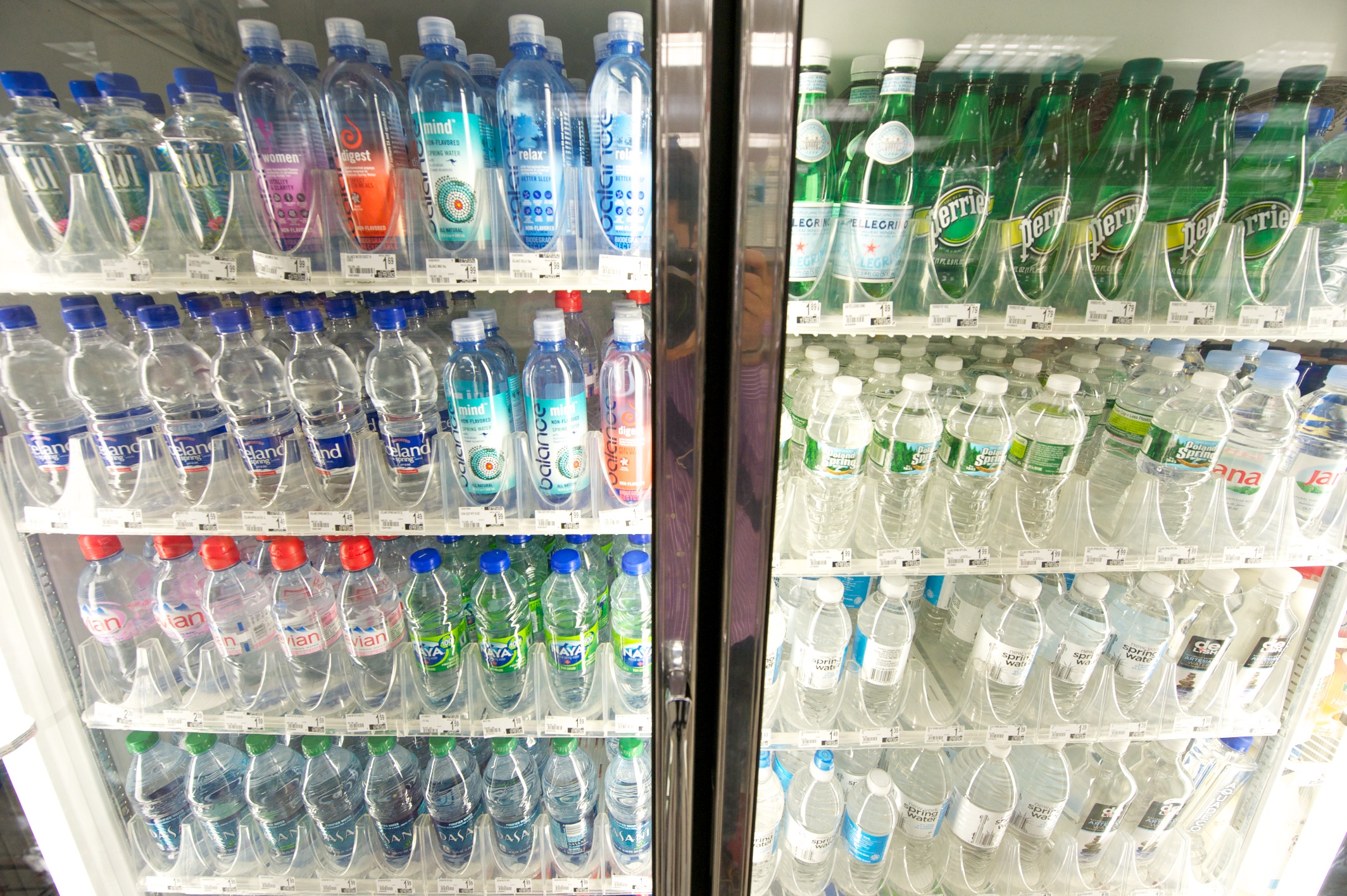
How Sexy is Bottled Water?


When the doctor advised, “Eight glasses of water a day,” did you retort, “Right, but what kind of water?” Didn’t think so.
However, that is just the question I’ve found myself pondering. Apparently “water” alone won’t suffice. Worse, I find myself standing idly in stores, gawking into the beverage fridge considering every option of H2O the world has so conveniently afforded me.
water
Minerals? Sure, why not. Filtered? Oh, definitely want that. Electrolytes? Now you’re talking!
Despite living in NYC with some of the tastiest tap water, I’m still all about paying $3+tax for mine to come in a bottle—and I’m hardly alone. According to the Beverage Marketing Corporation, U.S. consumption of bottled water increased from 2010-2011 by 4.1% to over 9 billion gallons gulped
Silly? Let me offer a theory.
Besides the appeal of portable, clean, consistent tasting water, what if your branded bottle said something about you? Aren’t all brands social status cues? Could water be that sexy? Which does the Dos Equis man prefer the next morning?
Most claim their preference revolves around price and taste. Some mention eco-friendliness, additives, personal sentiment or availability as factors—others simply scoff at the concept of bottled water entirely.
But, ridiculous inventions like Bling H20 aside, pricing is relatively comparable—about $1-2 per 500ml. I also have doubts about most people’s ability to discern water’s gustative qualities.
To test this, I had 12 of my coworkers participate in a blind taste test. Each wrote their current favorite brand, then blindly sampled and rated eight popular bottled water brands from 1-5. While purely anecdotal, the most favorite brands (pre-tasting) were Poland Spring and Evian, with 5 and 3 people preferring them, respectively. The highest taste ratings were Volvic and Poland Spring, averaging 3.75 and 3.66, while the lowest ratings were Voss and Evian, averaging 2.66 and 2.5, respectively.
Apparently taste matters. While rationales didn’t indicate a trend, people knew what they did and didn’t like. Why Volvic, then? What’s so great about French volcanoes? And Evian! Are you better cold? Poland Spring—crowd favorite, second-best taste rating, ubiquitous, homegrown story, cheapest at $1—you, I get.
Still, for me, the water itself is an afterthought. Yeah, it better be clear and without funky aftertastes. If you can make me think I’m restoring my body’s “vital minerals & nutrients” or saving the planet, praise be to you.
It’s the bottle that I find so satisfying—and at times, equally unnerving.
Why do I prefer Fiji? Frankly, the bottle looks cool and feels sturdy. Its “iconic square” form stands out and uses clever graphic placement to create dimension—like you’ve got a small window into Fiji. Though perhaps less eco-friendly with thicker plastic, it doesn’t sound like someone’s trying to get the last chip in the bag when you go for a sip (sorry Poland Spring, your crinkly “eco-slim” bottle makes me cringe). The brand also connotes “premium” without the pretention (sorry Evian and Voss). Fiji’s what I want on my nightstand.
And, I argue that the bottle matters to you too—just as much as your choice of glasses, handbag or jeans.
So, while you reflect, I ask that you pose one question to yourself: “Who am I trying to impress?”

Monday, July 30, 2012

Flow: For Love of Water


How did a handful of corporations steal our water?

Water is the very essence of life, sustaining every being on the planet. 'Flow' confronts the disturbing reality that our crucial resource is dwindling and greed just may be the cause.

Everyone is entitled to water as they are air. Water is fundamental to life. Farmers need water to grow their crops and animals. An economy needs water to grow.


Monday, July 16, 2012

Privatization of Water Services in New Delhi: Myth and Reality


Ever since the National Water Policy 2002 was formulated, there have been attempts in India to privatize and commodify water. This constitutes both a retreat from the constitutional and economic duty of the state, and from our own human obligations to other humans. Water is a naturally occurring public good. Not only is the right to basic services like health, education and water and sanitation essential for survival, our society has, over centuries, recognized its obligation to provide water to the needy and thirsty through the establishment of piaos at temples, mosques, gurudwaras, and dharamshalas, as well as by individuals in front of their homes and in public places.


Delhi Government decides to privatize water infrastructure


Delhi Government has, through directions given to the Delhi Jal Board (DJB), inflicted a fourfold increase in the cost of water and sanitation services since January 2010. The DJB’s increased water tariff includes a provision for an automatic 10 per cent increase in water bills every year. No such requirement exists in any other privatization process whether for electricity, education, health or public transport.


Many residents of ‘unauthorized’ colonies and slums are already paying even more than these increased rates for water of poor quality from private suppliers for the DJB does not provide an assured supply of drinking water in these areas. Water supplying contractors have the patronage of the local mafia and politicians. In addition to this privatization of water supply for the slums, large parts of the DJB works including maintenance of pipelines and construction works are already given out on contract to private agencies. DJB is inviting NGOs in provisioning of water supply in slums as well. All this amounts to a creeping privatization of the DJB, in the name of efficiency and people’s participation.


Delhi Government is utilizing the widespread public discontent over the lack of adequate, good-quality drinking water and of sanitation services to pave the way for full-scale privatization of the DJB. The government does not tell us why such investments in strengthening the DJB to deliver quality services to the slums and planned colonies of Delhi cannot be achieved. Instead, the single solution of privatization is offered as the answer to all problems.


The steep increase in water rates by the DJB is the first step towards privatization and for attracting private business interests. The government is now proposing to place the provision of water completely in the hands of private business, arguing that the private sector will charge less for these services than the mafia/private contractors. The argument that people are already paying higher rates cannot be used as an indication of their ‘willingness’ to pay exorbitant amounts for water — they do so from desperation.


It is obvious that no lessons have been learnt from the privatization of the Delhi Electricity Supply Undertaking (DESU). Not merely will consumers’ monthly bills for water increase, the government will eventually have to subsidise the private operators (as with North Delhi Power Limited - NDPL, now renamed as Tata Power Delhi Distribution Limited and Bombay Suburban Electric Supply - BSES).
Those who cannot pay for life-giving water will lose their water connections. Water will become a profitable business for a few and unaffordable to many.


Water Privatization


The key questions that the booklet raises are -
  1. Is there a real water shortage in Delhi or are the shortages a result of unequal distribution of the water available in Delhi?
  2. How can water efficiency be improved by privatization of water services?
  3. What are the proposed plans of privatization? How are the proposed plans going to bridge the demand-supply gap?
The arguments given by the Delhi Government are that there is inadequate drinking water, and leakages are high, privatization will solve all problems. What is not set out is how the proposed privatization of supply and distribution will address water shortages and the unequal access to drinking water supply that is at the root of the crisis. Rather than addressing the gaps and improving the efficiency of the existing Public Utility Service of the DJB, the whole problem is presented as one of creating infrastructure and privatization is presented as its solution.


The first issue is of unmetered connections. What are the reasons for unmetered connections? Why is the DJB unable to meter these connections? The reason is their unwillingness to provide water through pipelines to the vast majority of residents of the ‘unauthorized’, and resettlement colonies and slums of Delhi. Let the DJB provide them piped water and meter it.


The second and related issue is of improving the efficiency of water distribution to reduce the incidence of Non Revenue Water (NRW). What is the estimate of water losses in transit? What is the basis of these estimates and how reliable are they? How do private companies propose to reduce transit losses? Why can the DJB not do the same?


What are the inadequacies in the current infrastructure? What has been the budgetary outlay vis-a-vis real demand for improving infrastructure? What is the proposed private investment on infrastructure? 


Why does augmentation of infrastructure have to depend on private investment?


Whose responsibility is supply augmentation? What are the ongoing projects, their investments and time-frame for completion? Who is making the investment?


In the process of scrutinising these reasons and answering these questions in this booklet, we get a picture of the overall water situation in Delhi and realize how privatization cannot be a solution to Delhi’s water problems.


Demands of the Water Privatization-Commercialization Resistance Committee


We demand that the DJB accept responsibility for water and sanitation services in the slums and ‘unauthorized’ colonies of Delhi. We believe that Delhi Government needs to take steps immediately to strengthen the public utility purpose of the Delhi Jal Board, to make it accountable and capable of delivering quality water and sanitation services to the people of Delhi. The DJB should be strengthened with more funds and functionaries and placed under greater public scrutiny and accountability. Private contracts awarded by the DJB for operations and maintenance and new construction works must be stopped immediately as most of these construction contracts are meant to serve the private contractors’ interests more than the citizens of Delhi and the poorest slums and colonies. The government must understand that water, being the basis of life, cannot be equated with any other commodity or service.


Specific demands include -
1. Withdraw the privatization/commercialization initiatives immediately.


2. Provide water supply pipelines to unauthorized and J.J. Colonies without imposing development charges on the residents.


3. Revise the DJB Water Billing. Withdraw the Annual 10% automatic water bill hike immediately, with retrospective effect from 2010.


4. Reintroduce the lifeline zero-tariff slab for drinking water for household consumption of less than 10 kilo litres a month that was borrowed from the South African model of ensuring basic equity.


5. Remove inequity of water supply in different parts of Delhi. The NDMC and the Cantonment Board areas should get the same amount of per capita drinking water as other parts of Delhi. The Government of Delhi must make public disclosures on monthly per capita supplies in all areas of Delhi.


6. Make full public disclosures and initiate fresh surveys to identify water losses at various stages:
  • •Losses in transit at the canal stage to Delhi
  • Losses during water treatment stage
  • Losses during supply at the mainline stage of the pipeline
  • Losses during the distribution stage of pipelines


7. Restore piaos/public drinking water points and public toilets, at regular intervals all along the Ring Road, in market places and poor settlements. Use technology and staff to ensure that water points are functional and do not waste water.


8. Come out with a plan to conserve the Yamuna river banks from encroachment - as has been witnessed for the Akshardham temple, facilities for the Commonwealth Games and a host of other projects and allocations.


9. Make the DJB water bills available for public scrutiny. Information on monthly water bills of all residents and businesses should be in the public domain and placed on the DJB website. This will check the cheating in water bills that takes place with the collusion of DJB staff.


10. Make the DJB responsible for providing safe and adequate piped potable water, sewerage and waste disposal services to all residents of Delhi. The JJ slums, the ‘unauthorized’ and resettlement colonies should not be left to the mercy of the private water mafia or to tanker water supplies or to NGOs to provide and manage drinking water. The government is responsible for providing drinking water and sanitation services.


11. Improve the accountability of the DJB. Bring greater public scrutiny and control over the functioning of the DJB. The Government must initiate steps to set up ‘Area Committees’ involving people from the concerned area to oversee the functioning of the DJB. Resident Welfare Associations and similar organizations should be encouraged to take up this responsibility. Improve billing and poor services by providing adequate grievance-redressal systems.


12. Strengthen the systems of the DJB:
  • •Extend its functions from simply water distribution, to water conservation. Include the protection of river-banks, and recharging, monitoring water-quality
  • Improve systems and staff to provide transparency and information sharing
  • Increase staffing with adequate appointment of engineers and non-technical staff to provide quality service and grievance redressal.
13. Convert outstanding debts of the DJB into a grant and waive it immediately. Given that water is a social good, the government of Delhi should not see the DJB as a service provider operating on full cost-recovery efficiency criteria. The current outstanding debts are a result of the accumulation of interest burden on loans taken.


14. Make all documents pertaining to ‘reforms’ available on the DJB website or Delhi Government portal. This includes:
(i) Reports of Committees
(ii) MoUs between Government and private companies with respect to water distribution, revenue collection and other related activities;
(iii) Financial expenditure statements with respect to reforms
(iv) Up-to-date minutes of the meetings of the DJB
(v) All major decisions taken with respect to reforms
(vi) Delhi Assembly Debates pertaining to reforms
(vii) Objections of representatives of people, Government officials, and citizens and citizens’ groups


15. Hold public consultations on any restructuring plans of the DJB involving experts, civil society, academicians and people’s representatives.
To provide a better understanding of the problem, and possible solutions, this booklet has been prepared by the Water Privatization-Commercialization Resistance Committee for the ongoing campaign in Delhi. 


To get hard copies of the booklet please contact –
Dipak Dholakia, Water Privatization-Commercialization Resistance Committee, B-48/G-2, Dilshad Garden, Delhi-110095. Phone : 22573880, 9818848753; E-mail: watermovementdelhi@gmail.com
Or
Viren Lobo, Society for Promotion of Wastelands Development, 14A, Vishnu Digamber marg, New Delhi – 110002
The soft copy of the booklet is available in English and Hindi below:
AttachmentSize
Privatization of water services in New Delhi: Myth and reality – Report by Water Privatization-Commercialization Resistance Committee (2012)360.96 KB
Nai Dilli mein jal sewayo ka nijikaran - Report in Hindi by Water Privatization-Commercialization Resistance Committee, New Delhi (2012)372.92 KB


IndiaWaterPortal.org

Sunday, July 1, 2012

'No Water Shortage in Delhi, Only Discriminatory Supply

                                                                                                     Priyanka in New Delhi

An audit report of the Delhi Jal Board states that failure in timely construction of underground reservoirs and booster pumping stations has resulted in an unequal distribution of water. Priyanka reports 

In his mid 70s, Dhanpal watches over a child with a water pipe in his hands. A dozen people carrying plastic containers of all sizes crowd around him waiting anxiously for their turn to fill up.

Water is a scare commodity for these residents of Sangam Vihar, probably the biggest segregation of unauthorised houses in Delhi.

The past few weeks have witnessed an unprecedented hue and cry about water shortage in the capital. While residents, mainly in the southern and northern parts of Delhi, have complained of an acute shortage in water supply, this scarcity has not been evenly experienced by all residents across.

Dhanpal, a driver, owns some 50-odd rooms in gali no.1 of Sangam Vihar. His eight brothers, who are all residents of the same gali, also own rooms that are rent out to a family of three-four members. Most of these tenants work as vendors and laborers in adjoining Govindpuri and Kalkaji.

Dhanpal pays Rs 5,000 to a private contractor for two hours of uninterrupted water supply.
"Each one of them (his tenants) will store around 700 to 800 liters of water, which will be used for the next 4-5 days," Dhanpal explains. "There is no water here, we are hit by hard times," he says.

Saturday, June 30, 2012

US Water Policy Still All Wet


Growing conflicts over who owns water and how to manage it are emerging all over the world. Although debates at the UN and among civil society have moved toward the recognition of water as a basic human right, the United States still lags behind. Washington has instead largely supported private-sector approaches that will likely exacerbate conflicts over water resources. What is perhaps new is that the U.S. intelligence community is also looking at water as a potential national security concern.

A report led by the Defense Intelligence Agency (DIA), Global Water Security attempts to answer the question, “How will water problems (shortages, poor water quality, or floods) impact U.S. national security interests over the next 30 years.” The report focuses on trans-boundary water issues in seven river basins associated with countries that are identified as strategically important for U.S. security: Nile, Tigris-Euphrates, Jordan, Mekong, Brahmaputra, Indus, and Amu Darya. Except for the Nile, these rivers are all in Asia, and together these basins are home to over 1.5 billion people. The national intelligence community judged “that these examples are sufficient to illustrate the intersections between water challenges and US national security.”

According to the DIA assessment, “water problems—when combined with poverty, social tensions, environmental degradation, ineffectual leadership, and weak political institutions—contribute to social disruptions that can result in state failure.” It predicts that "as water shortages become more acute … water in shared basins will increasingly be used as leverage" for political purposes. The assessment expects that the water shortages and pollution will harm the performance of important U.S. trading partners and identifies agriculture and food security as the most important challenges.

The Brahmaputra and Mekong basins account for half of the population in the assessment. Some of the poorest communities in the world live in these basins. Countries such as India, China, and Thailand are considering proposals to divert water from these rivers to meet the water needs of arid regions that fall outside the basins. Environmental justice activists contend that these projects would violate the rights of already vulnerable communities living at the margins. For quite different reasons, environmental scientists are questioning the viability of such inter-basin water transfers and the implications for ecosystem integrity.


U.S. Policy Still Insufficient


Globally, for well over a decade, water issues have been making headlines: The global assessment on water and sanitation by WHO, UNICEF and UN Water Supply and Sanitation Council reported in 2000 that 1.1 billion people did not have access to drinking water and 2.6 billion did not have access to sanitation services. The infamous water privatization in Cochabamba, where massive protests forced out Aguas del Tunari, a consortium led by the U.S. multinational company Bechtel, in April 2000, became a rallying point for water justice activists and helped to draw attention to the ills of water privatization around the world.

Through most of this period, the United States paid scant attention to the global water crisis or related human rights concerns. But as the Institute for Agriculture and Trade Policy noted in early 2009, change was in the air. The following year, the United States chose to abstain rather than vote against the landmark UN General Assembly resolution introduced by Bolivia that recognized water as a human right. There seems to be an increasing recognition that water is a central developmental issue that affects humanity in myriad ways but particularly the rural poor by affecting local food availability. This is evident from the remarks by Secretary of State Hillary Rodham Clinton on World Water Day a year ago: “The water crisis is a health crisis, it's a farming crisis, it's an economic crisis, it's a climate crisis, and increasingly, it is a political crisis. And therefore, we must have an equally comprehensive response."

Thus by identifying water crisis as a precursor to political crisis, Clinton set the ball rolling for addressing what in her opinion is one of the three pillars of foreign policy: development. She acknowledged that her own ideas around foreign policy’s three Ds – “the need to elevate diplomacy and development alongside defense as pillars of our national security” – had been informed by the views of earlier generations of American leaders such as General George Marshall. In a recent speech Secretary  Clinton said: “Some of the greatest threats to our security come from a lack of opportunity, the denial of human rights, a changing climate, strains on water, food, and energy.”

Yet, the United States persists to address development issues as if they were discrete problems rather than closely interconnected.  The government continues to hold up the private sector, especially investments by multinational corporations, as the solution to more efficient management of water, food, and energy while neglecting the rights issues that run through all of them. Therein lies the challenge. The private sector is mandated to maximize profit, not to meet development goals. But meeting development goals is in the public interest and thus also a civic responsibility. The private sector can play a limited role in meeting development goals, but only if corporations first ensure that their actions do not violate basic human rights of people. 


Two Different Visions


The two differing visions around meeting development goals were articulated recently in two distinct water-related events held in Marseilles in March 2012. Organized by the World Water Council, the 6th World Water Forum was designed as an opportunity for businesses to work with governments and other stakeholders. Although its earlier boards consisted primarily of private water business, the Council over the years has expanded to include carefully selected staff of international environmental NGOs, representatives of UN organizations, and government officials who favor the private sector’s role in sustainable water management and see the water crisis as a profitable opportunity for investors. With a ministerial that accompanies the meeting, the World Water Forum has attempted to present itself as a multilateral event rather than the private water event that it is. Leading up to the event this time around, the International forum committee adopted several processes similar to that of the other UN events, such as regional meetings and major group interaction. But it also reportedly  allowed businesses increased access to senior officials. Many policies discussed and advanced in these fora are likely to further unequal access to resources, including water.

The other event, the Alternative Water Forum, opened two days later in a warehouse across town closer to the old port, at Dock Sud. Here participants from over 90 countries gathered to share their analysis of the fundamental causes of the multiple crises they experience. They shared the challenges they face in realizing the right to water and other related rights such as right to food, right to health, right to livelihood, rights of women, and rights of indigenous peoples. They shared the successes they have had leading up to this event.  The Alternative Water Forum sought to highlight low-cost solutions that were often rooted in communities: Innovations to enhance productivity and sustainability that were arrived at by selectively and carefully reintroducing both traditional and modern practices, such as that being undertaken by Tamil Nadu Women’s Collective in India. It also discussed ways to move forward such as the Peoples Guide to Implement Right to Water

Perhaps because the 6th World Water Forum turned out to be even more of a corporate trade show than ever before, many participants were curious to attend the Alternative Water Forum. In the end, several civil society participants at the 6th World Water Forum chose to engage with the alternative water forum as active participants, and many of them joined the protest march on March 17, the last day of the Alternate Water Forum. I was delighted that the head of the U.S. delegation accepted IATP’s invitation to attend the CSO-government dialogue organized by some of us in the global water justice movement, on March 11, 2012, a day before the opening of the 6th World Water Forum. He was accompanied by several State Department staff, as was his counterpart from the German Mission.

This did not of course change the trajectory of the official World Water Forum. Despite an appeal by over 40 international civil society organization -- and despite the warning by Catarina de Albuquerque, the UN special rapporteur on the right to water and sanitation, that the “outcome of the World Water Forum may become ‘solutions’ built on faulty foundations” -- the ministerial declaration endorsed by 84 government ministers and dozens of other national representatives from the 6th World Water Forum did not recognize water as a human right.

Once again the United States did not vote in favor of water as a human right, even though the mission later on agreed that in some situations an explicit recognition of the right to water is the only tool that can help ensure access to water to vulnerable communities.  Less than a week later, on World Water Day, Secretary Clinton also launched the U.S. Water Partnership, a public-private partnership to help address global water security concerns. This partnership, however, has members such as Coca Cola, whose corporate social responsibility initiatives are well publicized but whose business practices are based on unsustainable levels of water extraction and pollution. If a company’s practices themselves undermine people’s access to water, causing them livelihood-disruption, that is a sure recipe for social disruption, as the experience in Plachimada shows.


Water and Food


The U.S. intelligence assessment Global Water Security has rightly identified some of the most important water-related concerns of this century. But U.S. policy still lags behind by narrowly focusing on efficiency and favoring corporate control rather than actually looking at the causal relationship between human rights violations and the social disruptions that the intelligence community warns about.

A case in point is the role that water plays in food security, which the Defense Intelligence Agency has identified as one of the biggest challenges. The State Department too has been paying attention to global food security concerns since the recent food crisis. Its Feed the Future Initiative already focuses on increasing agricultural productivity through efficient use of water resources and better market access for farmers. This productivity improvement is partly to be achieved through genetic modification of  crops to withstand aridity and salinity. 

According to recent water policy documents, it is also to be achieved by improving water productivity through market mechanisms, such as pricing of irrigation water. An example is the World Economic Forums’ Water Initiative, a private sector-led consortium, and its Charting Our Water Future. Such approaches will shift water allocation in favor of economically productive enterprises, and crops desired by the agri-food value chains, rather than in support of local food sovereignty, further increasing poverty and related human right violations.

The challenges identified by the DIA may result in the State Department promoting further corporatization of water management as a way of addressing the crisis. A human-rights based approach to “water for food security,” on the other hand, would prioritize water allocation for basic needs, including water for livelihood security, before applying market mechanisms for improving economic efficiency of water use. If the United States shifted its focus away from corporate partnerships as a means for tackling developmental challenges, and adopted a rights-based approach to development, the State Department could simultaneously help address the global water security concerns and the global food crisis.


Saturday, June 16, 2012

Water Privatization in the Philippines

Breaking down the history of water privatization in the Philipine capital of Manila, this infographic explores the city’s varied success with privatization using a timeline and a map.

In 1946, after three centuries of Spanish colonization and 47 years of U.S. occupation, the Philippines achieved independence. In the following decades of transition, however, the nation struggled with devastating natural disasters. Typhoons, tsunamis, and earthquakes battered an already politically and financially unstable country.

Recipients of nine conditional loans, called Structural Adjustment Programs, from the World Bank, the economy of the Philippines was drastically restructured to favor privatization beginning in the 1960s. Bolstered by the perceived success of the privatization of electricity from 1994 to 1998 by President Fidel Ramos, the administration decided to also privatize the struggling Metropolitan Water and Sewerage System (MWSS) in 1997. Following the Paris water privatization model in which the utility split its jurisdiction in two to prevent monopoly, MWSS granted Manila Water a concession for the East Zone and Maynilad Water Services, Inc. the West Zone concession.

The infographic below explores the history of privatization in Manila, as well as how effective the project has been for certain regions in the metropolitan area.


This infographic breaks down the history of water privatization in the Philipine capital of Manila. Explore privatization’s varied success, depending on the metropolitan region.  


By Amanda Northrop@circle of blue