Showing posts with label Everglades. Show all posts

Tuesday, September 18, 2012

Restrictions In Everglades Due To High Water Levels


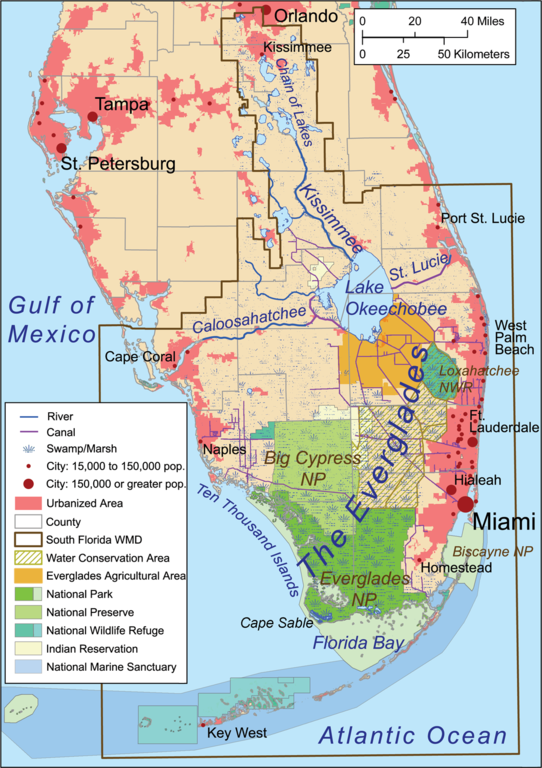
When Tropical Storm Isaac moved across South Florida, it brought some much needed rain to Lake Okeechobee which is South Florida’s back-up water supply. But at the time same time, it caused water levels to rise a bit too much in the Everglades which is bad for the wildlife.
Due to the current high water levels in the Everglades, the Florida Fish and Wildlife Conservation Commission (FWC) has issued an executive order temporarily restricting public access to portions of the Everglades and Francis S. Taylor Wildlife Management Area.


They say high water levels have forced area wildlife to take refuge on tree islands and levees, resulting in increased levels of stress for the animals.
“This is how 90 percent of the islands in the Everglades look right now,” said Marshall Jones of Mack’s Fish Camp as he stood in ankle deep water on one of the islands. “The water level is at its extreme to where the wildlife have no place to escape the water.”
When animals crowd onto the islands, they compete for not just space, but also food.
“The limited resources of food become scarce very, very fast,” said Jones. “It only takes a matter of a couple of weeks and the majority of the population of wildlife there no longer has much to forage on.”
For deer, if they don’t get onto dry ground, it could kill them.
“The deer would need approximately 4 hours a day in an area like this to dry out their hooves and their skin, their hide,” Jones explained. “Otherwise, they will begin to get hoof rot and hide rot and that will kill them in a matter of days.”
The order to restrict public access prohibits vehicles, airboats, ATVs and other means of public access to the Everglades and Francis S. Taylor Wildlife Management Area. This area lies in Palm Beach, Broward and Miami-Dade counties. Access to Conservation Area 2A from the L-35B levee north to the east-west airboat trail is still permitted.
The order also prohibits the taking of game. However, this order does not apply to people permitted to participate in the statewide alligator and migratory bird hunts, to frogging, or to people operating boats within the established canal systems and within one mile of marshes adjacent to canals within the wildlife management area.
Boaters must maintain a minimum distance of 100 yards from any tree island or levee when operating a vessel or airboat to minimize disturbance to upland wildlife.
To report a violation of this order, or any fish and wildlife law violation, call the FWC’s Wildlife Alert hotline at 888-404-3922.
As for Lake Okeechobee’s water level, it now stands at 15.05 feet above sea level, rising more than two feet due to Isaac’s drenching.
The extra water in the lake will help South Florida water supplies during the upcoming winter-to-spring dry season.
At one point following Isaac, storm water flowed into Lake Okeechobee at 30,000 cubic feet per second. That’s enough to fill an Olympic-sized swimming pool every two seconds, according to the South Florida Water Management District.
The Army Corps of Engineers tries to keep lake levels between 12.5 and 15.5 feet so if the lake level continues to rise, there could be a new problem, too much water. If that happens, the Army Corps of Engineers would consider dumping lake water out to sea.
Draining away lake water would ease the strain on the Herbert Hoover Dike which is considered one of the country’s most at risk of failure.
But dumping billions of gallons also wastes lake water relied on to back up South Florida water supplies during the typically dry winter and spring.
Also, dumping lake water out to sea can have damaging environmental consequences on coastal estuaries — leading to fish kills and harming delicate marine habitat.
Before farming and development spread across South Florida, water from Lake Okeechobee used to naturally overlap the lake’s southern shore and flow south to replenish the Everglades.
The lake’s dike was built to corral that water, guarding against flooding and using the lake to supplement South Florida water supplies. With few other storage options, when lake water levels rise too high the main option for flood-prevention is to dump it out to sea.
The restrictions will remain in place until the water goes down.


cbslocal.com


Everglades National Park


The Everglades Nature Park is located in the far south of Florida and covers an area of around 3,500 square kilometres. Beyond the protection of the park, the neighboring swamps are a major fascination of this region.

The textures of the landscape are both rugged and soft and its infinite waterways and riverbanks conjure up a strong sense of adventure. There are alligators, raccoons, pelicans, heron, ibis, and 275 species of fish including the manatee, a docile sea cow that weighs well over a ton, as well as more than 400 species of bird.

There's a replica of an original Miccosukee Indian village that has been transformed into an historical museum. The tiny settlement also contains a variety of well-stocked shops with an array of traditionally crafted Indian products.

An unusual vehicle that seems to be related to a tractor, but a more elevated version, is an ideal way to journey through the thick mud of the swamp, passing raccoons and even alligators along the way.

Numerous legends surround these mysterious, natural swamps, and some of the faces of its natural inhabitants, alligators, raccoons and birdlife, reflect the stories and history of this unique, highly atmospheric and fascinating nature park.

Tuesday, July 17, 2012

$80 Million in Everglades Project Funding


The Obama Administration today released a report outlining the historic Federal investments and progress made in Everglades restoration under the leadership of President Obama, and announced $80 million in additional funding to support farmers and ranchers who voluntarily conserve wetlands on agricultural land in the Northern Everglades Watershed.   This new investment, part of the U.S. Department of Agriculture’s Wetlands Reserve Program (WRP), will restore an additional 23,000 acres of wetlands vital to water quality and wildlife habitat in the Everglades system.

WRP is managed by USDA's Natural Resources Conservation Service. Learn more about NRCS' efforts in the Everglades.
 
President Obama has made restoring the Everglades a national priority. Using the partnerships and community-led approach that is a hallmark of the President’s America’s Great Outdoors initiative, the Administration has reinvigorated Federal leadership in Everglades restoration, investing $1.5 billion in Everglades projects and initiatives that will make a measurable impact on the ground, including nearly $900 million to jump start key construction projects that will restore water flow and essential habitat.  These projects already have generated 6,600 Florida jobs and are expected to generate more.  President Obama also has requested an additional $246 million in the Fiscal Year 2013 Budget to build on this progress and continue the investments, partnerships and projects that will return the Everglades to health. 

Senior Administration officials including U.S. Secretary of Agriculture Tom Vilsack, Council on Environmental Quality Chair Nancy Sutley, U.S. Department of Interior Assistant Secretary Rachel Jacobson, and Assistant Secretary of the Army Jo-Ellen Darcy released the report and made the funding announcement today in Kissimmee, FL. 

“The Everglades are an icon, an American treasure, and essential to the health and economy of Florida communities,” said Sutley. “With the President’s leadership, we are making real and measurable progress in Everglades restoration, dramatically increasing Federal funding, launching key construction projects, and working with the State and other partners to deliver results on the ground.  There is much more to do, and we are committed to returning this majestic natural resource to health.”

“President Obama has made restoring the iconic Everglades a national priority,” Vilsack said. “Restoring these wetlands demonstrates a strong commitment to partnerships with ranchers and farmers to improve water quality and habitat protection while supporting Florida’s strong agricultural economy and ranching heritage. These investments are paying off, creating nearly 7,000 jobs in Florida’s economy and preserving thousands of acres of precious wetlands for future generations to enjoy.”

“The Everglades are one of America’s most treasured places – for the people of Florida and for visitors and tourists from all over the world,” said Ken Salazar, Secretary of the U.S. Department of the Interior. “By working together in pursuit of President Obama’s vision for a renewed and healthy Everglades, we honor the stewardship of generations of Florida cattle ranchers and other landowners who understood that we all have a stake in preserving the health of our land, water, and wildlife. Under the President’s leadership, our commitment to restoring the Everglades is benefiting the environment and the Florida economy – creating jobs, while protecting this unique place for years to come.”

"The Everglades are essential to the environmental and economic strength of so many Florida communities. The health of this ecosystem affects everything from water quality and biodiversity to tourism, an industry that supports thousands of jobs across the state,” said EPA Administrator Lisa P. Jackson. "The success we've already seen in restoring the land, water and wildlife of the Everglades shows how investments in America’s extraordinary outdoors are also investments in our health and our economic future. Thanks to the additional funding announced today, we can expand our efforts to protect this vital watershed and build upon the progress that's already been made."

"In the last three years there has been unprecedented restoration progress in the Everglades,” said Darcy.  “President Obama has invested more than $130 million to restore flood plains and waters that flow from the Kissimmee River.  The Kissimmee River restoration project is the largest restoration project undertaken by the Corps to date and the benefits are already being realized.  Since 2009, the federal family and the State of Florida have invested in and broken ground on seven restoration projects.  We have seized the opportunity for stakeholders to work together toward common goal of restoring the Everglades."

Working in partnership with the State of Florida, Tribes and local leaders, since 2009, the Administration has restored more than 3,000 acres of the floodplains along the Kissimmee River; worked with landowners to improve habitat and water quality on more than 400,000 agricultural acres;  begun constructing the first mile of bridging for the Tamiami Trail to restore water flow to Everglades National Park;  begun implementing key components of the Comprehensive Everglades Restoration Plan to make more water available for environmental, urban and agricultural use; and reached an historic agreement with the State of Florida to make essential water quality improvements, including $879 million in State commitments for water quality projects. 

Today’s investment in the WRP also builds on other significant Obama administration accomplishments to conserve habitat in the greater Everglades ecosystem.  Earlier this year, the Department of the Interior’s Fish and Wildlife Service (FWS) established the 150,000-acre Everglades Headwaters National Wildlife Refuge and Conservation Area. Assistant Secretary Jacobson today announced that FWS has received $1.5 million in reprogrammed 2012 funding to begin securing additional conservation easements on priority parcels of some of the last remaining grass-land savannahs in the Northern Everglades – working with private land-owners to conserve the land, water and wildlife of the Everglades Headwaters.
 

NRCS: National Resources Conservation Service

Tuesday, March 20, 2012

New Conservation Area at the Headwaters of the Everglades in Central Florida

The U.S. Fish and Wildlife Service is working to conserve the natural resources and rural way of life in the Kissimmee River Valley. Our partners in this effort include the Florida Fish and Wildlife Conservation Commission, the U.S. Department of Agriculture's Natural Resources Conservation Service, the U.S. Department of Defense, The Nature Conservancy and the National Wildlife Refuge Association.

As part of President Obama’s America’s Great Outdoors initiative, Secretary of the Interior Ken Salazar has accepted a 10-acre donation of land in south-central Florida to officially establish the Everglades Headwaters National Wildlife Refuge and Conservation Area – conserving one of the last remaining grassland and longleaf pine savanna landscapes in eastern North America.

If fully realized, the refuge and conservation area will span 150,000 acres north of Lake Okeechobee. Two-thirds of the acreage, or 100,000 acres, will be protected through conservation easements purchased from willing sellers. With easements, private landowners would retain ownership of their land, as well as the right to work the land to raise cattle or crops. The easements would ensure the land could not be developed.


Thursday, March 15, 2012

Reservoirs, Creative Solutions Are Key to Everglades Restoration, Water Supply by Melissa L. Meeker

As South Florida's regional water management agency, the South Florida Water Management District is responsible for providing flood control, restoring natural systems and ensuring a sustainable water supply for more than 7.7 million residents.

This can be a daunting task. One of the most challenging aspects of water management in South Florida is not the 50-plus inches of rain that falls in our backyards each year. Rather, it is finding a place to store that water for beneficial use during dry times.

South Florida's flat landscape means that when it rains, without storage, water must be discharged through our extensive canal system to the ocean to prevent flooding. To capture this "lost" water and use it to support Everglades restoration and regional water supply needs, the district is working hard to identify and implement storage solutions. These can come in many shapes and sizes, from aboveground reservoirs and deep injection wells to shallow storage on agricultural lands.

 A unique geological formation in Palm Beach County is providing us with one of the more creative water storage solutions. The 950-acre L-8 reservoir is a strategically located former rock mine with a watertight geology. A component of Everglades restoration, this deep-ground reservoir will contribute to cleaner water for the Everglades, restoration of the Loxahatchee River and improved water quality in the Lake Worth Lagoon. Along with environmental benefits, it also offers residential advantages such as flood control and supplementing urban water supplies.

Approved in 2002, this first-of-its-kind project provides 15 billion gallons of water storage, enough to fill 24,000 football fields one foot deep in water. And, at an investment of $6,000 per acre-foot, the rock mine saves taxpayers millions of dollars compared to constructing an above ground reservoir.

Monday, February 13, 2012

Everglades Foundation Works to Preserve Florida’s Primary Source of Fresh Water By Jeffrey Langlois

Even if you’ve never visited, you’ve experienced a benefit from the Everglades.

Our neighboring wetlands are the major source of fresh water in Florida, a source threatened by pollution and water management. In 1993, an organization was founded to protect and restore the ecosystem that was once twice the size of New Jersey, The Everglades Foundation.

Although only half its original size, the Everglades is still home to a wide variety of animal and plant life. The 2 million-acre system still sustains an environment for 900 different types of fish and crustaceans, 830 varieties of plants, 250 species of birds, 65 species of reptiles and amphibians, 40 species of mammals and 67 threatened or endangered species.

Each year, several million visitors are drawn to Everglades National Park, Big Cypress National Preserve, Ten Thousand Islands National Wildlife Refuge, Biscayne National Park and John Pennekamp Coral Reef State Park. These visitors contribute hundreds of millions of dollars to Florida’s tourism economy.

Current projects are under way to restore the original flow of the Everglades. Through organizing and informing the public, government and nonprofit groups, The Everglades Foundation is making sure that this valuable resource remains for future generations.

Friday, February 10, 2012

Army Corps Announcement Could Bode Well for Endangered Everglades Species by Virginia Chamlee


The Army Corps of Engineers on Wednesday approved a South Florida Water Management District request for authorization to use temporary forward pumps to pull water from Lake Okeechobee lower than gravity-flow will allow, and now, the Corps has agreed to reduce that permit extension to one year only, in part to allow for a thorough analysis of the impacts of the pumps on the endangered Everglades snail kite. The announcement is an important one for the environmental group Audubon of Florida, which has long fought for the snail kite habitat.

The health of the snail kite is known to be indicative of the overall health of the Everglades system. Because the species’ diet consists almost solely of apple snails, the survival of the snail kite depends directly on the hydrology and water quality of the watersheds near which they live. Water conservation measures are imperative in order to comprehensively protect not only the kite habitat, but the greater Everglades ecosystem as a whole.


According to the National Park Service, the range of the Florida population of snail kites is restricted to watersheds in the central and southern part of the state. The species was listed as endangered in 1967.


“With three severe droughts hitting Lake Okeechobee in less than a decade, it is crucial for state and federal agencies to look closely at impacts of low water levels on the Everglade Snail Kite,” Everglades Policy Associate Jane Graham said in a press release sent out Thursday afternoon. “The Corps’ decision to renew the permit pending an evaluation of the impact of forward pumps on Lake ecology is an encouraging step in the right direction.”

Audubon of Florida Executive Director Eric Draper said that regulatory agencies (like the South Florida Water Management District) need to “rethink how water from Lake Okeechobee is being used throughout the year to put the environment on par with the sugar industry and other users.”