Showing posts with label Resources. Show all posts

Sunday, August 26, 2012

The Urban Quest for ‘Zero’ Waste: Cities Lead the Way in Diverting Trash from Landfills


Across the US, a handful of municipalities are radically reducing the amount of refuse they send to landfills, with the eventual goal of reaching “zero waste.” Seattle recycles or composts more than half of what its residents toss out. San Francisco diverts 77% of its waste from landfills. Even sprawling Los Angeles recycles or composts about two-thirds of its garbage.


hose numbers stand in stark contrast to the rest of the U.S., where the Environmental Protection Agency (EPA) estimates only about a third of waste is recycled or composted. The cities are getting the job done largely by having citizens and businesses sort trash more carefully, to recycle as much as possible.
Officials in these cities think they can go further. “It’s good; doesn’t mean we stop there,” says Tim Croll, solid-waste director for Seattle Public Utilities. “We know the word ‘low-hanging fruit’ is overused, but there is still more stuff to be gotten out of that waste stream.”

Less Than Zero?

The prime benefits in adopting zero waste are environmental; many cities that have enacted zero-waste plans say they have taken up the task in the name of sustainability. According to the EPA, recycling and composting are effective ways for households, communities and businesses to save energy while reducing water and air quality impacts as well as landfill-generated methane, a potent climate destabilizing greenhouse gas.
Zero Waste maximizes recycling, minimizes waste, reduces consumption and ensures that products are made to be reused, repaired or recycled back into nature or the marketplace. The Zero Waste International Alliancedefines it as such:
“Zero Waste is an ethical, efficient, economical, and visionary goal guiding lifestyle changes and practices emulating sustainable natural cycles, where all discarded materials are designed to become resources for others to use.
Zero Waste means designing and managing products and processes to systematically avoid and eliminate the volume and toxicity of waste and materials, conserve and recover all resources, and not burn or bury them.
Implementing Zero Waste will eliminate all discharges (90% reuse-recycle-diversion without incineration) to land, water or air that are a threat to planetary, human, animal or plant health.”
As well, supporters argue that reducing waste doesn’t necessarily mean increasing costs. For cities with limited landfill space—and the higher fees that come with it—most zero-waste activities cost less than normal garbage disposal, says Gary Liss, a zero-waste consultant who has helped about 20 cities form plans to reduce waste.
Why don’t cities shoot for 100% diversion? “We’re not crazy,” says Neil Seldman, president of the Institute for Local Self-Reliance, a nonprofit based in Washington, D.C., that promotes sustainable communities. The closer cities get to that goal, the harder it is to go further, largely because there are so many products out there that just can’t be recycled—and people continue to buy them.

According to Paul Connett, “Waste is the evidence that we are doing something wrong. Our task is to fight over-consumption and its most visible manifestation: the throwaway ethic. Instead of trying to become more sophisticated about getting rid of waste, we have to stop buying things we do not need, and industries have to stop making things, which cannot be reused in some way.”

Extended Producers Responsibility (EPR) could make a difference on the production end, placing the legal, financial, and environmental responsibility for materials entering the waste stream with the manufacturer, not on the consumer or the local government at the end of the product’s or packaging’s life cycle. The end result is a fundamental shift in responsibility and financing so that manufacturers redesign products to reduce material consumption and facilitate reuse, recycling and recovery.
Cities can pass ordinances and require households and businesses to recycle and compost, but “they can’t control the behavior of residents,” says Chaz Miller, the state programs director for the National Solid Wastes Management Association, a Washington, D.C., trade group for the waste and recycling industry. “There is still a lot of material to dispose of in this country, and it’s going to remain that way for a long time,” he adds.
Indeed, despite increased recycling in recent years, Americans are still prodigious wasters. In 2009, the most recent year for which figures are available, Americans threw out roughly 243 million tons of trash—or about 4.34 pounds of garbage per person, per day, according to data from the EPA. After recycling, composting and incineration, about 132 million tons ended up in landfills that year.

Recycling by the Bay

One of the most comprehensive zero-waste strategies is San Francisco’s. The city has relied on ordinances and regulations to prod citizens and businesses into wasting less. In 2009, it became the first city in the U.S. to require food composting for residents and businesses, Rather than throw food scraps and dirty napkins into the trash, individuals and businesses must chuck their organic material into city-provided green bins.
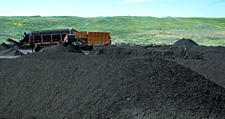
Jepson Prairie Organics
Jepson Prairie Organics is one of two Recology-owned compost facilities that together process 600 tons of organics collected daily from the City of San Francisco - from BioCycle
The mandate led to a large boost in compost collection, says San Francisco Department of the Environment director Melanie Nutter. Recology, the city’s collection agency, now hauls more than 600 tons of organic waste to a composting facility each day. In an effort to “close the loop,” Recology sells the certified organic compost materials.
Along with putting compost in green bins, individuals and companies are expected to sort plastics, aluminum and papers into blue bins and garbage in black “landfill” bins. The less waste residents put in the landfill bin, the less they pay for curbside collection; recycling and compost collection are free. (The system, known as “pay as you throw,” is used in hundreds of other cities as well.)
San Francisco’s rules don’t end there. There’s also a mandate for waste at building sites. Construction and demolition crews must recycle or reuse at least 65% of the material from a site, which involves sorting all debris or ensuring it is hauled to a collection facility.
The result of all these efforts is a waste-diversion rate of 77%—the nation’s highest—and the city is aiming for 100% by 2020. Ms. Nutter says the city can reach 90% if it prods its citizens to be even more waste-conscious; about a third of the waste that San Francisco sends to the landfill is recyclable, and another third is compostable.
Officials in San Francisco say sustainability is the driving factor behind its push for zero waste. The city pays for garbage collection only from city buildings and property; residents and businesses pay for their service through fees. The city says residents pay about the same for curbside trash service as in nearby cities.

Shades of Green

Another zero-waste leader is Seattle, which diverts about 54% of its waste from the dump and hopes to reach 70% by 2022. The city mandates recycling for businesses and residents, and requires food composting for single-family residences.
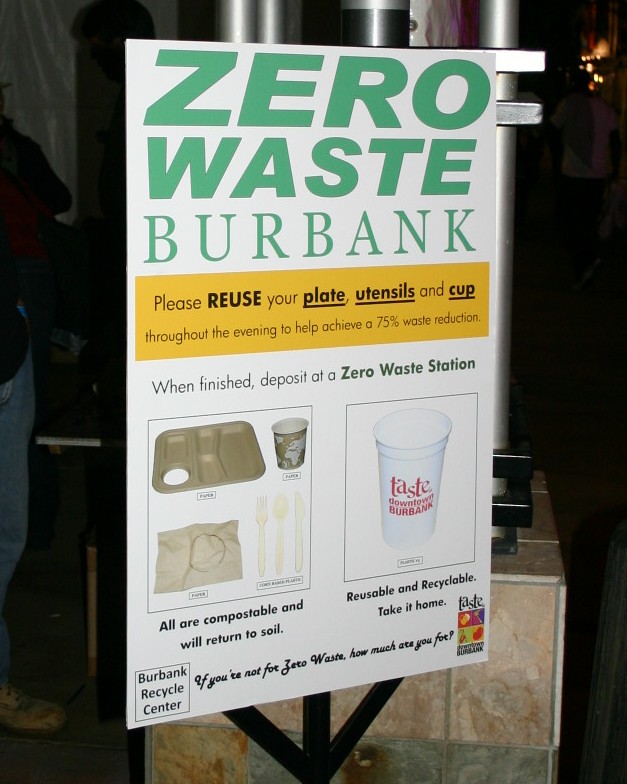
zero waste event
Zero Waste Event in Burbank - "If you're not for zero waste, how much are you for?"
It has also banned the food-service industry from providing goods in plastic-foam containers, and requires single-use packaging—including plates, coffee cups and utensils—to be recyclable or compostable. Among the approved alternatives on the city’s website: drink cups made from corn, bowls made from tapioca starch and wooden utensils.
Still, not all high-achieving cities get there with mandates and bans. Los Angeles diverts over 65% of its waste from landfills and is shooting for 70% by 2013. But it doesn’t mandate recycling. “We don’t believe in banning, as a city,” says Alex Helou, assistant director of the city’s Bureau of Sanitation.  However, the State of California, per AB341, will mandate for them and all municipalities. After July 1, 2012, a business that generates more than four cubic yards of commercial solid waste per week, or a multifamily residential dwelling of five units or more, shall arrange for recycling services consistent with state or local laws or requirements.
LA’s Mr. Helou says the bureau encourages residents by giving prizes like Starbucks gift cards to neighborhoods that increase their recycling the most. He says the city has also sought to make recycling as convenient as possible and has expanded the type of waste that consumers can throw into recycling bins to include items like plastic foam and milk cartons. Active movements in the city, however, are advocating for a stronger stance on recycling mandates.
Austin, Texas, currently recycles or composts about 38% of its waste and is in the process of finalizing its zero-waste plan. In addition to considering a recycling mandate, the city has pursued an original outreach campaign. Earlier this year, “Dare To Go Zero” premiered on the city’s public-access channel. The “Biggest Loser”-style reality show challenged four families to reduce their waste by 90% over the course of five weeks.
The city’s director of solid-waste services, Bob Gedert, says Austin hopes to ratchet up its diversion rate to 75% by 2020 through a mix of regulation and outreach, but says the city does not expect to reach zero waste until 2040.

Innovate Instead of Incinerate

Officials in San Francisco, like many other zero-waste supporters, maintain that incinerating waste increases greenhouse-gas emissions, and note that incineration destroys, rather than conserves, resources.
Still, many city officials agree that some sort of technological help will be needed as they get closer to zero waste. Seattle’s Mr. Croll says he is interested in anaerobic digestion, a process where micro-organisms break down organic waste and produce methane, which can later be used for energy. San Francisco is hoping to rely on advanced mechanized sorting systems that pick more recyclables from the garbage flow, Ms. Nutter says.
After that, she says, it may be out of the city’s hands. “There are some items in the waste stream that can’t be recycled or reused or repurposed,” she says. “So, in that case, we think the last 10% will really come down to working with manufacturers” to reduce and rework materials packaging.
Mr. Liss, the zero-waste consultant, says that at some point cities have to say, “We’ve done a lot with recycling, but we need to do a lot more with reducing and reusing.”

Monday, June 25, 2012

Dambisa Moyo: 'The World Will be Drawn into a War for Resources'

                                                   Dambisa Moyo: 'I think we'll see more wars'. Photograph: David Levene for the Guardian

Massive geopolitical shifts seldom announce themselves with a bang. They tend instead to creep up slowly, until it's hard to be sure exactly when they began. I remember going to buy some steel about six years ago, and being staggered by the price. "Ah," the man in the hardware store explained, "it's the Chinese, you see. They're buying up so much steel, the price has gone through the roof." The last time I visited my brother, all the lead had been stripped from his garden shed – the second theft in two months – thanks to rocketing lead prices. And it must have been around the time of the Iraq war that I recall first hearing someone say the next big war would be fought over water. At the time the prediction had sounded far-fetched; these days, it's a commonplace.

These sort of random, disconnected events look neither random nor disconnected once you read Dambisa Moyo's account of what's happening to the world's commodities. In 1950 the world's population stood at 2.5 billion; by last year it had reached 7 billion, and is projected to hit 10 billion by 2050. With almost all the population growth occurring in the emerging economies, by 2030 some 2 billion people will have joined the global middle classes. "Put another way," Moyo writes, "in less than 20 years we will witness the creation of a middle class of roughly the same size as the current total population of Africa, North America and Europe." Naturally, they will want mobile phones, fridges, cars and washing machines; 2,000 new cars already join Beijing's streets every day. In 2010 China had 40 cities with populations of more than a million; by 2020 it plans to have added another 225. The implications for the world's commodity resources are stark and sobering: global demand for food and water is expected to increase by 50% and 30% respectively by 2030, the pressure on copper, lead, zinc and corn is already becoming unsustainable, and no one has a clue where the energy we'll need is going to come from.

If Moyo's calculations are correct, we are in big trouble – which makes the central premise of her book, Winner Takes All, all the more arresting. Governments across the world, she writes, have singularly failed to grasp what's coming – with one sensational exception. "Simply put, the Chinese are on a global shopping spree." State-sponsored Chinese corporations are busy buying up commodities across Africa, North America, the Middle East, South America – anywhere they can – in a concerted strategy to seize control of resources before the rest of the world wakes up to the looming crisis. They're striking deals with what she calls the "axis of the unloved" – developing countries rich in commodities but poor in political and economic capital – in return for much needed investment, employment and infrastructure. Extravagant shoppers, the Chinese are happy to pay over the odds, treating their trading partners not as poverty-ridden charity cases nor political pariahs but valued commercial equals. But when the resources begin to run dry, the consequences will be catastrophic. Already, since 1990 at least 18 violent conflicts worldwide have been triggered by competition for resources. If nothing is done now, warns Moyo, commodity wars on a terrifying scale are all but inevitable.

To western eyes, Winner Take All makes for scary reading. Viewed through Chinese eyes, on the other hand, it's an altogether different story. For all its premonitions of armageddon, the book's tone feels more congratulatory than cautionary – reflecting the particular perspective of its author.

Moyo stepped off a transatlantic flight only hours before we meet, but arrives looking like a supermodel, shrugging off jet lag with the indifference of someone who, when asked where she lives, replies: "Oh, on a plane." Born in Zambia in 1969, she spent her first eight years in the US before returning with her parents, both economists, to the capital, Lusaka. At 19 she left again for good, acquiring a masters from Harvard and a doctorate from Oxford, and working for the World Bank and Goldman Sachs, before publishing her first book, Dead Aid, in 2009.

A turbocharged attack on aid, it caused quite a sensation – here was an African denouncing western aid as patronising and counterproductive – earning Moyo the nickname "the anti-Bono" and securing her reputation as a box-office star of the global high-finance circuit. Her second book, How The West Was Lost, was a devastating obituary of America's supremacy, the cause of death diagnosed as a fatal overdose of greed and laziness. With blue-chip western academic credentials, yet a distinctly non-western way of looking at the world, she was named one of the world's 100 most influential people by Time magazine. Yet her latest work, she says, was inspired by her own ignorance.

"I'm pretty savvy; I kind of understand what's going on in the world. So I was quite surprised to learn how little I knew about commodity scarcity. I was very shocked by my own ignorance. It just seemed to me surprising that the only country that seemed to be doing something in a very systematic and deliberate way was China."

Winner Take All is presented as a warning to the west – it's subtitled China's Race For Resources, and What It Means For Us – but the book reads more like a hymn of praise to China. When I ask if she regards its story as scary or thrilling, she doesn't hesitate. "Oh, I think it's fantastic. I think it's fundamentally fantastic – and also in the literal sense of the word. You know, it's fantastic – it's a good thing – but also 'fantastic' as in something really tremendous. They bought a mountain in Peru – half the height of Mount Everest – they bought the mineral rights. I flew in from Canada this morning, where they've done a laptops-for-pork deal. They're importing beef from Brazil, and in return they'll build roads and railways. It's just an amazing display of discipline, and a systematic approach – it's unparalleled. I don't know any other country that does it in this way."

If anything, the chief inspiration for Winner Take All seems to have been Moyo's irritation with western attitudes to Chinese growth. "There is this obsession with China being a culprit," she agrees. "Even now, people will still say: 'Oh, the reason why the United States' economy is not doing well is because the Chinese are manipulating the exchange rate,' or, 'The Chinese have human-rights issues,' and, 'The Chinese don't do democracy, and the Chinese cheat.' You know, it's always about the Chinese, and no one actually takes a step back and thinks: 'Gosh, actually, it's our fault that productivity is declining. It's got nothing to do with the Chinese.'"

The hypocrisy of western criticism is, she says, quite breathtaking. We accuse the Chinese government of meddling in free-market capitalism, clean forgetting that US farm subsidy programmes and Europe's Common Agricultural Policy have condemned Africa's farmers to poverty. The US is perfectly happy to take China's money – more than $1tn worth of government bonds – yet expects the emerging markets to say: "No, we don't want Chinese money because there's an issue of human rights." We complain that the Chinese are paying too much for commodities, instead of wondering whether China might in fact have grasped their true value. And we have the nerve, she marvels, to accuse China of neocolonialism, failing to understand that "the rest of the world actually thinks what China is doing is pretty damn clever". It was the west which got rich by invading and plundering the rest of the world, whereas China is engaging with it on respectful, peaceful, generous terms.

"What the Chinese are trying to do – move a billion people out of poverty – is just an unheard-of thing in history. The fact that they have moved 300 million in 30 years is unheard of. It took Britain 156 years to double its per capita income. It took America 57 years, Germany 65 years. It's taken the Chinese 12-and-a-half years."

Moyo stresses more than once: "I'm an economist, not a political scientist," and her writing is full of the maddeningly opaque jargon of commodity trading. Yet the book's fundamental message seems to be as much about the contrasting politics of Washington and Beijing as commodity prices. She is always described as a passionate free-market capitalist, so I ask how that fits with her admiration of China.

"I have to tell you, this is my favourite thing about being raised in Africa; we don't do labels very well, we don't do this, 'Oh, you're a Democrat; oh, you're a Republican.' Because we live in the real world. There's not a single country that actually approaches economics in a pure, free market, capitalist way. I like the free market – but it very much exists only in textbooks. If I had a choice, and we could live in a very pure world, I would be a supporter of the free markets. But because we don't live in that world, I do really admire what the Chinese have done. Having the good fortune of being born in Africa – I absolutely love the fact that I was raised and born in Africa – I love people who deliver results."

Moyo's critics say her predictions of a commodity crisis are alarmist, failing to account for future technological solutions to shortages. People have been worrying about unsustainable population growth ever since Thomas Malthus in 1798, goes this critique, and yet the world always somehow manages to muddle through.

"Right, but the people who are saying: 'We'll muddle through,' are people sitting in the west who get clean water when they turn the tap on. If you're in India, and the Brahmaputra river is being rerouted by the Chinese, you're not muddling through; lives are being lost. Wars are being fought right now. 'Oh, we'll muddle through,' is a very western view, because you're not killing each other yet, and oil prices haven't risen to $1,000 a barrel. If you live in a poor country, where you have to walk miles for water, or you have to fight for water or resources, it is already happening." She invests her money in technology and innovation, she adds. "And my sense is that we're not close to any big discovery in any of the categories – land, water, energy and minerals – that has made me not nervous about the coming headwinds."

Other critics dismiss her predictions of scarcity as miscalculations based upon a flawed assumption that China and other emerging markets will continue to grow at their recent prodigious rate – when in fact, their economies are starting to slow, and have probably already peaked. "People do not understand," she says, with a hint of weary incredulity, "that the Chinese government will and can do pretty much anything to make sure they don't have a recession. They're not going to sit there and do nothing while an economy slows down to 5% growth a year. They will have a political problem; they will have Tiananmen Square, they will have people on the streets. So what do they do? They'll turn the taps on." The notion that African aspirations could now be switched off strikes Moyo as equally laughable. "I go to Africa all the time. You talk to a young person and tell them they can't have Facebook? Seriously? You try telling them that."

It's not hard to see why Moyo is such a hit as a public intellectual. But when we come to the logical conclusion of her thesis, her position seems to become somewhat illogical. She calls for the creation of a global body focused exclusively on commodity issues – but when I ask what it would look like, her only clear stipulation is a central role within it for China. If China is winning the commodity race, its interest in any such body strikes me as doubtful, but Moyo thinks self-interest will ensure their support for a strategy to prevent resource depletion and consequent conflict. "I think the world will be drawn into a war for resources," she says firmly. "I think we'll see more wars."

Yet if all her predictions are correct, at that point surely the Chinese will flex their considerable military might in order to protect the worldwide interests they've paid for. It would be perverse of them not to, wouldn't it? Moyo flatly refuses to see it.

"They have been very deliberate in their speeches that this is about the peaceful rise of China. And by the way, what kind of campaign would they launch? They would go to all those countries and be fighting in all those different countries at the same time? I don't know how they would be able to do it. I can't play that scenario out." Perhaps my scepticism is simply evidence of the sort of suspicious western mindset Moyo scorns, but I wonder if her determination to champion China might not be in danger of tipping over into blind faith.

Moyo is clearly well aware that her critics dismiss her as more of a showy controversialist than a sober-minded thinker. When I ask about the factual errors that have been seized upon in all three books – in Winner Take All, for example, she says Opec stands for Oil Producing Exporting Countries – she bristles defensively. "Well, I wish I had been more perfect. But my book hit the New York Times bestseller list last week, and people seem interested in what I have to say." She considers it "rather cheap" to indict a book because of a few inaccuracies, and suspects critics make so much of her mistakes because they cannot forgive the heresy of Dead Aid. "They think I'm speaking out of my place." As for "the anti-Bono" nickname, "I absolutely despise it. When people make those type of cheap headlines, it takes away from fundamental points."

There certainly seems to be more than a hint of subtle prejudice in some of the comments she has attracted – both positive and negative. Nigel Lawson called her "confused" and "muddled" in a BBC radio debate, while his son Dominic has praised her as "a very serious lady indeed", and I can't imagine him describing a white male equivalent as a "very serious gentleman indeed".

She has homes in New York and London, but is anxious to point out: "That sounds all very glamorous, but it's just where I throw my stuff," and insists: "My core, core, core: I'm an African." I ask to what extent she suspects her work is viewed through the prism of her identity as an African woman. "Woman? Zero. African? 100." Given her own emphasis on the influence of African origins on her work, I can't work out if she considers this unfair or not.

"I think," she reflects with an elegant shrug, "I'm kind of a hard bird to figure out."


Tuesday, June 12, 2012

The Resource Shortage Is Real


In late March and early April, as average U.S. gasoline prices climbed above $3.80 per gal., headlines warned that soaring prices could imperil President Obama’s chance of re-election. But just two months later, after average prices dropped by 30 cents per gal., what once seemed a deal breaker for the election is no longer considered an issue. This narrow focus on short-term fluctuations in the price of a single commodity blinds us to one of the biggest threats to the world’s economic progress and political stability in the decades to come: resource scarcity.

Although gas prices, along with prices across the commodity complex, are currently trending downward, the fundamental imbalance between constrained supply and skyrocketing demand continues to point to higher prices in the long term. A recent IMF analysis, for example, suggests that the price of oil could more than double over the next decade, ascending to $180 per barrel by 2022. While this trend is worrying, hundreds of millions of people around the world are already suffering the effects of resource scarcity, as people in places like India and African nations struggle to gain access to potable water. A February report from the National Intelligence Council warns that water shortages will likely lead to political disruptions and many more violent wars in strategically important regions over the next decade.

As an economist and author, I have traveled to every continent over the past year, and the one common issue that every country I visited — from the richest to the poorest — is facing is the coming shortages of a wide range of key commodities. Dealing with this reality requires us to look past a myopic focus on individual commodities or short-term prices and understand the fundamental, long-term drivers of supply-and-demand imbalances.

Put simply, the world’s dwindling supplies of arable land, fresh water, energy and minerals — essential for the production of food and appliances such as mobile phones, cars, televisions and washing machines — cannot meet rising global demand.

Commodity demand is being driven by three primary factors: the rising world population, expected to grow from roughly 7 billion today to 9 billion by 2050; increasing global wealth, with an estimated 3 billion people expected to join the ranks of the middle class by 2030; and a marked trend toward urbanization. On the last point, demographers predict that the number of urban dwellers will rise from 3 billion today to 5 billion by 2030, and each of them will demand better quality foodstuffs and modern conveniences that will accelerate the draw on the world’s resources.

On the supply side, however, arable land, potable water, energy and minerals are finite, scarce and rapidly depleting. Take land — the earth contains approximately 13 billion hectares (32 billion acres) of land, or an area about 16 times the size of the United States. Of that, just 11% (1.4 billion hectares, or 3.5 billion acres) is arable and thus suitable to grow crops. The other 89% — including mountains and deserts — is prohibitively harder to exploit and farm. With the world’s population exploding, many more people will be looking to live and grow food on smaller patches of land.

Then there is water. Although the earth is 70% water, less than 1% is easily accessible fresh water that can be used for the sustenance of life, such as for drinking and sanitation. Meanwhile, by consuming about 85 million barrels of oil a day, we are living off oil discoveries that date as far back as the 1950s. Moreover, environmental concerns about fracking and shale gas could limit their promise so that such alternatives do not offer a real reprieve to global energy woes.

Finally, the global supply of minerals like copper is undermined by a decline in quality, a shrinking number of discoveries and increased vulnerability to political interventions. Increasingly, companies have to go much farther afield, into more difficult terrain and riskier geopolitical environments, in order to secure these minerals.

The widening imbalance between rising resource demand and falling commodity supplies means that commodity prices are likely to continue to rise substantially and thus hurt living standards. Plus, the risks of wars and conflicts will increase exponentially. Already there are 25 raging wars around the world that have their origins in disputes over access to scarce resources, and there will likely be many more.

Although traded-commodity prices have declined considerably in recent weeks, one fundamental fact remains: growing demand is far exceeding our finite supplies, pointing to severe commodity headwinds in the years to come. These risks remain particularly high because an explicit global framework that defines and manages competing resource interests and explores strategies for cooperation does not exist. As part of this multilateral framework, both demand-side and supply-side interventions could help curb consumption. On the demand side, higher taxes on consumption could curb commodity demand, but such policies are likely to be politically unpalatable. A better approach is to offer incentives that reward behaviors like conserving energy, seeking efficiency and recycling metal. Supply-side policies like subsidies could  alter the supply-demand equilibrium by encouraging greater investment in R&D and exploration into alternatives. Such interventions are critical, as we must move beyond our present approach of “every nation for itself.”


A bit alarmist. But our future is certainly uncertain.