
As Shell’s rigs head toward the Arctic to exploit melting sea ice to
drill for more oil, the company took a small step this weekend in
clarifying what would happen in an oil spill during the company’s
planned Arctic drilling operations this summer.
Despite the oil industry’s spin, experts know it is impossible to
recover more than a small fraction of a major marine oil spill, as
retired Coast Guard Admiral Roger Rufe told NPR:
“But once oil is in the water, it’s a mess. And we’ve never proven
anywhere in the world — let alone in the ice — that we’re very good at
picking up more than 3 or 5 or 10 percent of the oil once it’s in the
water.”
So how is it possible, according to the New York Times,
that Interior Secretary Ken Salazar “said he believed the company’s
claims that it could collect at least 90 percent of any oil spilled in
the event of a well blowout.” These sorts of claims have raised eyebrows
among advocates and scientists who study offshore oil drilling — they
aren’t just unbelievable, they’re laughably, outrageously impossible. NPR’s Richard Harris cuts through Shell’s spin, and explains what these numbers really mean:
“They have a miniscule number of boats compared to what was available in the Gulf of Mexico,” [Peter Van Tuyn, and environmental lawyer in Anchorage] says, and in the Gulf, “they didn’t have to deal with the extreme weather conditions that we’ve got in the Arctic.” High winds are the norm, and sea ice is always a possible hazard, “and yet they [Shell] claim they can collect as much as 95 percent.”
Merrell says the company has made no such claim. Instead, he says, the oil company’s plan is to confront 95 percent of the oil out in the open water, before it comes ashore. That doesn’t mean responders can collect what they encounter.
“Because the on-scene conditions can be so variable, it would be rather ridiculous of us to make any kind of performance guarantee,” Merrell says.
While discussing the same issue with the Associated Press, Shell PR folks take another word out for a spin, and even try to blame “opposition groups” for this confusion:
Shell Alaska spokesman Curtis Smith said opposition groups are purposely mischaracterizing Shell’s oil spill response plan. The plan does not claim Shell can clean up 90 percent of an oil spill, he said.
“We say in our plan we expect to ‘encounter’ 90 percent of any discharge on site — very close to the drilling rig,” he said. “We expect to encounter 5 percent near-shore between the drilling rig and the coast. And we expect to encounter another 5 percent on shore. We never make claims about the percent we could actually recover, because conditions vary, of course.”
Where Shell plans to drill in the Arctic, those conditions include 20
foot swells, hurricane force winds, sea ice, and months of total
darkness, and all without deep water ports or other infrastructure
needed to mount a major oil spill response. But let’s put that aside for
a moment, to make sure we’re not mischaracterizing here: Shell expects
to “encounter” or “confront” 90% of the spilled oil and another 5% the
company plans to — rendezvous? — with elsewhere in the ocean, while the
remaining 5% Shell might — happen upon? — on shore. How much of that oil
might be recovered, collected, or, you know, removed from the
environment? Well, Shell says conditions vary, so making a performance
guarantee would be rather ridiculous.
In the relatively calm conditions of the Gulf of Mexico, with
thousands of response vessels, only a small fraction was recovered from
the BP oil disaster. Despite shameful efforts to spin its announcement, a
government report found that 4% of the oil was skimmed, and another 6% was burned. And as oil spill expert Rick Steiner observes,
even those estimates might be too high, and burning oil isn’t really
removing it from the environment: “It either went into the air as
atmospheric emissions, and some of that is pretty toxic stuff, or
there’s a residue from burning crude that sinks to the ocean floor,
sometimes in big thick mats.”
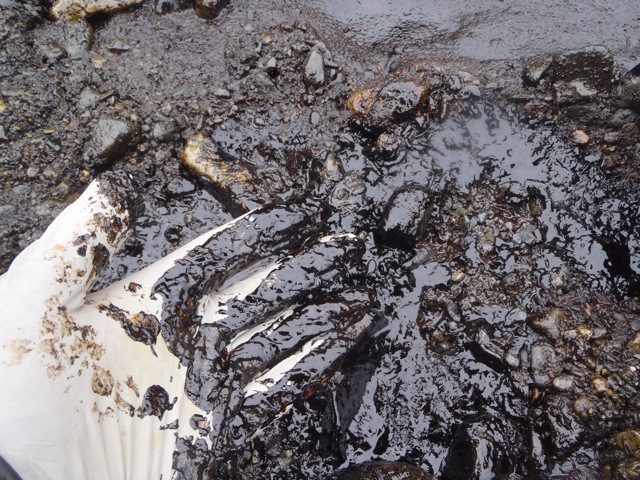
Exxon Valdez oil in 2012. Photo courtesy of David Janka, taken on May 24, 2012 on Eleanor Island, Prince William Sound, Alaska.
And the 1989 Exxon Valdez oil spill in Alaska’s Prince William Sound? Steiner explains in “Exxon Valdez Oil Spill a Cautionary Tale for Arctic Ocean Drilling:
And today, 23 years later, most of the fish and wildlife populations and habitats injured by the spill have yet to fully recover, and there is still residual, toxic oil in beach sediments. It is becoming evident that the injured Alaska coastal ecosystem may never fully recover from the Exxon Valdez spill.”
What of the promised “state-of-the-art spill response”? Despite a three-year, $2 billion effort by Exxon, the response was a spectacular failure, recovering less than 7 percent of the spilled oil.
Oil that Exxon might have “encountered” decades ago, still remains
today, as do the impacts to the ecosystem and the wildlife and
communities that depend upon it.
By Joe Smyth Media Officer with Greenpeace@Think Progress: Climate Progress

