Showing posts with label Oil Spill. Show all posts

Tuesday, July 10, 2012

Shell Clarifies: It Can "Encounter" 95 Percent Of An Arctic Oil Spill, Not Collect It


As Shell’s rigs head toward the Arctic to exploit melting sea ice to drill for more oil, the company took a small step this weekend in clarifying what would happen in an oil spill during the company’s planned Arctic drilling operations this summer.
Despite the oil industry’s spin, experts know it is impossible to recover more than a small fraction of a major marine oil spill, as retired Coast Guard Admiral Roger Rufe told NPR: “But once oil is in the water, it’s a mess. And we’ve never proven anywhere in the world — let alone in the ice — that we’re very good at picking up more than 3 or 5 or 10 percent of the oil once it’s in the water.”

So how is it possible, according to the New York Times, that Interior Secretary Ken Salazar “said he believed the company’s claims that it could collect at least 90 percent of any oil spilled in the event of a well blowout.” These sorts of claims have raised eyebrows among advocates and scientists who study offshore oil drilling — they aren’t just unbelievable, they’re laughably, outrageously impossible. NPR’s Richard Harris cuts through Shell’s spin, and explains what these numbers really mean:
“They have a miniscule number of boats compared to what was available in the Gulf of Mexico,” [Peter Van Tuyn, and environmental lawyer in Anchorage] says, and in the Gulf, “they didn’t have to deal with the extreme weather conditions that we’ve got in the Arctic.” High winds are the norm, and sea ice is always a possible hazard, “and yet they [Shell] claim they can collect as much as 95 percent.”

Merrell says the company has made no such claim. Instead, he says, the oil company’s plan is to confront 95 percent of the oil out in the open water, before it comes ashore. That doesn’t mean responders can collect what they encounter.

“Because the on-scene conditions can be so variable, it would be rather ridiculous of us to make any kind of performance guarantee,” Merrell says.
While discussing the same issue with the Associated Press, Shell PR folks take another word out for a spin, and even try to blame “opposition groups” for this confusion:
Shell Alaska spokesman Curtis Smith said opposition groups are purposely mischaracterizing Shell’s oil spill response plan. The plan does not claim Shell can clean up 90 percent of an oil spill, he said.

“We say in our plan we expect to ‘encounter’ 90 percent of any discharge on site — very close to the drilling rig,” he said. “We expect to encounter 5 percent near-shore between the drilling rig and the coast. And we expect to encounter another 5 percent on shore. We never make claims about the percent we could actually recover, because conditions vary, of course.”
Where Shell plans to drill in the Arctic, those conditions include 20 foot swells, hurricane force winds, sea ice, and months of total darkness, and all without deep water ports or other infrastructure needed to mount a major oil spill response. But let’s put that aside for a moment, to make sure we’re not mischaracterizing here: Shell expects to “encounter” or “confront” 90% of the spilled oil and another 5% the company plans to — rendezvous? — with elsewhere in the ocean, while the remaining 5% Shell might — happen upon? — on shore. How much of that oil might be recovered, collected, or, you know, removed from the environment? Well, Shell says conditions vary, so making a performance guarantee would be rather ridiculous.

In the relatively calm conditions of the Gulf of Mexico, with thousands of response vessels, only a small fraction was recovered from the BP oil disaster. Despite shameful efforts to spin its announcement, a government report found that 4% of the oil was skimmed, and another 6% was burned. And as oil spill expert Rick Steiner observes, even those estimates might be too high, and burning oil isn’t really removing it from the environment: “It either went into the air as atmospheric emissions, and some of that is pretty toxic stuff, or there’s a residue from burning crude that sinks to the ocean floor, sometimes in big thick mats.”
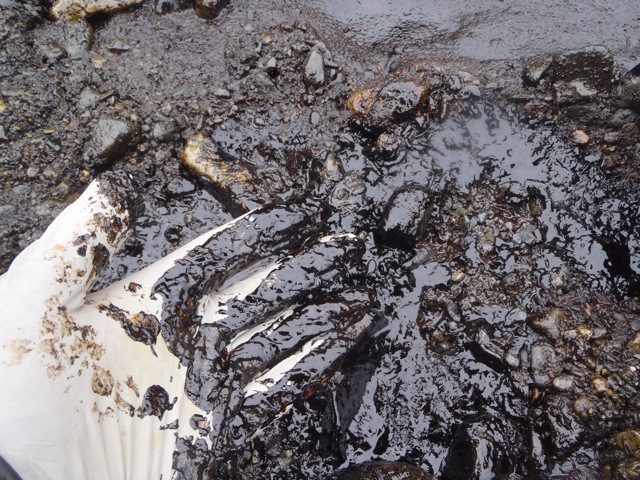
              Exxon Valdez oil in 2012. Photo courtesy of David Janka, taken on May 24, 2012 on Eleanor Island, Prince William Sound, Alaska.

And the 1989 Exxon Valdez oil spill in Alaska’s Prince William Sound? Steiner explains in “Exxon Valdez Oil Spill a Cautionary Tale for Arctic Ocean Drilling:
And today, 23 years later, most of the fish and wildlife populations and habitats injured by the spill have yet to fully recover, and there is still residual, toxic oil in beach sediments. It is becoming evident that the injured Alaska coastal ecosystem may never fully recover from the Exxon Valdez spill.”
What of the promised “state-of-the-art spill response”? Despite a three-year, $2 billion effort by Exxon, the response was a spectacular failure, recovering less than 7 percent of the spilled oil.
Oil that Exxon might have “encountered” decades ago, still remains today, as do the impacts to the ecosystem and the wildlife and communities that depend upon it.

By Joe Smyth Media Officer with Greenpeace@Think Progress: Climate Progress

Wednesday, June 27, 2012

Nigeria: Oil Spills Drench and Sicken Delta Communities

A Nigerian tries to separate crude oil from water in a boat at the Bodo waterways polluted by oil spills attributed to Shell equipment failure August 11, 2011. The Bodo community in the oil-producing Niger Delta region sued Shell oil company in the United Kingdom, alleging that spills in 2008 and 2009 had destroyed the environment and ruined their livelihoods. The UN released a report this month saying decades of oil spills in the Nigerian region of Ogoniland may require the biggest cleanup ever undertaken, with communities dependent upon farmers and fishermen left ravaged. (Pius Utomi Ekpei/AFP/Getty Images)

When he was a child, Tonye Emmanuel Isenah saw men in the Niger Delta who were 70 and even 80 years old. But these days, he said, people just don’t live that long.

Isenah is now the deputy leader of the state assembly in Bayelsa State, part of Nigeria’s oil rich Niger Delta region — a land that for decades has suffered annual devastating oil spills. Experts say the yearly spills are each comparable to the Exxon Valdez spill. And the environmental degradation is causing the local people to become ill and die at earlier ages.
“At the age of 45, people are beginning to have strokes,” he said. “I used to see people that lived up to 70 years and beyond.”

Life expectancy in Nigeria now hovers above 50 years, nearly 20 years below the world average, but Isenah says that in the Niger Delta, the life span is shorter. Isenah’s assertion that pollution in the Niger Delta is weakening the people, is as obvious to any observer as the oil that coats the mangrove roots in the creeks.

Nigeria is Africa’s largest oil producer, exporting about 2.5 million barrels of oil a day, almost entirely from the Niger Delta. It is the United States’ fifth largest oil supplier and the proceeds from sales of crude oil made up 80 percent of Nigeria’s national revenue and nearly all its foreign currency earnings.

But on the banks of the delta, locals say the oil has brought them nothing but suffering and things are getting worse. Last year, Royal Dutch Shell in Nigeria, the country’s largest oil company recorded twice as much spilled oil than the year before, with 6,000 tons of oil dumped into the delta due to operational failures, up from 2,900 tons the year before. This figure doesn't include spills from other major oil companies, like Chevron, Exxon-Mobile and Total, or from oil theft and illegal refineries.

Oil floats on the delta’s waterways killing and contaminating the plants and animals in one of Africa’s most bio-diverse regions. Along the banks of the creeks, muddy fishing villages are slick with oil that washes ashore. Villagers say they drink and bathe in the oily waters and as a result, children are dying of diseases.

The pollution and lack of attention to it is fueling anger among the people of the Niger Delta. Militant rebels charge that their grievances have not been addressed since the 2009 amnesty deal and some are threatening to fight again if the government does not clean up the area and make it place where people can live safely.

Last year, the United Nations Environment Program conducted a study of an oil spill in the Niger Delta and found some water with 900 times more carcinogens than what is safe. With almost no hospitals in the creeks and wooden dugout canoes being the common mode of transport, parents say sick children often cannot live long enough to get help.
Like the rest of her family, Decent Victor fishes for a living and dries the fish into flakes to sell. She said it can take five to six hours to paddle to the nearest hospital.

“If you see a 10-year-old child getting a sickness, you carry the boy to the hospital,” she said. “But before getting to Warri the child dies.”

Fishing is almost the sole economic activity for many villages in the Niger Delta and locals say they now catch six to eight times less fish than they did a few years ago — barely enough to sell. Officials and oil companies do not deny that people are suffering from the oil drenching their land, but responsibility for cleaning up is elusive. Officials say they are currently conducting studies and will order companies to compensate people in villages devastated by spills, if they can prove the oil in the village came from the company in question.

A week doesn’t go by without a report of an oil spill, said Warri head of the National Oil Spill Detection and Response Agency, Benjamin Olubunmi Akindele. He said his office does not have the means or the mandate to clean them all up.

“It is the job of the polluter to clean up the spills, not the agency,” he said. Oil companies, however, lay blame on the government, saying insecurity in the region makes clean-ups difficult.

The companies also blame many of the oil spills on attacks on their pipelines by local oil thieves. Shell says more than 75 percent of all oil spills in the delta between 2006 and 2010 were caused by illegal refining and sabotage

Village leaders say if the dangers in the water were not enough, the air is also increasingly dangerous to breathe. Gas flaring — a process in which natural gas associated with crude oil pumping is burned — has been declared illegal by many Nigerian lawmakers over the years, but the fires still burn every day, all day and all night.

Oil companies say they are working to reduce continuous flaring, with Shell reporting a 60 percent decrease over the past nine years. The company said it is currently implementing a $5 billion program to reduce flaring and gather more of the natural gas for power.
Felix Fawei, a community leader on the banks of the delta said fumes from the flares sicken locals, forcing many to flee from their villages into the cities. “Sometimes you’ll see that the water is very bright even though this area is very dark,” he said. “This in an environment that is not safe to live.”


Thursday, June 21, 2012

Officials Investigate Another Alberta Pipeline Leak

A boom stretches out to contain a pipeline leak on the Gleniffer reservoir near Innisfail, Alta., Tuesday, June 12, 2012. Enbridge Inc. announced on June 18 that another oil spill had occurred near Elk Lake, northeast of Edmonton.(Jeff McIntosh / THE CANADIAN PRESS)


Alberta officials are investigating after yet another pipeline leaked in the province, causing crude oil to spill at a pumping station near Elk Lake, northeast of Edmonton.

The spill at Enbridge Inc.'s Athabasca pipeline happened Monday. An estimated 230,000 litres of heavy crude oil leaked, according to the company.

However, Darin Barter of the province's Energy Resources Conservation Board (ERCB) said the amount of oil spilled, and the cause, have not yet been confirmed.

"It's too early to really tell what the cause will be because we are in frankly a messy situation with oil and at this point the priority is to get it off the ground," Barter told CTV Edmonton in an interview.

Enbridge confirmed Tuesday the leak occurred at the pumping station about 24 kilometres southeast of Elk Point, Alberta.

In a release, the oil company said the pipeline had been shut down and the pumping station had been isolated.

"No waterways are impacted and cleanup is underway," the statement said.
There were no injuries or evacuations as a result of the oil leak. The ERCB is continuing to investigate the leak.

Earlier this month the oil company Plains Midstream Canada announced that 475,000 litres of oil had spilled into Alberta's Red Deer River and a water reservoir downstream of the leak.

And in May, Calgary-based Pace Oil and Gas announced a spill after it was spotted during a flyover in a remote muskeg area of northwestern Alberta, about 20 kilometres southeast of Rainbow Lake.

The spill affected an area about 500 metres long by 200 metres wide, said Fred Woods, president and CEO of Pace Oil and Gas Ltd.

CTV News


This post documents 2 leaks in Canadian pipelines. It is these companies that want to build a pipeline from the Canadian border, through the midwest, to refineries near the gulf. Lets hope the president continues to block this construction. This is the "dirtiest" oil on the planet and we certainly don't need another catastrophic oil spill. 

Thursday, April 26, 2012

Shell Nigeria Oil Spill '60 Times Bigger Than It Claimed'

                               Fishing boats lie abandoned in oil-polluted water near Bodo, Nigeria. Photograph: Pius Utomi Ekpei/AFP/Getty


A Shell oil spill on the Niger delta was at least 60 times greater than the company reported at the time, according to unpublished documents obtained by Amnesty International.

According to Shell, the 2008 spill from a faulty weld on a pipeline resulted in 1,640 barrels of oil being spilt into the creeks near the town of Bodo in Ogoniland. The figure was based on an assessment agreed at the time by the company, the government oil spill agency, the 

Nigerian oil regulator and a representative of the community.

But a previously unpublished assessment, carried out by independent US oil spill consultancy firm Accufacts, suggests that a total of between 103,000 barrels and 311,000 barrels of oil flooded into the Bodo creeks over the period of the leak. Accufacts arrived at the figure following analysis of video footage of the leak taken at the time by local people. This suggested that between one and three barrels of oil were leaking every minute. A similar method was used by spill assessors to gauge the scale of the BP Deepwater spill underwater in the gulf of Mexico in 2010.

"The difference is staggering: even using the lower end of the Accufacts estimate, the volume of oil spilt at Bodo was more than 60 times the volume Shell has repeatedly claimed leaked," said Audrey Gaughran, director of global issues at Amnesty International.

"All oil spill incidents are investigated jointly by communities, regulators, operators and security agencies," said a Shell spokeswoman in London. "The team visits the site of the incident, determines the cause and volume of spilled oil and impact on the environment, and signs off the findings in a report. This is an independent process – communities and regulators are all involved. This is the process that was employed with the two spills in question, and we stand by the findings [of 1,640 barrels]." Shell has argued the community prevented the company being allowed near the pipeline to repair it.

The amount of oil spilled by Shell at Bodo will be key to a high court case expected to be heard in London later in 2012. Shell is being sued by nearly 11,000 Bodo inhabitants, who say their lives were devastated by the spill which destroyed their fishing grounds, caused long-lasting ill health and polluted fresh water sources. The community, represented by the London law firm Leigh Day, is thought to be seeking more than $150m (£93m) to clean up the creeks, which, even four years after the spill, remain coated in oil.

Oil spill compensation in Nigeria is based largely on the amount of oil spilt. But negotiations over the Bodo spill broke down earlier in 2012 in London when the gap between what Shell was offering and what the community wanted could not be bridged. Neither party can agree on when the 40-year-old pipeline started to leak.

In a letter to Amnesty International, Shell wrote: "The court will decide what the volume of the spill was. We suggest you might be better to wait for the authoritative view on the volume of the spill and publish at that stage rather than risk misleading the public with Accufacts estimate."

But this was dismissed by Amnesty's Gaughran: "Even if we use the start date given by Shell, the volume of oil spilt is far greater than Shell recorded. More than three years after the Bodo oil spill, Shell has yet to conduct a proper cleanup or to pay any official compensation to the affected communities. After years of trying to seek justice in Nigeria, the people of Bodo have now taken their claim to the UK courts."

"The evidence of Shell's bad practice in the Niger delta is mounting," said Patrick Naagbanton, co-ordinator of the local oil watch group Centre for Environment, Human Rights and Development (CEHRD). "Shell seems more interested in conducting a PR operation than a cleanup operation. The problem is not going away; and sadly neither is the misery for the people of Bodo."

Amnesty and CEHRD have repeatedly called for an independent process to investigate oil spills in Nigeria, and an end to the system that allows oil companies to have such influence over the process.


Monday, April 23, 2012

New Ecological Model for Deep-Water Oil Spills

On the second anniversary of the Deepwater Horizon oil platform blowout, a national panel of researchers is providing new insight into what happened in the disaster, as well as a guide for how to deal with such events in the future, and why existing tools were inadequate to predict what lay before them.

The study, produced by the Gulf Oil Spill Ecotox Working Group at UC Santa Barbara's National Center for Ecological Analysis and Synthesis (NCEAS), is published in the May issue of the journal Bioscience. It is titled, "A Tale of Two Spills: Novel Science and Policy Implications of an Emerging New Oil Spill Model."

"The old model assumed that oil would simply float up to the surface and accumulate there and along the coastline," said co-author Sean Anderson, an associate professor at California State University Channel Islands. "That model works well for pipeline breaks and tanker ruptures, but it is inadequate for this novel type of deep blowout."

The 2010 Deepwater Horizon oil spill in the Gulf of Mexico was unlike any oil spill science and society had encountered. The blowout occurred at unprecedented depths and released enormous quantities of oil (an estimated 4.9 million barrels, or 206 million gallons). Marine and wildlife habitats suffered major damage, and, according to authors, the damage continues to happen today, out of sight. Local and regional economies and livelihoods suffered as well.


According to the researchers -- a renowned group of ecotoxicologists, oceanographers, and ecologists who convened under the auspices of NCEAS while the spill was still active -- the response to clean up and contain the oil followed a framework that assumed the oil's behavior would mimic the more familiar shallow-water and surface spills, despite the fact that the dynamics, fate, and effect of deep-water oil on ecosystems are not understood.

"As the Deepwater Horizon spill unfolded, you would hear folks saying things like, 'We all know what happens when oil and water mix; the oil floats.' That wasn't the whole story, and that oversimplification initially sent us down an incorrect path full of assumptions and actions that were not the best possible use of our time and effort," said Anderson.

After synthesizing existing knowledge to anticipate the potential ecotoxicological effects of the spill, and highlighting major gaps in scientific understanding, the scientists have created the first complete conceptual model for understanding both the Deepwater Horizon spill and analogous disasters in the future.

This new model accounts for how deepwater oil spills unfold and where the resulting ecological impacts accrue. It also emphasizes that the vast majority of the oil is retained at depth -- rapidly emulsified and dispersed due to the physics of the pressurized oil jetting from the tip of the wellbore -- and, among other response actions, calls into question the efficacy of dispersants.

"We have generally hailed the use of [chemical] dispersants as helpful, but really are basing this on the fact we seemed to have kept oil from getting to the surface," argues co-author Gary Cherr, director of UC Davis's Bodega Marine Lab. "The truth is, much of this oil probably was staying at depth, independent of the amount of surfactants we dumped into the ocean. And we dumped a lot of dispersants into the ocean -- all told, approximately one-third of the global supply."

Co-author Ron Tjeerdema, chair of the Environmental Toxicology Department at UC Davis, concurs. "The problem is, we really must address the downside of such compounds, particularly in light of the fact that the upside probably was not so great as it seemed at the time," he said.

Armed with a new foundation for research and policy implications, the NCEAS Gulf Oil Spill Ecotox Working Group is calling for further investigation into the long-term effects of deep-water oil spills.

"We now have a sense that the bulk of the impact was probably in the mid-water and deep ocean," said the study's lead author, Charles "Pete" Peterson, a professor at University of North Carolina at Chapel Hill, who has been deeply involved in the study of the environmental effects of the Exxon Valdez oil spill for over two decades. "Who the heck knows what oil does to the mid-water pelagic and deep-dwelling critters? We need an integrated collaboration between deepwater explorers, modelers, ecotoxicologists, microbial ecologists, and so on ó all working together in unprecedented ways. We need a whole new type of marine ecology."

Saturday, April 21, 2012

Spills Around The World Since Deepwater Horizon

As the country's attention is turned toward the Gulf of Mexico on the second anniversary of the Deepwater Horizon spill, it is also important to recognize that the 2010 BP spill was not the only one that happened in the past two years, even in the U.S.

States including Alaska, Utah, Michigan and Montana all saw oil spills in the past two years, along with countries like Canada, New Zealand and China. While several leaks were relatively small and pale in comparison to the Deepwater Horizon spill, they still represent what can go wrong with oil extraction and shipment.

Despite the apparent damage to the Gulf region and subsequent spills in the U.S., the government's oil spill commission set up after the 2010 Gulf spill, and disbanded a year ago, announced recently that many of its recommendations have yet to be implemented, especially by Congress.

In Nigeria's Akwa Ibom State, an ExxonMobil pipeline ruptured on May 1 and spilled over a million gallons of oil, reported the Guardian. The leak continued for seven days before it was stopped.

HuffPost blogger Omoyele Sowore explained in July 2010 that an oil spill from ExxonMobil operations was nothing new to the country. He wrote that an "environmental catastrophe [had] been going on since December 2009." He described the toll on Nigeria: "There's oil on the surface of the ocean, wildlife coated in crude, fishermen losing their businesses."

In May 2010, several thousand barrels of oil spilled from the Trans-Alaska pipeline "during a scheduled pipeline shutdown at a pump station near Fort Greely," explained AP.

No injuries were reported and officials said the spill was likely "limited to the gravel on top of the containment area's line."

In June 2010, a Chevron pipeline ruptured and spilled oil into a creek near Salt Lake City, Utah.

It was first estimated that over 400 to 500 barrels spilled into the creek, which leads into the Great Salt Lake, reported AP. Around 150 birds were "identified for rehabilitation." The oil did not reach the Great Salt Lake, however.

Chevron was later cited for the spill, which released an estimated 33,000 gallons in total.

In March 2012, a group of 66 residents of a Salt Lake City neighborhood sued Chevron for damage caused by the Red Butte Creek spill and a smaller spill in December 2011.

In late July 2010, an Enbridge pipeline in southwestern Michigan sprung a leak and spilled over 800,000 gallons of oil into a creek which flows into the Kalamazoo River.

By August, a regional EPA administrator said that significant progress had been made at the site, but "the agency cautioned that it will take months to complete the cleanup," reported AP.

By the end of September, the pipeline -- which travels from Ontario to Indiana -- was back in operation.

The EPA later reported that about 1.1 million gallons of oil were recovered, but pipeline operator Enbridge said that it would stick with previous estimates that only about 843,000 gallons were spilled.

In July 2010, China experienced what was reported as the "country's largest reported oil spill" after a pipeline rupture near the northeastern port city of Dailan.

Several days after the spill, cleanup efforts were underway over a 165 square mile (430 square kilometer) area of the Yellow Sea.

The Chinese government reported that about 1,500 tons or 461,790 gallons of oil had spilled, but experts contended that the spill could have been "dozens of times larger," reported AP.

 In late April 2011, a pipeline in northwestern Alberta began leaking, and created the worst spill in the province in 36 years, reported the Calgary Herald.

About 28,000 barrels of oil were reportedly spilled from the Rainbow pipeline, which is operated by Plains Midstream Canada.

The Globe and Mail revealed that the pipeline operators "detected a potential problem nearly eight hours before halting the flow of crude." A nearby school in a First Nation community was closed after residents reported "nausea, burning eyes and other symptoms," and several animals were found dead.

In late July, Plains Midstream requested to re-open the pipeline and begin to ship oil to Edmonton again.

In June 2011, an oil spill occurred about 25 miles off the coast of China's Shandong province in Bohai Bay. A second spill followed in July.

In late August, it was reported that ConocoPhillips had discovered more oil seeps in Bohai Bay, although only "1 to 2 liters (a quarter to a half-gallon) of oil and drilling mud were being released each day."

The company reported that the 2011 spills released 700 barrels of oil and 2,500 barrels of drilling mud into the bay and that most of it was recovered. In September, China's State Oceanic Administration claimed that oil was still seeping underwater.

In early 2012, Texas-based ConocoPhillips reached a settlement deal with the Chinese government for $160 million.

In July 2011, a pipeline beneath Montana's Yellowstone River ruptured and sent an oil plume 25 miles downstream, reported AP.

Despite reassurances from ExxonMobil that the pipeline was safe, the July spill released what was originally estimated to be 42,000 gallons of oil. With other 1,000 workers assisting the cleanup, ExxonMobil estimated that it would cost $135 million to clean the river.

In January 2012, it was reported that ExxonMobil had increased its estimate of the spill size by 500 barrels. AP later reported the estimated spill size as 63,000 barrels.

In August 2011, an oil rig off the eastern coast of Scotland began leaking oil into the North Sea. Royal Dutch Shell, which operates the Gannet Alpha oil rig, initially reported that 54,600 gallons of oil were spilled.

A second leak soon occurred, turning the spill into the worst in the North Sea in a decade, reported AP.

Several days later, Shell announced that it had "closed a valve from which oil was spilling into the North Sea," according to AP. The spill released about 1,300 barrels of oil, which spread out over a 2.5 square mile (6.7 square kilometer) area.

 In mid-November 2011, Brazilian authorities began investigating an offshore spill near Rio de Janeiro, reported AP.

Chevron initially reported that between 400 and 650 barrels of oil had spilled into the Atlantic, while a nonprofit environmental group using satellite imagery estimated that the spill rate was at least 3,738 barrels per day.

Chevron soon claimed full responsibility for the spill. The brazilian division's COO said, Chevron "takes full responsibility for this incident," and that "any oil on the surface of the ocean is unacceptable to Chevron," reported AP.

In December, Brazilian prosecutors announced that they were seeking $10.6 billion in damages from Chevron for the spill that leaked nearly 3,000 barrels of oil.

In March 2012, a Brazilian federal judge allowed prosecutors to file criminal charges against Chevron and Transocean and 17 executives from both companies were barred from leaving Brazil.
 In October 2011, a Liberian-flagged cargo ship ran aground on a reef in Northern New Zealand and began leaking oil.

With oil washing up on shore, a government minister deemed it the country's largest maritime environmental disaster a week later.

Although over 2,000 sea birds were killed by the spill that spilled about 400 tons of fuel oil, 343 little blue penguins were rescued and cleaned of oil. [Watch video of the penguins' release into the wild here.]

In January, half of the stricken Rena began sinking into the sea after breaking apart and spilling over 100 cargo containers.

The spill, which took place near the coast of Nigeria, was reported as "likely the worst to hit those waters in a decade," according to AP.

After two days, the spill had affected 115 miles (185 kilometers) of Nigerian coastline.

Several days after the December 20 spill, Shell reported that the leak -- which occurred about 75 miles offshore -- had been contained before it reached the Nigerian coast.

The spill, which covered 350 square miles of ocean at its peak, was reported as having released less than "40,000 barrels -- or 1.68 million gallons" of oil.

HuffingtonPost Green


Wednesday, March 21, 2012

Research Confirms Oil from BP Disaster Contaminated Ocean Food Chain by Sue Sturgis

Temora turbinata: Recorded from tropical, subtropical and temperate coastal waters of the Indian Ocean, Pacific and Atlantic Oceans.

Scientists have confirmed that oil from BP's Deepwater Horizon disaster has entered the marine food chain.

Research by faculty and students at East Carolina University in Greenville, N.C. found crude oil from the 2010 spill in zooplankton (photo), small animals that play a critical role in the aquatic food web.

Dr. Siddhartha Mitra with ECU's Department of Geological Sciences and Dr. David Kimmel with the Department of Biology and Institute for Coastal Sciences and Policy worked with students to analyze samples of zooplankton collected from the Gulf of Mexico in August and September 2010. They identified the origin of the oil by examining polycyclic aromatic hydrocarbons, natural components of crude oil known to cause cancer, reproductive problems and birth defects.

"Our research helped to determine a 'fingerprint' of the Deepwater Horizon spill; something that other researchers interested the spill may be able to use," Mitra told ECU Now Blog. "Furthermore, our work demonstrated that zooplankton in the Northern Gulf of Mexico accumulated toxic compounds derived from the well."

The ECU researchers worked with colleagues at the University of Maryland Center for Environmental Science, the Georgia Institute of Technology, Oregon State University and the U.S. Geological Survey. The National Science Foundation funded the study, which appeared in Geophysical Research Letters.

Next, they plan to look at whether oil compounds from the BP disaster made it to the North Carolina coast.

Fisheries in the Gulf of Mexico have been severely impacted by the 2010 oil spill, with fishermen reporting that catches are down dramatically since the disaster. At the same time, consumers are reluctant to consume Gulf seafood over concerns about contamination.

Saturday, January 14, 2012

Comprehensive Picture of the Fate of Oil from Deepwater Horizon Spill

In June 2010, a WHOI-led team used the autonomous underwater vehicle Sentry in the Gulf of Mexico to define and characterize the deepsea hydrocarbon plume from the Deepwater Horizon spill. Sentry, equipped with a miniaturized mass spectrometer called TETHYS, was able to crisscross plume boundaries 19 times to help determine the trapped plume’s size, shape, and composition. (Credit: Chris Reddy, Woods Hole Oceanographic Institution)

A new study provides a composite picture of the environmental distribution of oil and gas from the 2010 Deepwater Horizon spill in the Gulf of Mexico. It amasses a vast collection of available atmospheric, surface and subsurface chemical data to assemble a "mass balance" of how much oil and gas was released, where it went and the chemical makeup of the compounds that remained in the air, on the surface, and in the deep water.

The study, "Chemical data quantify Deepwater Horizon hydrocarbon flow rate and environmental distribution," is published online in the Proceedings of the National Academy of Sciences.

The lead author, NOAA research chemist Thomas Ryerson, assembled an all-star team of 14 scientists from diverse backgrounds and organizations including academia, private research institutions and federal labs, all of whom played important roles collecting and analyzing data during the spill. Four scientists from the Woods Hole Oceanographic Institution (WHOI) were integral to the paper: environmental engineer Richard Camilli, and marine chemists Elizabeth Kujawinski, Christopher Reddy, and Jeffrey Seewald. The other nine authors hailed from Texas A&M University, the University of California at Santa Barbara and at Irvine, the University of Miami, and the University of Colorado.

"This paper is exciting for several reasons," said Reddy, a WHOI senior scientist who specializes in oil spills. "This is a study based on data from the Gulf and not on models, and it tells the big picture of this spill just 18 months after the leak was capped -- a remarkably short amount of time." Reddy further emphasized the importance of the array of scientists Ryerson assembled to help tell this story. "He brought together key players to analyze relatively new data that came from an impressive array of sampling techniques."

In addition to hydrocarbon data Ryerson collected from overflights on NOAA P-3 planes and other air samples from research vessels, the paper incorporates data collected by a remotely operated vehicle (ROV) using a unique device developed by Seewald to sample the leaking fluid at the well, as well as data from the WHOI-designed and -built autonomous underwater vehicle Sentry outfitted with a miniaturized mass spectrometer developed by Camilli. Additionally, it uses many water samples from various depths taken and analyzed by Reddy, Camilli, Kujawinski, and others, using finely-tuned analytical instruments and techniques to track minute amounts of the oil and gas components.

Friday, January 13, 2012

Chemical Measurements Confirm Official Estimate of Gulf Oil Spill Rate


By combining detailed chemical measurements in the deep ocean, in the oil slick, and in the air, NOAA scientists and academic colleagues have independently estimated how fast gases and oil were leaking during the 2010 Deepwater Horizon oil spill in the Gulf of Mexico.

The new chemistry-based spill rate estimate, an average of 11,130 tons of gas and oil compounds per day, is close to the official average leak rate estimate of about 11,350 tons of gas and oil per day (equal to about 59,200 barrels of liquid oil per day).

"This study uses the available chemical data to give a better understanding of what went where, and why," said Thomas Ryerson, Ph.D., a NOAA research chemist and lead author of the study. "The surface and subsurface measurements and analysis provided by our university colleagues were key to this unprecedented approach to understanding an oil spill."

The NOAA-led team did not rely on any of the data used in the original estimates, such as video flow analysis, pipe diameter and fluid flow calculations. "We analyzed a completely separate set of chemical measurements, which independently led us to a very similar leak estimate," Ryerson said.

The new study, Chemical data quantify Deepwater Horizon hydrocarbon flow rate and environmental distribution, was published online January 9 in the journal Proceedings of the National Academy of Sciences.

The new analysis follows on another NOAA-led study published last year, in which Ryerson and colleagues estimated a lower limit to the Deepwater Horizon leak rate based on two days of airborne data collected during the spill and the chemical makeup of the reservoir gas and oil determined before the spill. The new analysis adds in many other sources of data, including subsurface and surface samples taken during six weeks of the spill and including a direct measure of the makeup of the gas and oil actually leaking into the Gulf.