Showing posts with label Research. Show all posts

Monday, July 16, 2012

Study Says Asteroids Delivered Water to Earth


How did the Earth get its oceans? The primordial Earth was a seething ball of magma, so the water that it began with would have evaporated into space. As a result, planetary scientists have long debated which of two types of objects, comets or asteroids, were more responsible for delivering Earth’s water.
A new study, published today in Science, says that asteroids were the source. The authors, led by Conel Alexander of the Carnegie Institution of Washington, in Washington DC, analysed the isotopic abundances of nitrogen and hydrogen in 86 primitive meteorites, and found that they coordinate with Earth’s.
Asteroids had already been the favored source. Studies of solar system dynamics suggest that there was a period of time around 3.9 billion years ago, called the Late Heavy Bombardment, during which the Earth would have been barraged, mostly by asteroids.
Even though comets are ideal sources, with their high percentage content of water, rich with amino acids, there are a few strikes against them. Six studies of comets from the Oort Cloud found that their isotopic ratios of heavy hydrogen (or deuterium) were much higher than Earth’s. When a 2011 Nature paper found isotopic levels of heavy hydrogen in the comet Hartley 2 to be similar to Earth’s, it revived interest in water-from-comets idea. But Alexander and his colleagues suggest that the overall levels of heavy hydrogen in Hartley 2 (and not just the levels in the comet’s ice) would be much higher.
For the first time, researchers have detected water on an asteroid. Two research teams independently determined that the 24 Themis asteroid, which orbits between Mars and Jupiter, is completely covered in a thin layer of frost. The discovery indicates that comets and asteroids may be more similar than previously thought. Comets are traditionally defined as small lumps of rock and ice that form vapor tails when they venture close to the Sun. Asteroids are usually characterized as large dry rocks. Now the distinction between these two types of space rock is not so clear.

The ice on 24 Themis appears to have been present for billions of years. Researchers suggest that an icy reservoir within the asteroid may continually replenish the surface frost. This find is prompting astronomers to hypothesize that an asteroid collision with early Earth might explain how water was delivered to our planet.

Tuesday, January 17, 2012

Engineering Team Completes Ambitious Antarctic Expedition in the 'Deep-Field'

The exploration of Lake Ellsworth is an ongoing story. Only some of the preliminary work has been done. The attempt to drill through to the lake won't happen until latter this year. To prevent contamination the instruments that will penetrate to the lake are being prepared in a "clean room" more sterile then a surgical operating room. Could there be life here, is the big question to be answered. I will be posting events as they unfold.

A team of four British Antarctic Survey (BAS) engineers has returned to the UK after completing a grueling journey to one of the most remote and hostile locations on the planet to put in place equipment and supplies for an ambitious project later this year. Enduring temperatures of minus 35°C the Subglacial Lake Ellsworth 'Advance Party' has successfully paved the way to explore an ancient lake buried beneath 3 km of Antarctic ice. A powerful 'tractor-train' towed nearly 70 tonnes of equipment across Antarctica's ice over deep snow and steep mountain passes. 

This December a science and engineering team will make the 16,000 km journey from the UK to collect water and sediments from the buried lake.

Lake Ellsworth will be the first Antarctic subglacial lake to be measured and sampled directly through the design and manufacture of space-industry standard 'clean technology'. Scientists have been planning for more than 15 years to access the lake, which is one of more than 400 known subglacial lakes in Antarctica, in the quest to yield new knowledge about the evolution of life on Earth and other planets. Lake-bed sediments could also provide vital clues about Earth's past climate. Through a bore hole, drilled using high-pressure hot water, the team will lower a titanium probe to measure and sample the water, followed by a corer to extract sediment from the lake.

The Advance Party team paved the way for this mission by transporting the drilling equipment more than 250 km through the Ellsworth Mountain range, over deep-snow terrain and crevasses to the Lake Ellsworth drilling site. The final leg of this journey was the most challenging and required powerful tractors to tow heavy containers of equipment on sledges and skis, forming a 'tractor-train'. The soft, deep snow and concrete-hard 'sastrugi' snow forms caused the Advance Party's progress to slow, but after three days they safely reached the Lake Ellsworth drilling site.

Andy Tait, Advance Party Member and Hot Water Drill Designer / Engineer from BAS says, "Lake Ellsworth is extremely remote, cold and hostile -- ambient temperatures dropped to −35°C and with wind chill they dropped further still making living and working on site a physical challenge. We deliberately located the equipment over a kilometer (1.7km) from the drill site to protect it during the harsh Antarctic winter. We will move it to its final position and set up the rig ready for drilling in December.

Sunday, January 15, 2012

Our Ocean Backyard: Fertility Food Chains and Fish by Gary Griggs


The waters off the coast of California are some of the most biologically productive on the planet because of the process of upwelling, which is most pronounced in the spring and early summer. During these months, winds from the northwest dominate along the California coast, and help drive the offshore California Current southward.

The surface waters of the ocean, however, are also influenced by the Earth's rotation. This process, known as the Coriolis effect, causes surface currents in the northern hemisphere to be deflected ninety degrees to the right of their direction of movement. As a result, the surface waters off California tend to move offshore in the spring and early summer, and are replaced by bottom waters through upwelling.

This deeper water is typically rich in nutrients, such as nitrates and phosphates, from the decomposing organic matter that is constantly sinking to the sea floor.

The combination of the nutrients, which serve as fertilizer, and the exposure to the longer days and sunlight of spring and summer, lead to enhanced photosynthesis or blooms of the phytoplankton, which are the small floating algae. These microscopic plants, such as diatoms, are in turn fed on by the zooplankton, or the small floating animals such as krill.

The growth of the small plants and animals serve as the base of the food chain that provides for all of those marine animals higher up the food chain, the fish, sea birds, and marine mammals.

Coastal upwelling also influences weather patterns. Along the northern and central California coast, upwelling lowers sea surface temperatures and increases the frequency of summer fog. The cold surface waters chill the overlying humid air so that saturation occurs and fog forms, just like the condensation of moisture that occurs on a glass when you bring an ice cold drink outside on a warm day.

Globally, upwelling regions only constitute about 0.1 percent of the total surface area of the oceans, but these regions account for an astonishing 95 percent of the global production of marine biomass, and about 21 percent of the world's fishery landings. The major upwelling areas occur off the west coast of continents. In addition to California, these include the rich fishing grounds off Ecuador, Peru and Chile, and off northwest Africa.

The fertile waters offshore California have been fished for as long as there have been humans occupying the coast. Native Americans stayed close to shore, fishing in the bays, estuaries and tide pools.

The Chinese, Japanese, Italians, Azoreans, Portuguese, and others who came later, all discovered different resources they could harvest from the near shore waters. At different times over the past 150 years these included abalone, albacore, anchovies, crabs, salmon, sardines, sea otters and sea urchins, shrimp, squid, rockfish, whales and just about everything else that had any value to humans.

Tuesday, January 3, 2012

Tracking Penguins in Antarctica from 400 Miles Up

Researchers are using satellite data to track penguins and seals across the coldest region on earth without disturbing them - and without leaving home. WSJ's Robert Lee Hotz reports.
From The Wall Street Journal 

Unlocking Antarctica's Secrets

The polar ice cap is a unique chemical archive of Earth's atmosphere. Data collected from the ice could pin down a puzzling problem in the science of global warming: How greenhouse gases have influenced the climate for the past 100,000 years. WSJ's Robert Lee Hotz reports from Antarctica.
From the Wall Street Journal 

Monday, December 26, 2011

Salmon born in captivity become domesticated in as little as one generation, a new study finds, explaining why hatchery-born fish don't do as well as wild-born ones in Oregon rivers.

Researchers created an enormous fish family tree using genetic samples from 12,700 steelhead trout (which are in the same family as salmon) returning from the sea to Oregon's Hood River to spawn. This fishy pedigree revealed the fish that spawned well in hatcheries had offspring that spawned poorly in the wild.

"They're adapting to captivity in a single generation," study scientist Mark Christie, a postdoctoral researcher at Oregon State University, told LiveScience. In other words, the fish rapidly became domesticated, Christie and his colleagues reported yesterday (Dec. 19) in the journal Proceedings of the National Academy of Sciences.

"It's similar to the process by which wolves were transformed into dogs," Christie said. "That's all that's occurring here, except it's occurring at a really rapid time scale." From LiveScience.com

Wednesday, December 21, 2011

NASA's Antarctic 2011 IceBridge Campaign

The yellow lines on this map depict the flight path of NASA's DC-8 airborne science laboratory over the ice fields of the Weddell Sea off Antarctica's northern coast. A portion of the flight path lined up exactly with that of the European CryoSat-2 satellite that is also taking measurements of ice thickness. (NASA graphic / Michael Studinger)

After five successful long-duration data-collection flights over the past week, NASA's Operation IceBridge scientists and flight crew were scheduled to take a day off Oct. 19 before resuming another series of flights over the Antarctic ice fields and surrounding sea ice.

Including pre-mission instrument checkout flights and the transit flight from its base in Palmdale, Calif., to its deployment base at Punta Arenas, Chile, NASA's DC-8 airborne science laboratory had flown about 67 of the 250 flight hours allocated for the six-week campaign as of Tuesday morning. Most of the flights have been lasted about 11 hours, with three to four hours of on-site data collection and the remainder being transit time to and from Punta Arenas.

NASA's DC-8 airborne science laboratory soars over Dryden Flight Research Center on a test flight before its departure to Chile for the Fall 2011 IceBridge campaign 
NASA's DC-8 airborne science laboratory soars over Dryden Flight Research Center on a test flight before its departure to Chile for the Fall 2011 IceBridge campaign. Note the fairing on the bottom of the aircraft behind the wing that houses the MCoRDS multi-channel coherent radar depth sounder that helps determine ice thickness. (NASA / Kyle Krabill) 

On Monday, Oct.17, the DC-8 overflew the Getz Glacier during the fourth science flight in the Fall 2011 IceBridge campaign, following up on flights over the Pine Island Glacier and two over the Weddell Sea during the preceding week. At least two of the flights were coordinated with overflights of the CloudSat and the European Space Agency's CryoSat-2 satellites, which also collect data on thickness and movement of the Antarctic ice fields that cover about 98 percent of the continent.

This fall marks the third year of airborne data collection over the same general areas in Operation IceBridge. By comparing the year-to-year readings of ice thickness and movement both on land and on the sea, scientists can learn more about the trends that could affect sea-level rise and climate around the globe.

Operation IceBridge was begun in 2009 to bridge the gap in data collection after NASA's ICESat-1 satellite stopped functioning and when the ICESat-2 satellite becomes operational in 2016.

In addition to NASA's DC-8 flying laboratory, a Gulfstream V (G-V) operated by the National Science Foundation and the National Center for Atmospheric Research is participating in the Fall 2011 IceBridge mission. The G-V carries one instrument, a laser-ranging topography mapper, while the DC-8 carries seven instruments, including a laser altimeter and radars that can distinguish how much snow sits on top of sea ice and map the terrain of bedrock below thick ice cover.
Read more:

Sunday, December 18, 2011

Our Extreme Weather: Is Arctic Sea Ice Loss Partly to Blame? by Jeff Masters in a Wunderblog Repost

Arctic sea ice in September 2007 reached its lowest extent on record, approximately 40% lower than when satellite records began in 1979. Sea ice loss in 2011 was virtually tied with the ice loss in 2007, despite weather conditions that were not as unusual in the Arctic. Image credit: University of Illinois Cryosphere Today.

“The question is not whether sea ice loss is affecting the large-scale atmospheric circulation…. It’s how can it not?” That was the take-home message from Dr. Jennifer Francis of Rutgers University, in her talk “Does Arctic Amplification Fuel Extreme Weather in Mid-Latitudes?”, presented at last week’s American Geophysical Union meeting in San Francisco.


Dr. Francis presented new research in review for publication, which shows that Arctic sea ice loss may significantly affect the upper-level atmospheric circulation, slowing its winds and increasing its tendency to make contorted high-amplitude loops. High-amplitude loops in the upper level wind pattern (and associated jet stream) increases the probability of persistent weather patterns in the Northern Hemisphere, potentially leading to extreme weather due to longer-duration cold spells, snow events, heat waves, flooding events, and drought conditions.

Summertime Arctic sea ice loss: 40% since 1980

The Arctic has seen a stunning amount of sea ice loss in recent years, due to melting and unfavorable winds that have pushed large amounts of ice out of the region. Forty percent of the sea ice was missing in September 2007, compared to September of 1980. This is an area equivalent to about 44% of the contiguous U.S., or 71% of the non-Russian portion of Europe. Such a large area of open water is bound to cause significant impacts on weather patterns, due to the huge amount of heat and moisture that escapes from the exposed ocean into the atmosphere over a multi-month period following the summer melt.


The extent of Arctic sea ice loss in the summer July – August – September period in 2007 was about 1.4 million square miles (3.6 million square kilometers) greater than in 1980, according to the University of Illinois Cryosphere Today. For comparison, the lost ice coverage (orange colors) was equal to an area about 44% of the size of the contiguous U.S., or 71% of the non-Russian portion of Europe.
Read more:

Nitrogen Polluting Lakes in Northern Hemisphere

Scientists claim to have found evidence that nitrogen from human activity has been polluting lakes in the northern hemisphere since the late 19th century.

In fact, the clear signs of industrialisation can be found even in very remote lakes, thousands of kilometres from the nearest city, according to their findings published in the 'Science' journal.

The research is based on studies of sediment from 36 lakes in the USA, Canada, Greenland and Svalbard, Norway.

The scientists have analysed how the chemical composition of the sediment has changed over the centuries. Twentyfive of the lakes all show the same sign -- that biologically active nitrogen from human sources can be traced back to the end of the 19th century.

The nitrogen analyses of the lake sediments show that the changes began around 1895. The results also show that the rate of change has accelerated over the past 60 years, which is in agreement with the commercialisation of artificial fertilizer production in the 1950s.

Sofia Holmgren, one of the scientists from Lund University in Sweden, said: "I have studied lakes on Svalbard, where the effects of the increased nitrogen deposition are clearly visible in the algal flora."

She explains that both the species composition and production of diatoms -- microscopic siliceous algae – have changed dramatically in the lakes on Svalbard since the start of the 20th century, with the most significant changes over the past decades.

Combustion of fossil fuels and use of fertiliser are the main sources of the increasing amount of nitrogen in the atmosphere.

Tuesday, December 6, 2011

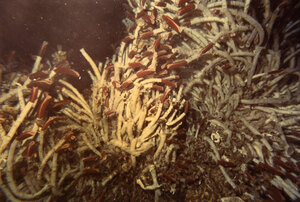
The Deep-Sea Find That Changed Biology by Rebecca Davis and Christopher Joyce

Saturday, December 3, 2011

Alabama Pilot's Nightmare in Shark-infested Waters May Help Save Coral Reefs

Twenty five years ago, on December 4, 1986, Walter Wyatt's plane crashed in the waters of Cay Sal Bank, a remote area between Cuba and The Bahamas. It sank almost immediately.

Walter, who now lives in Enterprise, Alabama, spent a night in the ocean fending off sharks, plugging holes in his leaking life vest, and hoping for a merciful end. The Coast Guard located and saved him the next morning and his harrowing experience made many headlines.

Now, a quarter-century later, his sunken plane has played an important part in a discovery that may help scientists better understand coral reef ecosystems.

In April, 2011, researchers from the Global Reef Expedition, a project of the Khaled bin Sultan Living Oceans Foundation, stumbled upon Walter's submerged twin-engine plane. That discovery shed light on the mysterious formation of perfectly circular "meadows" of seagrass.

The Seagrass circles range in diameter from a few dozen meters to hundreds of meters. Some are solid circles and others have a 'doughnut hole' in the middle. They are important to the health of coral reefs, because they provide vital nursery habitat and feeding areas to many animal species that live in and around reefs. But their round shape has been baffling.

Scientists from the Global Reef Expedition, a multi year research program to study and preserve coral reefs around the world, discovered filled in sink holes under the solid seagrass circles. And, in every doughnut shaped seagrass circle they found a synthetic object, including Walter Wyatt's plane.
Research suggests that phosphorous leaching from the sinkholes acts like a fertilizer for the solid circular seagrass beds above. And, for the doughnut shaped seagrass beds another kind of fertilizer is at work.

Underwater observations made during reef surveys revealed that Walter Wyatt's plane is acting as an artificial reef, providing safe harbor for many fishes and marine invertebrates. This "fertilizer," the researchers believe, is the waste excreted by the animals that make the reefs home.  To avoid predators, these creatures typically venture just a short distance from the safety of the reefs.  As a result, they fertilize a relatively narrow ring around the 'reef' or object.  It's in this circular ring where seagrass thrives.

The findings of the Global Reef Expedition will help the Bahamian government better manage Cay Sal Bank.  That should lead to improved protection of the coral reefs that are such a vital part of ocean environment.  That's good news for coral reefs in the western Atlantic Ocean, and for people everywhere.

Walter now feels that he benefited from his terrible misfortune. "It was a life-changing experience for me, and not entirely to the negative," he said.  "For one thing, I found out I wasn't the only being in the world.  I found out I was fragile."

As are coral reefs everywhere.

Thursday, December 1, 2011

EPA proposes standards for cleansing ship ballast water, leading pathway for invasive species


The Environmental Protection Agency proposed stricter requirements Wednesday for cleaning ballast water that keeps ships upright in rolling seas but enables invasive species to reach U.S. waters, where they have ravaged ecosystems and caused billions of dollars in economic losses.
The new standards would require commercial vessels to install technology strong enough to kill at least some of the fish, mussels and even microorganisms such as viruses that lurk in ballast water before it’s dumped into harbors after ships arrive in port. Environmentalists whose lawsuits forced the EPA to implement rules in the first place said the new proposal is largely inadequate.

More than 180 exotic species have invaded the Great Lakes, about two-thirds of which are believed to have been carried in ballast water. Among them are zebra and quagga mussels, which have spread across most of the lakes and turned up as far away as California. Ballast water also has brought invaders to ocean coasts, including Asian clams in San Francisco Bay and Japanese shore crabs on the Atlantic seaboard.

Ballast water regulation has been debated in Congress for years but no legislation has passed because of disagreements over how strict the cleanliness standards should be.

The EPA refused for years to set rules for ballast water under the Clean Water Act, but the agency was ordered to do so by federal courts after environmental groups sued. The agency issued an industry-wide permit in 2008 requiring shippers to exchange their millions of gallons of ballast water at sea or, if the tanks were empty, rinse them with salt water before entering U.S. territory. Environmentalists sued again, saying the requirement was too weak.

Monday, November 28, 2011


The Arctic Ocean and its adjacent seas are undergoing rapid environmental changes, most notably in the extent and duration of sea ice cover. However, the biological consequences of these changes and their impacts on humans remain poorly understood. For example, larger areas of open water and a longer production season are likely to increase primary production, but nutrient availability and increased storm events may limit any such increases. Changes in the abundance and spatial distribution of fish and mammals have been documented, but the ability of subarctic species to colonize new habitat in the Arctic, and the response of arctic species to an extended ice-free season, are highly uncertain. This symposium seeks to advance our understanding of present and future responses of arctic marine ecosystems to climate change at all trophic levels, from plankton to marine mammals. In addition to documenting and forecasting likely changes, we encourage contributions that focus on strategies for a proactive approach to managing living marine resources of the Arctic and for the successful adaptation of arctic people and their communities to these changing conditions.

Sunday, November 13, 2011

The Search for a Cancer Treatment


What is an immunologist doing in an oceanographic research vessel? Well, if one is lucky enough to work at the Biomedical and Biotechnology Research Group at Harbor Branch Oceanographic Institute, the answer is simple: collecting organisms that hold potential cures against cancer.

About 70 percent of medicines we routinely use have their origin in a natural product: they are either produced naturally, or were derived from a natural product. Given that the oceans cover ¾ of the earth, it makes perfect sense to look into the ocean richness for potential new drugs. The biological diversity of invertebrates and soft corals results in an equally amazing diversity of chemicals with the potential to cure human disease. Our group has been isolating these chemicals and testing them for about 26 years, taking advantage of the amazing tools we have: the RV Seward Johnson and the unparalleled, manned submersibles, the Johnson-Sea-Links, which can reach depths of up to 3,000 ft and has unique collecting capabilities.

Today’s dive has Dr. Amy Wright, our director, and me very excited. In our search to find potential therapeutics useful in the fight against pancreatic cancer, we identified an organism that holds a compound that looks very promising. This dive will give us the chance to recollect the organism, so that we can continue our research on this very promising compound and confirm its potential.
Read more @ CIOERT