Showing posts with label Weather. Show all posts

Thursday, October 18, 2012

UK Experiences ‘Weirdest’ Weather


The UK has just experienced its “weirdest” weather on record, scientists have confirmed.
The driest spring for over a century gave way to the wettest recorded April to June in a dramatic turnaround never documented before.
The scientists said there was no evidence of a link to manmade climate change.
But they say we must now plan for periodic swings of drought conditions and flooding.
The warning came from the Environment Agency, Met Office and Centre for Ecology & Hydrology (CEH) at a joint briefing in London.
Terry Marsh from the CEH said there was no close modern precedent for the extraordinary switch in river flows. The nearest comparison was 1903 but this year was, he said, truly remarkable.
What was also remarkable – and also fortunate – was that more people did not suffer from flooding. Indeed, one major message of the briefing was that society has been steadily increasing its resilience to floods.
Paul Mustow, head of flood management at the Environment Agency, told BBC News that 4,500 properties were flooded this year. “But if you look back to 2007 when over 55,000 properties were flooded we were relatively lucky – if lucky is the right word – for the impacts we saw this summer,” he said.
“The rainfall patterns affected different areas – and also there were periods of respite between the rain which lessened the impact.”
Fast moving
He said 53,000 properties would have been flooded this year without flood defences. In total, he said, 190,000 properties had received flood protection in recent years.
Mr Mustow claimed that flood defences repaid their investment by a factor of 8-1 but admitted that continuing to invest would be a “challenge”, after government cuts to planned projects.
But he said that new streams of joint funding from local authorities and private developers had allowed 60 schemes to happen that otherwise would not have gone ahead.
He said: “We have to get our heads round the possibility now that we’re going to have to move very quickly from drought to flood – with river levels very high and very low over a short period of time.
“We used to say we had a traditional flood season in winter – now often it’s in summer. This is an integrated problem – there’s no one thing that going to solve it. The situation is changing all the time.”
But scientists present from the Met Office and CEH said not much could be read into the weird weather. Terry Marsh from CEH said: “Rainfall charts show no compelling long-term trend – the annual precipitation table shows lots of variability.”
Sarah Jackson from the Met Office confirmed that they did not discern any pattern that suggested manmade climate change was at play in UK rainfall – although if temperatures rise as projected in future, that would lead to warmer air being able to carry more moisture to fall as rain.
She said that this year’s conditions were partly caused by a move to a negative phase of the North Atlantic Oscillation which would be likely to lead to more frequent cold drier winters – like the 1960s – and also wetter summers for 10-20 years.
“Longer term we will see a trend to drier summers but superimposed on that we will always see natural variability,” she said.
Whatever happens with the weather, the Environment Agency expects that more and more people will be protected from floods and droughts thanks to water sharing between farmers, water transfer between water companies, and better management of leaks and demand.
But Mr Mustow admitted that much more needed to be done to ensure that farmers didn’t increase flood risk with land drainage schemes and that developers and builders ensured that new developments allowed water to drain into the soil rather than flushing into the sewers.


Friday, October 12, 2012

Global Warming May Shift Summer Weather Patterns


By altering the heat balance between land and sea, manmade global warming may be altering summer weather patterns in the Northern Hemisphere, a new study found. The study, published on Sept. 30 in Nature Geoscience, shows that the sprawling high pressure areas that set up shop over the Western North Atlantic and North Pacific Oceans during the summer months have become larger and stronger during the past 40 years, and these trends are likely to continue during the next several decades as temperatures increase.
These changing weather patterns could have far-reaching impacts, from redirecting powerful hurricanes toward the East Coast, to making the Southeast and Central states see-saw more frequently between extremely hot and dry summers and cooler, wetter summers. In addition, a shift in the strength and shape of the North Pacific subtropical high could affect the South Asian Monsoon, which is already being altered by warming and increased regional pollution. 
The study does not formally attribute the cause of the recent trends, but says that the future changes will most likely be driven by global warming.
Although highs (the big "H" symbols on your local TV weathercast) are typically associated with pleasant weather, the position and shape of these systems shape large-scale weather patterns, helping to determine the locations of subtropical deserts. More importantly for the U.S., they help steer the most powerful storms on Earth, and modulate rainfall amounts in the Central, Southeast, and Mid-Atlantic states.
The Atlantic subtropical high, more commonly known as the “Bermuda High” because of its semi-permanent location near that Western Atlantic island during the summer months, helps determine whether Atlantic hurricanes recurve harmlessly out to sea before reaching the East Coast, or make landfall with potentially devastating impacts.
Hurricanes tend to skirt around the edges of the high by catching a ride on the clockwise flow of air around the periphery.
The Bermuda High also helps draw warm and humid air up the Eastern seaboard, contributing to some of the most intense heatwaves on record.
The study, which relies on climate model simulations as well as weather data for the past 40 years, shows that the Bermuda High has already expanded westward, which could be making summertime rainfall in the Central and Southeast U.S. much more variable.
“The intensification and westward movement of the subtropical highs may cause more landfalling hurricanes/typhoons and cause more intense Southeast U.S. rainfall variability, leading to more extreme events in the[se] regions,” said coauthor Mingfang Ting of Columbia University in an email conversation.
2010 study published in theJournal of Climate found that a westward shift in the Bermuda High helped cause a marked increase in the frequency of summers with “strongly anomalous precipitation” in the Southeast. Recent summers have seen dramatic flips between punishing droughts and severe flooding in states such as Georgia, for example.
According to the research of Ting and her colleagues, the sharpened temperature contrast between land areas and the oceans, which is related to manmade global warming, is the main mechanism behind the intensifying and expanding Highs.
“... In the future warming scenario, we show that this pattern is intensifying, and land and ocean heat contrasts are intensifying. This leads to the intensification of the anticyclones,” Ting said.
In the Pacific, the consequences of the intensifying and expanding subtropical high could be just as serious, considering that the high helps regulate the South Asian Monsoon season, which provides vital water for irrigating crops.


Tuesday, October 9, 2012

Warm North Atlantic Ocean Causing UK's Wet Summers


The UK's dismal recent summers can be blamed on a substantial warming of the North Atlantic Ocean in the late 1990s, according to new scientific research. The shift has resulted in rain-soaked weathersystems being driven into northern Europe, increasing summer rainfall by about a third.
The pattern is likely to revert to drier summers and may do so suddenly, according to Prof Rowan Sutton, at the University of Reading, who led the work. "I can't guarantee it but it is likely," he said. "However we are not sure of the timing, which is what every one wants to know – but we are working on this now." Sutton added that when the switch occurs, it could happen as rapidly as over two to three years.
The summer of 2012 was the wettest in a century and follows a series of above average years for summer rainfall. Sutton's team, who published their study in Nature Geoscience, examined over a century of data and found that the temperature of the North Atlantic remains above or below the long term average for decades at a time. The periods of warmer temperature, the latest of which started in the late 1990s, were found to correlate with wet summers in Northern Europe and hotter, drier summers in the Mediterranean. The team used existing detailed climate simulations to demonstrate a causal link between the warmer oceans and the change in the weather.
Sutton said these shifts have been occurring for many hundreds of years, but that global warming was also having an impact. "It is not now purely natural or purely a manifestation of human-induced climate change," he said. "There is lot of evidence to show that climate change is changing the timing and amplitude of the temperature changes." For example, he said, the cooler period from the 1960s to the 1980s occurred when soot and other pollution from dirty power stations cooled the planet.
The previous North Atlantic warm phase, which ran from the 1930s to the 1950s, also saw a run of wet summers in the UK, including severe flooding in August 1948, which closed the east coast mainline railway for three months, and the Lynmouth floods in August 1952 in which 34 people died.
The warming of the North Atlantic has been one reason for the record low in Arctic sea ice this summer. It is possible that the shrinking of thesea ice is also contributing to poor summers in the UK, as the exposed ocean waters warm in the sun. However, Sutton said that this remains to be proven by scientific work that is now underway.
The warm and cold swings in the North Atlantic affect temperatures, rain and winds across Europe, Africa and North and South America, and previous research indicates they are related to changes in ocean circulation. Other research at Reading University has suggested that it may in future be possible to predict the warming and cooling cycles some years ahead.


Tuesday, October 2, 2012

Can the World Save Lives and Combat Climate Change?

                             An innovative effort in western Kenya is attempting to provide clean water as well as reductions in the emissions of greenhouse gases.


Environmental, humanitarian and economic challenges do not exist in isolation, but that is how the world most often deals with them. To take just one example: one of the key challenges facing cities around the globe in the 21st century is flooding. Flooding is determined by environmental factors, from climate change to overcrowding of floodplains with habitation. Flooding is also often a humanitarian disaster when it strikes and can be an aftereffect of big development projects, like hydroelectric dams.
Or take the metals in a cell phone. As Judith Rodin, president of the philanthropic Rockefeller Foundation, noted at her organization's event about "resilient livelihoods" on September 25, tungsten is the "metal that puts the buzz in your cell phone." Mining that tungsten is an economic development opportunity but also too often creates a humanitarian crisis when such economically valuable minerals become a source of conflict—as has been the case in the eastern Congo. At the same time, the mining practices used to extract such metals can be more or less bad for the environment and human health.
The U.N. buzz phrase of the last decade—"sustainable development"—is slowly morphing into a new sustainable buzzword for the development and humanitarian communities: resilience. Resilience means, at its core, an ability to bounce back fromstress in a healthy way, Rodin said. But, as development expert Edward Carr of the University of South Carolina rightly notes, resilience of what, to what? Enabling the poor to be resilient in the face of challenges like climate change may require a fundamental rethinking of the methods used to address both poverty and global warming.
After all, poverty and climate change are inextricably linked: The developed world has progressed, thanks to fossil fuels, and burning them has resulted in the elevated levels of greenhouse gases in the atmosphere trapping heat, raising global temperatures and spawning weird weather. To resolve the energy poverty of billions will likely require burning more fossil fuels, but preventing catastrophic climate change definitely requires reducing concentrations of atmospheric greenhouse gas. "You cannot tackle one without the other," Rodin noted.
Thus far, despite some recent success in reducing poverty thanks to rising living standards in China, the world has mostly failed to truly tackle either. Although drought in the Horn of Africa is predictable and cyclical even under the present climate, famine still stalks the region. "To have drought at the level of 2011 and no deaths in Ethiopia? That was progress," argued Ertharin Cousin, executive director of the United Nations World Food Programme at the Rockefeller event. Yet, thousands perished of starvation throughout the region and populations in Somalia, Kenya and elsewhere remain reliant on aid—a decades-long failure that also encompasses civil war and political instability. "How do you eventually graduate from aid?" asks Mikkel Vestergaard Frandsen, CEO of Vestergaard Frandsen, a Denmark-based company that makes disease-control products.
Plus, "we are not winning the war on hunger. We are losing it," argued European Union Commissioner Kristalina Georgieva at the Rockefeller event. One of the big reasons that levels of hunger have started to grow again is the impact of climate change—variable weather means variable harvests whereas programs to reduce the greenhouse gas emissions of cars have ended up taking away food to make biofuelslike ethanol. The lack of investment in agricultural innovation and the devastating impact of food aid on local farmers hasn't helped either. "Yes, we feed the hungry but we kill the farmers," Georgieva noted. Or, as food security specialist Amadou Diallo of the government of Niger said: "The basis of peace is food security." When people lack food, they turn to rebellion or terrorism.
Switching from food to cash grants except in those cases where food cannot be provided locally may be the key, argued Degan Ali of Adeso, an advocacy group for development in Africa, at the Rockefeller event. Such "flexible interventions" give the poor the ability to invest in their homes and villages rather than abandon everything and become permanent refugees.
In fact, one of the goals of humanitarian assistance now is preventative: keep people home rather than trekking to refugee camps, argued Rajiv Shah, administrator of the U.S. Agency for International Development, at the event. Interventions that have been proved to work in that regard are as simple as selling off livestock or providing fodder for lactating goats. These ideas "solve the problem in a far more fundamental manner than rushing in with food aid," Shah argued—a fact that has been born out in academic research for the past several decades.
At the same time, the world will continue to urbanize, as one-time villagers abandon everything and move to the city for a better life. That may improve economic circumstances but it also tends to increase the impact of natural disasters. Floods are more devastating, thanks to migrant villagers building in neglected floodplains or other undesirable areas.
So finding new ways to fund environmental improvement and economic development at the same time will be crucial. And a new project in western Kenya may provide an all too unique example of how the two might be linked.
Life saver?
The LifeStraw is a plastic tube with a hollow-fiber membrane tucked inside. The membrane filters out bacteria, particles, viruses and other nasty stuff from freshwater, making it safe for drinking according to both U.S. Environmental Protection Agency and World Health Organization standards. That is no small thing in the all too many parts of the world where there is no guarantee that drinking waterwill not induce illness. All told, nearly one billion people worldwide lack access to such safe drinking water—a long-standing humanitarian crisis.
More than 870,000 households in western Kenya now have family-size capacity versions of these straws, part of a program to deliver, maintain and make sure such potentially life-saving technology is used. And this humanitarian program is funded byselling carbon dioxide emission reductions.
What's the connection between CO2 and humanitarian aid? One word: firewood. In the absence of the LifeStraw, these Kenyan families must boil their water to ensure its safety. To do so, they must gather extra firewood (more than that they would need just for cooking), which spurs both bigger the cutting down of trees as well as times when such critical safety practices have to be skipped due to a lack of resources. Skipping even one day of safe drinking water can mean a health disaster. "It's not a vaccine. You can't relax and stop using it," Vestergaard Frandsen says. As it stands, more than 1.5 million children die of diarrheal disease annually around the world, mostly due to bad drinking water.
In order to generate its 2.7 million metric tons worth of verified emission reductions to date, the LifeStraw effort sends field workers out every six months to ensure the technology is both working and being used—and have committed to keep doing so for a decade. Already, according to the company, they are "seeing a statistically significant reduction in the odds of a child under five presenting at a clinic with diarrhea," Vestergaard Frandsen says. Each LifeStraw can filter at least 18,000 liters—enough to supply a family of four for three years with their clean drinking water needs.
The carbon credits fetch between $11.50 and $14 per metric ton, generating at least $30 million for the project. But such a charismatic carbon project is all too rare these days, both because the carbon market is dominated by less robust emission reductions from heavy industry in China and India as well as development efforts that proceed with little thought of the environmental cost or co-benefits. At present, there is simply no way to scale up such innovative efforts because there is no larger market for such "premium" credits as well as no interest from aid agencies. "In development aid, we give upfront dollars and start hoping," Vestergaard Frandsen notes. In order to solve environmental and economic problems, that has to change.


Sunday, September 30, 2012

Water, Water Everywhere!


Coming in to land at Yola airport, I was simply struck by the sheer magnitude of devastation to the surrounding communities from the quadruple threat of a more than average heavy and persistent rainfall compounded by the release of water from Kiri and Lagdo dam in Cameroon, and then River Benue overflowing its banks.  

I lost count of the number of houses that only had protruding roofs. The devastation was heart wrenching. The impact on the affected lives is unquantifiable.
Our communities are on the path of environmental annihilation. This scene has been repeated from Imo State where roads have simply been eroded cutting off the governor who could not get to his village to assess damage, to Edo state with at least 20 communities affected and approximately ten thousand people made homeless, to the closure of Abuja –Lokoja road due to river Niger overflowing its banks and submerging  bordering communities and huge tracts of farmland, to Cross River with devastation across 49 villages  displacing over 12,000 citizens and destroying valuable farmland, and in Taraba with over 13,000 displaced persons in 30 communities.
The stories are all the same. All are affected in one way or the other. This has been the worst in over three decades especially as our two main rivers appear not to be fortified to withstand heavy rains. The President we are told has asked the Ministers of Environment and Works to shift base and move to the affected communities. Let us hope it is not too late and their presence makes a difference and most importantly, they have the resources to tackle the problems.
Fundamentally though, Nigeria has had a higher than average rainfall this year and it appears we are yet again not ready and certainly caught napping.  The Nigeria Meteorological Agency had gone on an advocacy warning of the impending rains and flooding but it appears their message did not get through to the population even as it was done in local languages.
Is it us as a people who are not prepared or the various state governments that are not doing their jobs? In the case of the North-eastern states, the Nigeria Emergency Management Agency (NEMA) came out to defend its position under the Nigeria-Cameroon Bilateral Commission, and felt its job had been done prior to the release of excess water thereby passing the buck to the state governments. The state governments did not take action. Some cynics will say state governments are hoping the flooding will occur so they get extra funding from the centre. I pray this is not the case. 
The citizenry on its part is perhaps not aware of the inherent dangers of building houses on low lying plains due to a lack of understanding, and see the land as their friend. Driving between Yola and Jalingo for instance, there are numerous NEMA signs indicating flood plains and areas peoples should avoid, but it still did not prevent people dying from flooding.
It is important that citizens also take personal responsibility for their inability to act. We saw how poverty prevented many citizens in New Orleans in 2005 from fleeing from Hurricane Katrina despite it being a category five and a one week warning. The point is, where will they go and who will protect their property?
Like any country, Nigeria has its fair share of government agencies that are directly responsible for these problems. Funds of course will always be a problem, but an urgent advocacy drive would be useful.
So what can we all do to avoid future devastation? Our monthly environmental exercise needs a rethink. It is lacklustre and no one really knows its purpose. The FCT has gone as far as eliminating it totally. I am an advocate of community involvement from the local level. Our local leaders must know their environs and understand what they are prone to and hopefully educate their followers on that.
Simple things like decongesting drainages, picking litter, planting trees, recycling rubbish, demarcating land properly and clearly identifying danger zones, not building on reclaimed land or on Fadama areas, allowing rivers to follow their natural tributaries will help.
It is a collective effort and not that of government alone. We the people must take responsibility in our immediate communities to ensure that we come together to avert future crises. We cannot continue to lament when the obvious is staring us in the face. If we respect nature and live in harmony with it, we will live with water everywhere but not in our front rooms.


Wednesday, September 26, 2012

24 HOURS OF REALITY: The Dirty Weather Report

Al Gore announces 24 Hours of Reality: The Dirty Weather Report at Mashable’s Social Good Summit.

NOVEMBER 14-15, 2012

A lot can change in a day. This November 14, we hope you can help us make big change happen.
Join The Climate Reality Project for 24 Hours of Reality: The Dirty Weather Report. This will be our second annual, online event showing how global climate change is connected to the extreme weather we experience in our daily lives. The entire 24-hour event will be broadcast live over the Internet.
We’ll move between our home studio in New York City and into each region of the world, bringing voices, news and multimedia content across all 24 time zones. We’ll feature videos from around the globe, man-on-the-street reports, music, and most importantly, stories from communities moving forward with solutions.
Most of all, we’ll generate new energy and urgency around the fact that we must — and we can — work together to address the climate crisis.

GET INVOLVED

Sign up today to be a part of the global community taking part in 24 Hours of Reality.RSVP on Facebook. Share this event with your friends. Submit your own videoabout the impacts of climate change where you live. And keep checking this page: We’ll post further details as the event draws closer.


climaterealityproject.org

Sunday, September 16, 2012

Why Algorithms Need Humans to Predict the Weather


History is rich with intellectuals who have revered theories of determinism; ideas that suggest if we could only know every facet of a situation, every molecule of the landscape, we could predict and even shape future political, economic, and cultural outcomes.
But when it comes to the weather, forecasters long ago gave up any hope of cataloging all of the variables that could impact rainfall in Seattle, or the arrival of a cold front in New York. At least that’s what Nate Silver reports in his new book, The Signal and the Noise: Why So Many Predictions Fail — but Some Don’t, an excerpt of which was adapted for a recent article in The New York Times Magazine.
If you go by Silver’s account, weather forecasting is something of a dark art. Despite all of the measurements, modeling, and statistical analyses, the weather business relies as much on human insight as it does on computer programming. This is best evidenced by the National Weather Service’s own historical records. According to the agency’s data, a combination of human and computing power creates the most accurate weather forecasts. People improve accuracy levels for precipitation and temperature forecasts by about 25 percent and 10 percent respectively over forecasts done by computers alone.
In other words, the algorithms haven’t bested us yet.
Even as modern futurists envision a time when computers will out-think people, it turns out that there may always be a role for the human mind. In weather forecasting, even the most sophisticated computer modeling systems disagree with each other all the time. It’s up to the people studying those models to illuminate nuance and apply additional context; whether that means knowing how best to weight the variables that determine where a storm is headed, or that morning fog in the northeast tends to dissipate quickly when the wind is blowing in a particular direction.
As powerful as computers are, they can’t “see” everything. And they’re not necessarily as good as humans at knowing when and where to look for more information. Our obsession with big data, and the quantification of industries - financeadvertisingspace - can sometimes blind us to the fact that human perception and insight, fuzzy and imprecise though they may be, are still critical to society’s progress. Maybe in the future they’ll laugh at our fixation with numbers. Or maybe they’ll simply recognize better than we seem to that numbers are only part of the equation.

Saturday, September 15, 2012

International Flash Flood Project in Europe


NOAA, NASA and the University of Connecticut are representing the United States in theHydrological Cycle in the Mediterranean Experiment (HyMeX), the largest weather field research project in European history.   
HyMex is a 10-year international effort to better understand, quantify and model the hydrologic cycle in support of improved forecasts and warnings of flash floods in the Mediterranean region.
The project targets central Italy, southern France, the Balearic Islands, Corsica and northern Italy — all areas particularly susceptible to devastating flash flood events. Improved understanding of the land, atmosphere and ocean interactions that contribute to flash flooding in this part of the world will advance the state of the science that will ultimately be represented in forecast models with application in the United States.

NOAA National Severe Storms Laboratory (NSSL) researchers will operate a mobile radar, NOAA - XPol (NOXP), in southeast France from Sept. 10 to Nov. 10. This is the first of several special observation periods during the HyMeX 10-year timeframe. Additionally, NOAA’s Satellite and Information Service is sponsoring scientists from New Mexico Tech to operate and evaluate a Lightning Mapping Array during HyMeX to support product development and validation for the future Geostationary Lightning Mapper on NOAA’s GOES-R satellite, which is scheduled to launch in late 2015.
The radar will provide high-resolution data and low altitude scans to help determine the size of the raindrops, the intensity of rainfall, and rainfall rates to help predict flash flooding conditions in the Cévennes Vivarais region of France. 
During autumn, onshore moisture from the Mediterranean Sea encounters the 5,000-feet high Cévennes Mountains in southeast France making numerous towns and villages particularly subject to severe flash flood events.

“Data collected in the air, at sea and on land will shed light on how catastrophic flash-flooding events begin, which may help local officials better prepare for and respond to these types of emergencies,” said Jonathan Gourley, Ph.D., an NSSL research hydrologist.
Other sensors include three instrumented research aircraft, three research ships, buoys, ocean sensors, additional mobile precipitation radars, cloud radars and microradars, hundreds of rain gauges, ten disdrometers (to measure size and speed of individual raindrops), a dozen lidars, sonar, instrumented balloons, wind profilers, and a lightning mapping array.

NSSL’s participation in HyMeX is sponsored by MétéoFrance, and operations are coordinated with the Cévennes-Vivarais Mediterranean Hydro-Meteorological Observatory, The University of Grenoble, NASA, University of Connecticut and Cemagraf.

Friday, September 14, 2012

‘Astonishing’ Ice Melt May Lead to More Extreme Winters

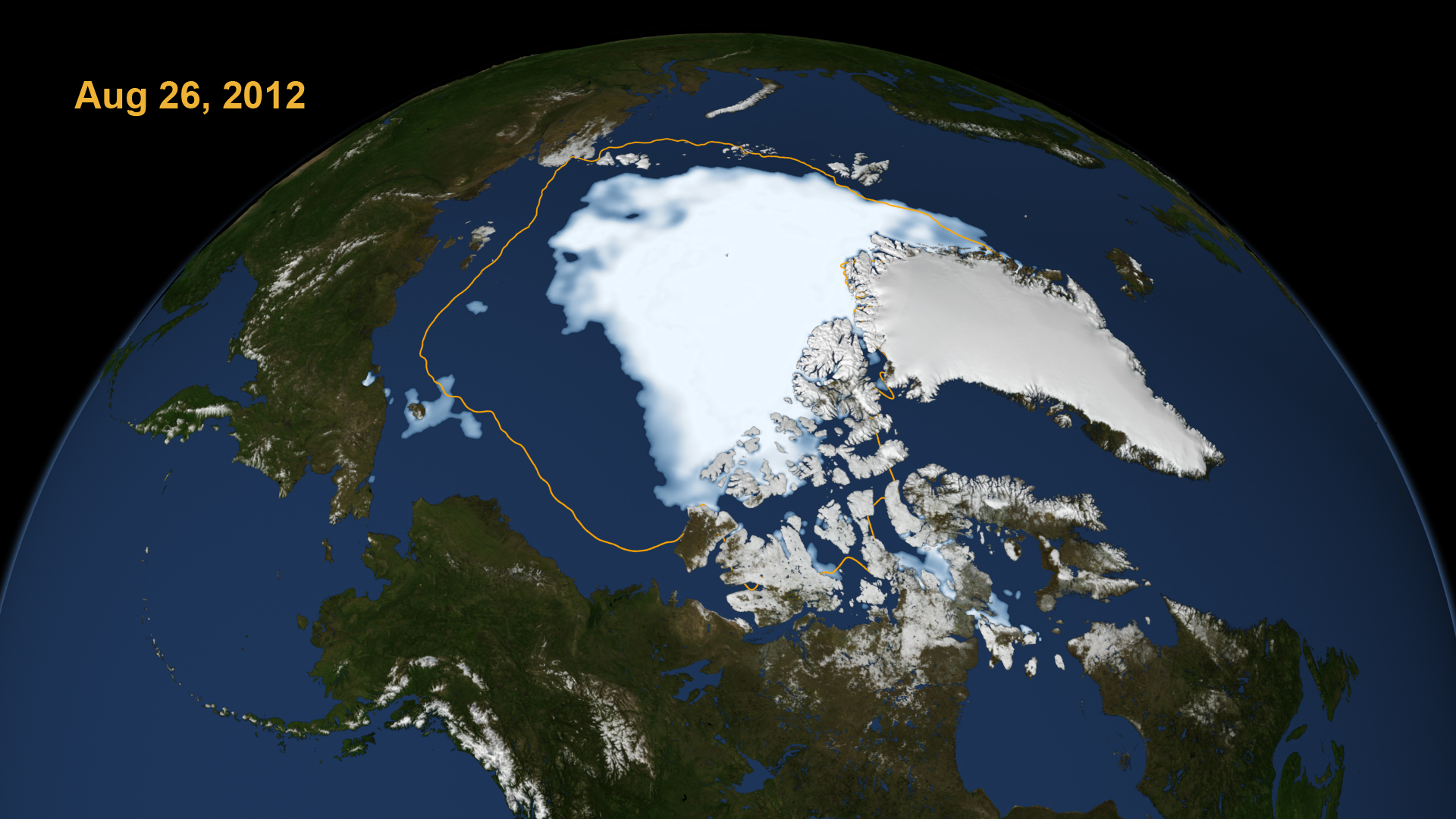
The extent of Arctic sea ice on Aug. 26, 2012, the day the sea ice dipped to its smallest extent ever recorded in more than three decades of satellite measurements. 
The line on the image shows the average minimum extent from the period covering 1979-2010. Click on the image for a larger version. Credit: NASA/JPL.
The record loss of Arctic sea ice this summer will echo throughout the weather patterns affecting the U.S. and Europe this winter, climate scientists said on Wednesday, since added heat in the Arctic influences the jet stream and may make extreme weather and climate events more likely.

The “astounding” loss of sea ice this year is adding a huge amount of heat to the Arctic Ocean and the atmosphere, said Jennifer Francis, an atmospheric scientist at Rutgers University in New Jersey. “It’s like having a new energy source for the atmosphere.” Francis was one of three scientists on a conference call Wednesday to discuss the ramifications of sea ice loss for areas outside the Arctic. The call was hosted by Climate Nexus.


On August 26, Arctic sea ice extent broke the record low set in 2007, and it has continued to decline since, dropping below 1.5 million square miles. That represents a 45 percent reduction in the area covered by sea ice compared to the 1980s and 1990s, according to the National Snow and Ice Data Center (NSIDC), and may be unprecedented in human history. The extent of sea ice that melted so far this year is equivalent to the size of Canada and Alaska combined.
The loss of sea ice initiates a feedback loop known as Arctic amplification. As sea ice melts, it exposes darker ocean waters to incoming solar radiation. The ocean then absorbs far more energy than had been the case when the brightly colored sea ice was present, and this increases water and air temperatures, thereby melting even more sea ice.
Peter Wadhams, the head of the polar ocean physics group at the University of Cambridge in the U.K., told BBC News on September 6 that the added heat from sea ice loss is equivalent to the warming from 20 years of carbon dioxide emissions. Carbon dioxide is the main greenhouse gas that is causing manmade global warming.
During the fall, when the sun sets once again and the Arctic Ocean begins to refreeze, the heat in the ocean gets released back into the atmosphere. Since the jet stream, which is a corridor of strong winds at upper levels of the atmosphere that generally blows from west to east across the northern mid-latitudes, is powered by the temperature difference between the Arctic and areas farther south, any alteration of that temperature difference is bound to alter the jet stream — with potentially profound implications. It just so happens that the jet stream steers day-to-day weather systems.
Francis published a study last year in which she showed that Arctic warming might already be causing the jet stream to become more amplified in a north-south direction. In other words, the fall and winter jet stream may be getting wavier. A more topsy-turvy jet stream can yield more extreme weather events, Francis said, because weather and climate extremes are often associated with large undulations in the jet stream that can take a long time to dissipate.
“We know that certain types of extreme weather events are related to weather that takes a long time to change,” Francis said.
While there are indications that the jet stream is slowing and may be more prone to making huge dips, or “troughs,” scientists have a limited ability to pinpoint how this will play out in the coming winter season.
“The locations of those waves really depends on other factors,” Francis said, such as El Niño and a natural climate pattern known as the Arctic Oscillation. “I can only say that it’s probably going to be a very interesting winter,” she said.
Francis’ work has linked Arctic warming to the unusually cold and snowy winters of 2009-10 and 2010-11, during which the U.S. East Coast and parts of Europe were pummeled by fierce winter storms and experienced cooler-than-average conditions. The winter of 2011-12 was much milder, by comparison, but Francis said it, too, was consistent with her research. Not all meteorologists agree on the Arctic connection theory, but that may change with time.
Jim Overland, an oceanographer at NOAA's Pacific Marine Environmental Laboratory, said the inconsistency of the past three winters doesn’t mean the Arctic connection hypothesis is invalid.
“People like direct causality, [the notion that] if you lose the ice every year it will cause the same effect,” Overland said. But the chaotic nature of the atmosphere means that all that scientists can say with a high degree of confidence is that “the number of [extreme] events somewhere are destined to increase” as a result of rapid Arctic climate change, Overland said.


Thursday, September 6, 2012

Weathergirl Goes Off Script, Mentions Science :-))

Pippa the weathergirl goes off script and drops some science instead of the usual barbeque forecast:

Yes, there is more sea ice missing now than there is ice remaining. It’s in a “death spiral”, scientists are saying:
This picture from NASA shows the current extent of Arctic sea ice. The line shows the averageminimum extent from 1979 to 2010.

Source: NASA Goddard Flight Centre
If this truth-telling leaves you in despair and feeling hopeless, you’re not alone (“The Six Stages Of Climate Grief“). But recognizing there is a problem, as T.V.’s Dr Phil likes to say, is only the start. The sixth stage of climate grief that Ms. Wysham talks about is action. I’m living proof that action is a surefire antidote to climate trauma and despair. This is our generation’s “Great Work” – let’s get to it!
If you’re ready to embrace the “The Work” but aren’t sure where to turn, check out Citizens Climate Lobby, a grassroots group focused on creating the political will for a sustainable climate as well as empowering individuals to claim their personal and political power. You might also be interested in the approach that the Transition Network takes, which is focused on preparing communities for the twin challenges of peak oil and climate change by becoming more resilient.

Saturday, September 1, 2012

Agricultural Weather and Drought Update


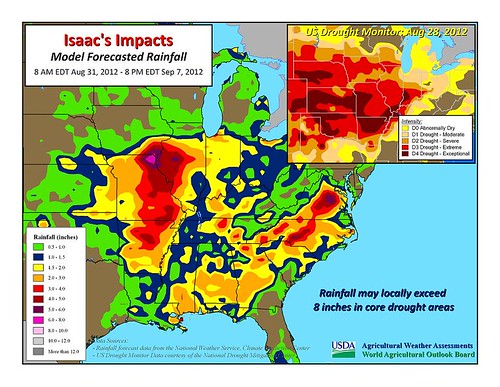
Isaac's Impacts: Model Forecasted Rainfall, August 31, 2012
Isaac's Impacts: Model Forecasted Rainfall, August 31, 2012. Click to enlarge image.
Visit www.usda.gov/drought for the latest information regarding USDA’s Drought Disaster response and assistance.
Hurricane Isaac has grabbed most of the weather headlines in recent days, but drought remains deeply entrenched across nearly two-thirds of the continental United States.  According to the latest U.S. Drought Monitor, dated August 28, drought covered 62.9% of the Lower 48 states, down only slightly from a peak of 63.9% on July 24.  However, during the five-week period from July 24 to August 28, the portion of the country in exceptional drought (D4) increased from 2.4 to 6.0%.
In fact, hot weather in recent days across the central and northern Great Plains has caused further deterioration in pasture conditions.  According to USDA’s National Agricultural Statistics Service, at least half of the rangeland and pastures were rated in very poor to poor condition on August 26 in every Great Plains state (from Texas to Montana and North Dakota).  Overall, twenty states – from California to Ohio – are reporting at least 50% of their rangeland and pastures in very poor to poor condition.  The list is topped by Missouri (99% very poor to poor), Nebraska (95%), Kansas (92%), and Illinois (90%).
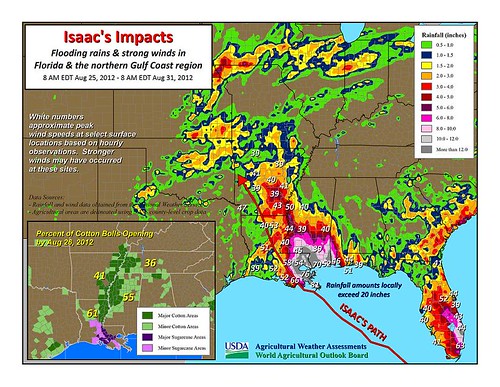
Isaac's Impacts: flooding rains and strong winds in Florida and the northern Gulf Coast region, August 31, 2012
Isaac's Impacts: flooding rains and strong winds in Florida and the northern Gulf Coast region, August 31, 2012. Click to enlarge image.
The good news for Missouri and Illinois is that heavy rainfall associated with Isaac’s remnant circulation is spreading across the southern Corn Belt.  By mid-day Friday, August 31, Tropical Depression Isaac was centered over northwestern Arkansas, drifting northward.  Maximum sustained winds have diminished to 25 mph.  During the Labor Day weekend, Isaac’s remnants will turn eastward across the middle Mississippi Valley and the lower Midwest.  Additional rainfall could reach 2 to 6 inches or more from the Mid-South into the eastern Corn Belt, where positive impacts of Isaac’s rainfall will include pasture recovery and replenishment of soil moisture in preparation for the soft red winter wheat planting season.
As Isaac continues to decay over land, flooding will remain the primary threat.  Indeed, significant lowland flooding persists in the central Gulf Coast region, including southeastern Louisiana and southern Mississippi, where as much as 10 to 20 inches of rain fell.  Although steady rainfall has ended in the areas hardest-hit by flooding, locally heavy showers persist.  According to information provided by the National Weather Service and the U.S. Geological Survey, record-high water levels were established in a few river basins, including East Hobolochitto Creek near Caesar, Mississippi.  Elsewhere in Mississippi, the Bogue Chitto River near Tylertown climbed nearly 15 feet above flood stage on August 31 – the highest water level in that location since February 2003.  Similarly, the Tangipahoa River near Kentwood, Louisiana, crested almost four feet above flood stage on August 31, less than eight inches below the high-water mark of 4.5 feet above flood stage established on January 25, 1990.
In Isaac’s wake, agricultural impact assessments are getting underway across the central Gulf Coast region, which was most heavily affected by Isaac’s rain, wind, and coastal storm surge.  Updated information will be available next week, when USDA/NASS will release updated crop progress and condition statistics on Tuesday, September 4 at 4:00 pm EDT.  Crops to watch include cotton and rice.  In the lower Mississippi Valley, some of the cotton crop was hit by torrential rainfall and tropical storm-force wind gusts (39 mph or greater).  Before Isaac hit, Delta cotton in the vulnerable open-boll stage of development ranged from 32% open on August 26 in Missouri to 61% in Louisiana.  Meanwhile, the Delta rice harvest had begun in the days before Isaac hit.  By August 26, the rice harvest ranged from 6% complete in Missouri to 71% finished in Louisiana.  Rice still in the field may have been susceptible to being lodged, or knocked down, by rain and wind.

Monday, August 27, 2012

Climate System Versus Weather: Extreme Events Narrow the Doubts

Heatwaves, drought and floods that have struck the northern hemisphere for the third summer running are narrowing doubts that man-made warming is disrupting Earth's climate system, say some scientists. 

Climate experts as a group are reluctant to ascribe a single extreme event or season to global warming. 

Weather, they argue, has to be assessed over far longer periods to confirm a shift in the climate and whether natural factors or fossil-fuel emissions are the cause. 

But for some, such caution is easing. 

A lengthening string of brutal weather events is going hand in hand with record-breaking rises in temperatures and greenhouse-gas levels, an association so stark that it can no longer be dismissed as statistical coincidence, they say. 

"We prefer to look at average annual temperatures on a global scale, rather than extreme temperatures," said Jean Jouzel, vice chairman of the UN's Nobel-winning scientists, the Intergovernmental Panel on Climate Change (IPCC). 

Even so, according to computer models, "over the medium and long term, one of the clearest signs of climate change is a rise in the frequency of heatwaves", he said. 

"Over the last 50 years, we have seen that as warming progresses, heatwaves are becoming more and more frequent," Jouzel said. 

"If we don't do anything, the risk of a heatwave occurring will be 10 times higher by 2100 compared with the start of the century." 

The past three months have seen some extraordinary weather in the United States, Europe and East and Southeast Asia. 

The worst drought in more than 50 years hit the US Midwest breadbasket while forest fires stoked by fierce heat and dry undergrowth erupted in California, France, Greece, Italy, Croatia and Spain. 

Heavy rains flooded Manila and Beijing and China's eastern coast was hit by an unprecedented three typhoons in a week. 

Last month was the warmest ever recorded for land in the northern hemisphere and a record high for the contiguous United States, according to the US National Oceanic and Atmospheric Administration (NOAA). 

Globally, the temperature in July was the fourth highest since records began in 1880, it said. 

James Hansen, arguably the world's most famous climate scientist (and a bogeyman to climate skeptics), contends the link between extreme heat events and global warming is now all but irrefutable. 

The evidence, he says, comes not from computer simulations but from weather observations themselves. 

In a study published this month in the peer-reviewed US journal Proceedings of the National Academy of Sciences (PNAS), Hansen and colleagues compared temperatures over the past three decades to a baseline of 1951-80, a period of relative stability. 

Over the last 30 years, there was 0.5-0.6 C (0.9-1.0 F) of warming, a rise that seems small but "is already having important effects", said Hansen, director of NASA's Goddard Institute for Space Studies. 

During the baseline period, cold summers occurred about a third of the time, but this fell to about 10 percent in the 30-year period that followed. 

Hot summers which during the baseline period occurred 33 percent of the time, rose to about 75 percent in the three decades that followed. 

Even more remarkable, though, was the geographical expansion of heatwaves. 

During the baseline period, an unusually hot summer would yield a heatwave that would cover just a few tenths of one percent of the world's land area. 

Today, though, an above-the-norm summer causes heatwaves that in total affect about 10 percent of the land surface. 

"The extreme summer climate anomalies in Texas in 2011, in Moscow in 2010 and in France in 2003 almost certainly would not have occurred in the absence of global warming with its resulting shift of the anomaly situation," says the paper. 

In March, an IPCC special report said there was mounting evidence of a shift in patterns of extreme events in some regions, including more intense and longer droughts and rainfall. But it saw no increases in the frequency, length or severity of tropical storms. 


Agence France-Presse