Showing posts with label Rain. Show all posts

Thursday, October 18, 2012

UK Experiences ‘Weirdest’ Weather


The UK has just experienced its “weirdest” weather on record, scientists have confirmed.
The driest spring for over a century gave way to the wettest recorded April to June in a dramatic turnaround never documented before.
The scientists said there was no evidence of a link to manmade climate change.
But they say we must now plan for periodic swings of drought conditions and flooding.
The warning came from the Environment Agency, Met Office and Centre for Ecology & Hydrology (CEH) at a joint briefing in London.
Terry Marsh from the CEH said there was no close modern precedent for the extraordinary switch in river flows. The nearest comparison was 1903 but this year was, he said, truly remarkable.
What was also remarkable – and also fortunate – was that more people did not suffer from flooding. Indeed, one major message of the briefing was that society has been steadily increasing its resilience to floods.
Paul Mustow, head of flood management at the Environment Agency, told BBC News that 4,500 properties were flooded this year. “But if you look back to 2007 when over 55,000 properties were flooded we were relatively lucky – if lucky is the right word – for the impacts we saw this summer,” he said.
“The rainfall patterns affected different areas – and also there were periods of respite between the rain which lessened the impact.”
Fast moving
He said 53,000 properties would have been flooded this year without flood defences. In total, he said, 190,000 properties had received flood protection in recent years.
Mr Mustow claimed that flood defences repaid their investment by a factor of 8-1 but admitted that continuing to invest would be a “challenge”, after government cuts to planned projects.
But he said that new streams of joint funding from local authorities and private developers had allowed 60 schemes to happen that otherwise would not have gone ahead.
He said: “We have to get our heads round the possibility now that we’re going to have to move very quickly from drought to flood – with river levels very high and very low over a short period of time.
“We used to say we had a traditional flood season in winter – now often it’s in summer. This is an integrated problem – there’s no one thing that going to solve it. The situation is changing all the time.”
But scientists present from the Met Office and CEH said not much could be read into the weird weather. Terry Marsh from CEH said: “Rainfall charts show no compelling long-term trend – the annual precipitation table shows lots of variability.”
Sarah Jackson from the Met Office confirmed that they did not discern any pattern that suggested manmade climate change was at play in UK rainfall – although if temperatures rise as projected in future, that would lead to warmer air being able to carry more moisture to fall as rain.
She said that this year’s conditions were partly caused by a move to a negative phase of the North Atlantic Oscillation which would be likely to lead to more frequent cold drier winters – like the 1960s – and also wetter summers for 10-20 years.
“Longer term we will see a trend to drier summers but superimposed on that we will always see natural variability,” she said.
Whatever happens with the weather, the Environment Agency expects that more and more people will be protected from floods and droughts thanks to water sharing between farmers, water transfer between water companies, and better management of leaks and demand.
But Mr Mustow admitted that much more needed to be done to ensure that farmers didn’t increase flood risk with land drainage schemes and that developers and builders ensured that new developments allowed water to drain into the soil rather than flushing into the sewers.


Tuesday, October 9, 2012

Warm North Atlantic Ocean Causing UK's Wet Summers


The UK's dismal recent summers can be blamed on a substantial warming of the North Atlantic Ocean in the late 1990s, according to new scientific research. The shift has resulted in rain-soaked weathersystems being driven into northern Europe, increasing summer rainfall by about a third.
The pattern is likely to revert to drier summers and may do so suddenly, according to Prof Rowan Sutton, at the University of Reading, who led the work. "I can't guarantee it but it is likely," he said. "However we are not sure of the timing, which is what every one wants to know – but we are working on this now." Sutton added that when the switch occurs, it could happen as rapidly as over two to three years.
The summer of 2012 was the wettest in a century and follows a series of above average years for summer rainfall. Sutton's team, who published their study in Nature Geoscience, examined over a century of data and found that the temperature of the North Atlantic remains above or below the long term average for decades at a time. The periods of warmer temperature, the latest of which started in the late 1990s, were found to correlate with wet summers in Northern Europe and hotter, drier summers in the Mediterranean. The team used existing detailed climate simulations to demonstrate a causal link between the warmer oceans and the change in the weather.
Sutton said these shifts have been occurring for many hundreds of years, but that global warming was also having an impact. "It is not now purely natural or purely a manifestation of human-induced climate change," he said. "There is lot of evidence to show that climate change is changing the timing and amplitude of the temperature changes." For example, he said, the cooler period from the 1960s to the 1980s occurred when soot and other pollution from dirty power stations cooled the planet.
The previous North Atlantic warm phase, which ran from the 1930s to the 1950s, also saw a run of wet summers in the UK, including severe flooding in August 1948, which closed the east coast mainline railway for three months, and the Lynmouth floods in August 1952 in which 34 people died.
The warming of the North Atlantic has been one reason for the record low in Arctic sea ice this summer. It is possible that the shrinking of thesea ice is also contributing to poor summers in the UK, as the exposed ocean waters warm in the sun. However, Sutton said that this remains to be proven by scientific work that is now underway.
The warm and cold swings in the North Atlantic affect temperatures, rain and winds across Europe, Africa and North and South America, and previous research indicates they are related to changes in ocean circulation. Other research at Reading University has suggested that it may in future be possible to predict the warming and cooling cycles some years ahead.


Friday, September 28, 2012

Monsoon Withdraws from Punjab, Haryana; Rainfall Deficiency 46%, 39%


As the southwest monsoon has withdrawn from Punjab and Haryana, the overall rainfall deficiency in the two States stood at 46 and 39 per cent respectively, while Chandigarh received normal rains between the June-September period.
From June 1-September 26, Punjab had received 266 mm of rains against normal of 488.2, a deficiency of 46 per cent, said Rajinder Singh, a MeT official with the Chandigarh Meteorological Department.
He said neighbouring Haryana had received 277.8 mm of rains during the period against a normal of 454.3 mm, leaving a deficiency of 39 per cent, following the said monsoon’s withdrawal on Tuesday.
The monsoon rain deficiency, which hovered around 70 per cent due to scanty rains in June-July period in the two agrarian states, had improved somewhat after the weather system picked up pace in August, during which Punjab (105.1 mm) and Haryana (161.6 mm) received bulk rains.
Chandigarh, the joint capital of the two states, received 759.7 mm monsoon rains as against normal of 837.7 mm, leaving a deficiency of 9 per cent, which Singh said is considered as normal.
With rain deficiency high in Punjab, the State’s Deputy Chief Minister Sukhbir Singh Badal had recently accused the Congress led UPA government for allegedly ignoring the claim of Rs 5,112 crore drought relief for the farmers despite the State having “maximum rain deficiency in the country”.
According to Rajinder Singh, in last year’s monsoon season (June-September), Punjab and Haryana had received 459.3 mm and 374.4 mm of rainfall respectively, and the rains were deficient by 7 per cent and 19 per cent.


Stratfor Asia analyst John Minnich discusses the importance of India's monsoon season, not only for the country's farmers, but for the internal political system as well.

Sunday, September 23, 2012

Global Warming to Affect Rainfall


Global warming is expected to intensify extreme precipitation, but the rate at which it does so in the tropics has remained unclear. Now an MIT study has given an estimate based on model simulations and observations: With every 1 degree Celsius rise in temperature, the study finds, tropical regions will see 10 percent heavier rainfall extremes, with possible impacts for flooding in populous regions.

"The study includes some populous countries that are vulnerable to climate change," says Paul O'Gorman, the Victor P. Starr Career Development Assistant Professor of Atmospheric Science at MIT, "and impacts of changes in rainfall could be important there."

O'Gorman found that, compared to other regions of the world, extreme rainfall in the tropics responds differently to climate change. "It seems rainfall extremes in tropical regions are more sensitive to global warming,"" O'Gorman says. ""We have yet to understand the mechanism for this higher sensitivity."

Results from the study are published online this week in the journal Nature Geoscience.
Global warming's effect on rainfall in general is relatively well-understood: As carbon dioxide and other greenhouse gases enter the atmosphere, they increase the temperature, which in turn leads to increases in the amount of water vapor in the atmosphere. When storm systems develop, the increased humidity prompts heavier rain events that become more extreme as the climate warms.

Scientists have been developing models and simulations of Earth's climate that can be used to help understand the impact of global warming on extreme rainfall around the world. For the most part, O'Gorman says, existing models do a decent job of simulating rainfall outside the tropics -- for instance, in mid-latitude regions such as the United States and Europe. In those regions, the models agree on the rate at which heavy rains intensify with global warming.
However, when it comes to precipitation in the tropics, these models, O'Gorman says, are not in agreement with one another. The reason may come down to resolution: Climate models simulate weather systems by dividing the globe into a grid, with each square on the grid representing a wide swath of oceans or land. Large weather systems that span multiple squares, such as those that occur in the United States and Europe in winter, are relatively easy to simulate. In contrast, smaller, more isolated storms that occur in the tropics may be trickier to track.

To better understand global warming's effect on tropical precipitation, O'Gorman studied satellite observations of extreme rainfall between the latitudes of 30 degrees north and 30 degrees south -- just above and below the Equator. The observations spanned the last 20 years, the extent of the satellite record. He then compared the observations to results from 18 different climate models over a similar 20-year period.

"That's not long enough to get a trend in extreme rainfall, but there are variations from year to year," O'Gorman says. "Some years are warmer than others, and it's known to rain more overall in those years."

This year-to-year variability is mostly due to El Nino -- a tropical weather phenomenon that warms the surface of the Eastern Pacific Ocean. El Nino causes localized warming and changes in rainfall patterns and occurs independent of global warming.

Looking through the climate models, which can simulate the effects of both El Nino and global warming, O'Gorman found a pattern. Models that showed a strong response in rainfall to El Nino also responded strongly to global warming, and vice versa. The results, he says, suggest a link between the response of tropical extreme rainfall to year-to-year temperature changes and longer-term climate change.

O'Gorman then looked at satellite observations to see what rainfall actually occurred as a result of El Nino in the past 20 years, and found that the observations were consistent with the models in that the most extreme rainfall events occurred in warmer periods. Using the observations to constrain the model results, he determined that with every 1 degree Celsius rise under global warming, the most extreme tropical rainfall would become 10 percent more intense -- a more sensitive response than is expected for nontropical parts of the world.

"Unfortunately, the results of the study suggest a relatively high sensitivity of tropical extreme rainfall to global warming,"" O'Gorman says. ""But they also provide an estimate of what that sensitivity is, which should be of practical value for planning."

The results of the study are in line with scientists' current understanding of how global warming affects rainfall, says Richard Allan, an associate professor of climate science at the University of Reading in England. A warming climate, he says, adds more water vapor to the atmosphere, fueling more intense storm systems.

"However, it is important to note that computer projections indicate that although the rainfall increases in the wettest regions -- or similarly, the wet season -- the drier parts of the tropics ... will become drier still,"" Allan says. ""So policymakers may have to plan for more damaging flooding, but also less reliable rains from year to year."


Wednesday, September 19, 2012

An Oceanographer And The Water Cycle


SPURS Chief Scientist Ray Schmitt has been thinking about the salt in the ocean for a long time. He did his PhD thesis on an unusual form of mixing called “salt fingers,” which we will discuss in a later post. This small scale mixing process led him to consider the origins of the ocean salinity contrasts that we see around the world.
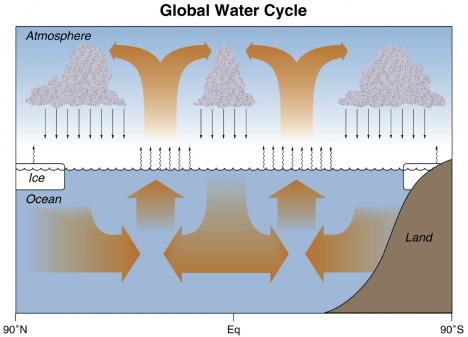
It’s fairly obvious that salty waters arise from high evaporation regions and fresher waters originate from high rainfall areas or river flows into the ocean. But it turns out that accurate estimates of evaporation and rainfall over the ocean were hard to come by. For a long time, it was a relatively neglected research topic. Many meteorologists were only concerned about how much it rained on land and few seemed to care if it rained on the ocean. Pulling together the best data he could, Ray found that, in fact, the ocean completely dominated the global water cycle. The terrestrial part, so important to us on a daily basis, is a much smaller piece. The oceans hold 97 percent of the Earths free water, the atmosphere only 0.001 percent. The oceans provide 86 percent of global evaporation and receive 78 percent of all rainfall. The total of all river flows into the ocean sums to less than 10 percent of global ocean evaporation. Clearly, if one wants to find out what the water cycle is doing, one should be looking at the oceans. The traditional fixation on the terrestrial water cycle is understandable, but risks missing the big picture. It seems that the tail is wagging the dog in terms of research on the global water cycle!
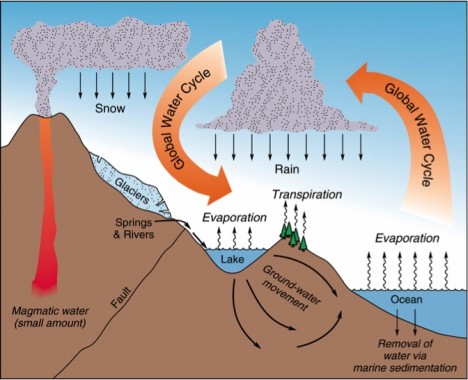
A traditional view of the water cycle.
The oceanographers’ view of the water cycle.
Of course, one of the most important questions for climate change is what the water cycle will do with continued warming. Basic physics tells us that a warmer atmosphere will hold more water vapor, so an intensified water cycle is expected. Oceanographers should be able to assess any trend in the water cycle if we do a good job in monitoring ocean salinity. On land, man has altered every watershed with dams, groundwater irrigation, deforestation and human consumption. But the ocean’s mostly unaltered and its salinity field provides insight into the vast majority of the pristine natural water cycle. The ocean has its own rain gauge in the form of salinity, and our task in SPURS is to learn how to read it.
The combination of the global coverage from Aquarius for surface salinity, detailed process studies in the ocean like SPURS, and sophisticated high-resolution computer models working in concert open up the oceanic water cycle to careful scientific examination.
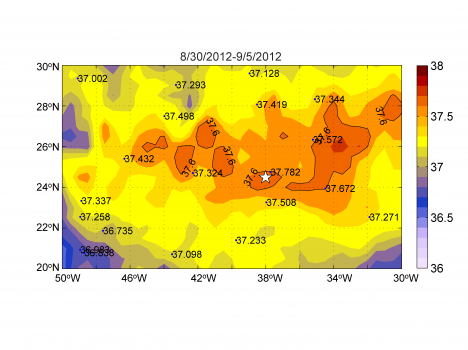
Aquarius salinity data from the first week of September 2012.
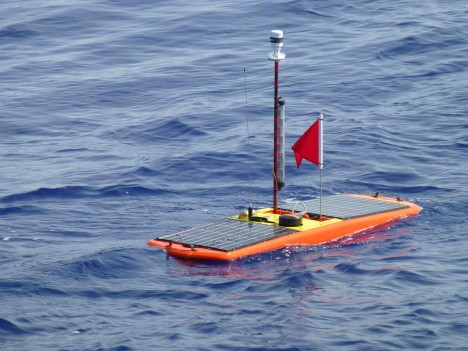
A SPURS Waveglider begins its journey to study upper ocean salinity.
We are begging to deploy the array of instruments on the ship and they are starting their year-long mission to examine the ocean salinity variations. Our challenge is to understand the detailed picture of salinity that will be painted by the various sensors and to make sense of this in the larger picture of the global water cycle.

Thursday, September 13, 2012

Minimizing the Urban Heat Island Effect Could Reduce Rainfall


You don't really need to know much about the urban heat island effect to understand that Arizona is feeling it.
With both a rapidly expanding urban footprint and some of the highest temperatures in the country, the increasingly studied feedback loop of city surfaces absorbing heat and raising temperatures is in hyperdrive in Arizona. Mitigating the heat-holding effects of urban growth has become a high priority in the state's metropolitan areas, and various efforts are underway to prevent some of that heat from soaking into the sponge that is the paved and built urban environment. But these efforts could also be making the region's overall environmental future worse.
According to new research out of Arizona State University, efforts to improve the reflectance of Arizona's cities by painting roofs white may be reducing rainfall across the state.
Published recently in the journal Environmental Review Lettersthe study finds that average rainfall statewide could drop by as much as 4 percent if roof painting efforts continue. The increased reflectivity of these roofs has been found to modify hydroclimatic processes in the region by reducing what's called evapotranspiration, or how much water evaporates back into the air from the land and its plants.
The researchers looked specifically at the "Sun Corridor" – the metropolitan areas of Phoenix, Tucson, Prescott and Nogales. By projecting growth and urban expansion models out to 2050, the researchers warn that overall precipitation could go down as the use of this white roof mitigation measure spreads across the growing urban footprint.
The researchers also note that the urban heat island itself is a major cause of reduced rainfall in the region. If urban expansion reaches the projected growth the region's association of governments is expecting, the researchers say that urban heat island effects could result in a 12 percent reduction in rainfall averaged across the state.
Combating the urban heat island effect will be incredibly important for growing places like Arizona. Though this research shows that white roofs are effective at reducing urban heat island effects, there may also be side effects of this mitigation approach that shouldn't be ignored.

Saturday, September 1, 2012

Agricultural Weather and Drought Update


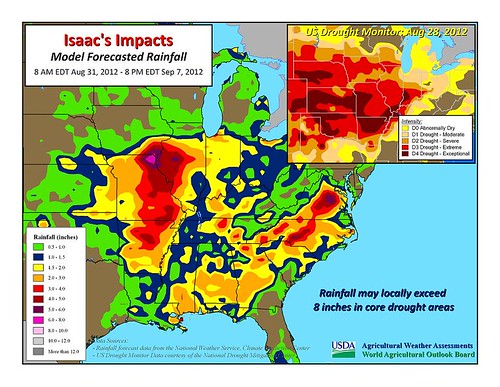
Isaac's Impacts: Model Forecasted Rainfall, August 31, 2012
Isaac's Impacts: Model Forecasted Rainfall, August 31, 2012. Click to enlarge image.
Visit www.usda.gov/drought for the latest information regarding USDA’s Drought Disaster response and assistance.
Hurricane Isaac has grabbed most of the weather headlines in recent days, but drought remains deeply entrenched across nearly two-thirds of the continental United States.  According to the latest U.S. Drought Monitor, dated August 28, drought covered 62.9% of the Lower 48 states, down only slightly from a peak of 63.9% on July 24.  However, during the five-week period from July 24 to August 28, the portion of the country in exceptional drought (D4) increased from 2.4 to 6.0%.
In fact, hot weather in recent days across the central and northern Great Plains has caused further deterioration in pasture conditions.  According to USDA’s National Agricultural Statistics Service, at least half of the rangeland and pastures were rated in very poor to poor condition on August 26 in every Great Plains state (from Texas to Montana and North Dakota).  Overall, twenty states – from California to Ohio – are reporting at least 50% of their rangeland and pastures in very poor to poor condition.  The list is topped by Missouri (99% very poor to poor), Nebraska (95%), Kansas (92%), and Illinois (90%).
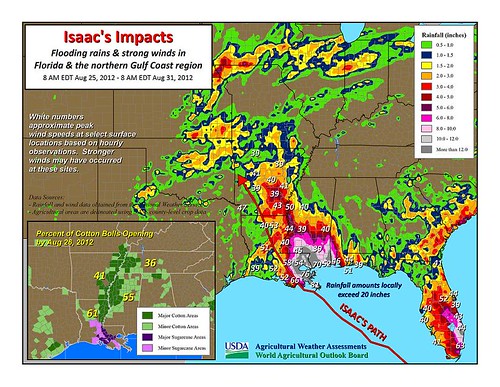
Isaac's Impacts: flooding rains and strong winds in Florida and the northern Gulf Coast region, August 31, 2012
Isaac's Impacts: flooding rains and strong winds in Florida and the northern Gulf Coast region, August 31, 2012. Click to enlarge image.
The good news for Missouri and Illinois is that heavy rainfall associated with Isaac’s remnant circulation is spreading across the southern Corn Belt.  By mid-day Friday, August 31, Tropical Depression Isaac was centered over northwestern Arkansas, drifting northward.  Maximum sustained winds have diminished to 25 mph.  During the Labor Day weekend, Isaac’s remnants will turn eastward across the middle Mississippi Valley and the lower Midwest.  Additional rainfall could reach 2 to 6 inches or more from the Mid-South into the eastern Corn Belt, where positive impacts of Isaac’s rainfall will include pasture recovery and replenishment of soil moisture in preparation for the soft red winter wheat planting season.
As Isaac continues to decay over land, flooding will remain the primary threat.  Indeed, significant lowland flooding persists in the central Gulf Coast region, including southeastern Louisiana and southern Mississippi, where as much as 10 to 20 inches of rain fell.  Although steady rainfall has ended in the areas hardest-hit by flooding, locally heavy showers persist.  According to information provided by the National Weather Service and the U.S. Geological Survey, record-high water levels were established in a few river basins, including East Hobolochitto Creek near Caesar, Mississippi.  Elsewhere in Mississippi, the Bogue Chitto River near Tylertown climbed nearly 15 feet above flood stage on August 31 – the highest water level in that location since February 2003.  Similarly, the Tangipahoa River near Kentwood, Louisiana, crested almost four feet above flood stage on August 31, less than eight inches below the high-water mark of 4.5 feet above flood stage established on January 25, 1990.
In Isaac’s wake, agricultural impact assessments are getting underway across the central Gulf Coast region, which was most heavily affected by Isaac’s rain, wind, and coastal storm surge.  Updated information will be available next week, when USDA/NASS will release updated crop progress and condition statistics on Tuesday, September 4 at 4:00 pm EDT.  Crops to watch include cotton and rice.  In the lower Mississippi Valley, some of the cotton crop was hit by torrential rainfall and tropical storm-force wind gusts (39 mph or greater).  Before Isaac hit, Delta cotton in the vulnerable open-boll stage of development ranged from 32% open on August 26 in Missouri to 61% in Louisiana.  Meanwhile, the Delta rice harvest had begun in the days before Isaac hit.  By August 26, the rice harvest ranged from 6% complete in Missouri to 71% finished in Louisiana.  Rice still in the field may have been susceptible to being lodged, or knocked down, by rain and wind.

Tuesday, July 31, 2012

Beijing Flood Victims Fume at Official Response


Four days after the biggest rainstorm in six decades hit the Chinese capital, Zhang Huishen remains furious over what she perceives as government indifference to her family's plight.

"Our family of five lives off one income," said the 46-year-old farmer Wednesday. "Nobody cares about us because there's no official in this household."

Zhang lives along what once was a paved road in the small village of Louzishui in Beijing's southwestern Fangshan district, the area hit hardest by the storm last weekend.

A flashflood has reduced the road to a muddy path littered with furniture, clothes and even a tin shed -- all objects washed away by powerful waters.

Water marks some two meters high stay visible on the exterior walls of a dozen houses by the road, while mud piles stand outside doorways with flies circling around garbage nearby.

Zhang says she largely relies on her husband's monthly wage of $300 to take care of her family that includes the couple, their two children and her sick father-in-law.

"Everything was floating in water -- refrigerator, television, everything," she said while showing a CNN crew her just-dried kitchen and living room. "I borrowed money to renovate the house and lost more than 100,000 yuan ($15,000)."

Zhang and her neighbors alike remember a fearful night spent in dark attics or higher ground after carrying the elderly and children out of fast-rising water -- all the while unable to reach anyone at the city's flood control hotline.

One neighbor, Gao Liying, added that she feels even more shaken by the village officials' response when she told them the flood has ruined almost all her worldly possessions.

"They actually said: 'If your house didn't collapse and nobody died, then you're not a victim,'" she said, raising her voice. "I asked: are you still human?"

Villagers like Zhang and Gao blame local officials for their decision to cover a former waterway with concrete -- thus turning it to a road and diminishing drainage capacity -- and their failure to warn residents before the storm.

"It was more than a natural disaster," Gao said. "The officials are responsible too."

Fangshan authorities have acknowledged shortcomings in the local drainage system, telling reporters they have learned their lessons and will address people's concerns. They also insist the need to prioritize their effort in a district where the storm has affected 800,000 residents, cost at least $1 billion in economic losses, and the death toll is expected to rise significantly.

For some villagers of Louzishui, however, such words hardly resonate. As loudspeakers mounted throughout the village began to broadcast propaganda messages touting rapid government aid to victims, Liu Wenzhi scoffed.

"Why bother howling now? Where were they when we needed help?" the 60-year-old resident asked. "This is a place led by the Communist Party. Where is our equality?"

Not long after the loudspeakers turned quiet, local officials showed up in two white vans to deliver bottled water, instant noodles and blankets to residents affected by the flood.

A shouting match soon broke out between a village Party official and a resident living by the water-ripped road whose home was totally flooded.

"I have to take the overall situation into consideration -- there are many others who are much worse off than you," the official shouted at a fuming Zhang Chunrong.

"I don't want your damn stuff," Zhang yelled back.

"My husband is a Party member so I was asked to keep quiet," she later explained, wiping tears off. "But I can't bear it anymore -- how dare he come to my home to insult me by saying my loss is nothing?"


By Steven Jiang@CNN

More Damage Expected after Floods in North Korea Kill Dozens

Heavy rain hit the capital Pyongyang, as well as North and South Phyongan provinces Sunday. The country faced similar extreme weather in 2010 (as pictured here in the Pyongyang province)

Heavy rain across large swathes of North Korea has caused widespread flooding and killed dozens of people, state media reported, with warnings of more damage still to come.

The downpours have been rolling over the impoverished country for more than a week, sweeping away crops and destroying buildings, the state-run Korean Central News Agency (KCNA) said in reports over the weekend.

As of Saturday, 88 people had died and 134 had been injured, KCNA said. It reported that more than 5,000 houses had been destroyed or damaged and 12,030 homes inundated, leaving almost 63,000 people homeless.

And the torrential rain persisted into Monday, causing further chaos.

"Most areas of the DPRK are expected to suffer big damage from continuous downpour accompanied by thunder and storm," KCNA reported Monday, using the abbreviation of the country's official name, the Democratic People's Republic of Korea.

But the agency hasn't provided an update of damage and deaths resulting from it since Saturday.

The destruction of farmland is of particular concern in a country that struggles to feed itself.
About 4,800 hectares (11,900 acres) of cropland had been washed away by Saturday, KCNA said, and more than 25,700 hectares submerged.

Employees from humanitarian groups that operate inside North Korea describe severe malnourishment on a large scale. A deal earlier this year for the United States to ship food aid to the country fell apart after the regime went ahead with a controversial rocket launch.

The highest numbers of deaths so far from the flooding were reported in areas of South Phyongan province, northeast of the capital, Pyongyang.

The heavy rains Sunday hit Pyongyang, as well as North and South Phyongan provinces. 
The capital is the richest and most developed part of the country, used as a showcase by the secretive, nuclear-armed regime. The provinces tend to be poorer and have weaker infrastructure.

By Saturday, a total of 91,809 square meters (51,700 square feet) of road surface had been destroyed by the rain, KCNA reported.

Other areas of East Asia have been hit by severe weather in recent weeks.

A violent rainstorm in Beijing more than a week ago caused the worst flooding in the Chinese capital in decades, killing at least 77 people and provoking criticism from residents about the city's infrastructure and response to the disaster.

Heavy rain elsewhere in China has left dozens more people dead, filled rivers and lakes to dangerous levels and forced the authorities to step up emergency preparations.

Early last week, a powerful storm that hit the southern Chinese coast prompted Hong Kong to raise its strongest typhoon warning for the first time in 13 years, shuttering much of the city.


By Jethro Mullen@CNN


Sunday, July 29, 2012

Censors Block Eyewitness Accounts of Beijing Flood

          Flooding leaves many vehicles submerged in water in a residential community in Beijing on July 21. Censors withheld an in-depth story on the Beijing floods

Censors withheld an in-depth story on the Beijing floods produced by Southern Weekly, a Chinese newspaper based in Guangzhou known for bold reporting.
Southern Weekly reporter Zhang Yuqun blogged on Sina Weibo that seven of his colleagues traveled over 1,243 miles to interview relatives of 24 Beijing flood victims. According to Zhang, they did an eight-page story, but government censors cut it. Zhang’s blog post was later removed.

A Southern Weekly blog post on Weibo said:  “Sinking under water and trapped by swirling currents, he used his hands and head to hit against the car window. In the end his wife held a useless hammer and watched him drown. He is Ding Zhijian, one of the Beijing flood victims. His story is in the unpublished reports.”
A staff member of Southern Weekly at its Guangzhou headquarters confirmed the censorship to New Tang Dynasty (NTD) Television, saying, “Right! Because they modified the version.”

A Southern Weekly editor said the names of 24 victims were marked with a big red cross, and replaced with the names of five officials who died on duty, Radio France Internationale (RFI) reported on July 26.

RFI also reported that former chief editor of Business Weekly Magazine Gao Yu said, “The lives lost on that stormy night and the bitter weeping of their families were struck out, along with the missions and beliefs of Chinese journalists and intellectuals.” 

Gong Xiaoyue, executive chief editor of Xiaoxiang Morning Herald, posted on Weibo: “The Beijing big shots and those in the south who suck up to them, why are you so shameless? Why are we pushed around by authorities so easily?”
RFI reported that the CCP’s Central Propaganda Department ordered that the critical reports and comments on the Beijing flood be reduced, and focus instead be given to positive reports.”

The first report from Beijing authorities said the flood death toll was 37. Then, on July 26, the authorities raised the official death toll to 77. However, Beijing residents have been saying online that the death toll exceeds 1,000. Bloggers have uploaded videos and photos as proof. Regime authorities kept deleting the online messages. 

According to Sound of Hope (SOH) Radio Network, a reporter named Tan Weishan who works for Southern Metropolis Daily, an affiliate of Southern Weekly, uploaded a video of an interview conducted by his colleagues to Sina Weibo. In the video, a resident from Shidu Township, which suffered significant flood damage, said he was on duty in the Zijinguan Reservoir on the night of July 21, and saw the reservoir release flood waters. The video was soon removed from Sina Weibo.

SOH’s report commented that Southern Weekly’s eight-page flood reports were censored because the authorities want to cover up the death toll, as well as the discharge of water from the reservoir. 

U.S.-based China commentator Chen Pokong told SOH that the flood has exposed corrupt construction practices in Beijing. He said torrential rain paralyzed the city on July 10, 2004, yet eight years later Beijing’s underground sewage system remains unimproved. The city authorities spent tens of billions on building Olympic projects, airports, and subways. However, corruption has plagued numerous construction projects, in particular underground ones, Chen said.

He said that the torrential rain showed that despite great investments in infrastructure, the capital of China was still unprepared for the recent weather. He says Beijing has too many “tofu-dreg” buildings—a term of derision for building projects which use substandard materials, often caused by corruption, that degrade easily during natural disasters.

“The entire modernized China is made of tofu-dreg buildings,” Chen said. “The arrogant, nouveau riche regime is also like a tofu-dreg building,” he added.


By Xiong Bin & Ding Ning@The Epoch Times

Saturday, July 28, 2012

Beijing Flood Death Toll Hits 77

A bus is almost submerged in Tianjin on Thursday. Heavy rain, widely forecast, bypassed Beijing on Wednesday but battered the neighboring city. [Photo/China Daily]


Highways to get water indicators as people battle to resume normal life

The death toll from the storm that lashed the capital on Saturday climbed to 77, as more bodies were retrieved, the Beijing municipal government said on Thursday night.
Eleven of the bodies have yet to be identified.

Of the 66 identified victims, five perished in the line of duty, according to the Information Office of the municipal government.

Of the remaining 61 civilian victims, 36 men and 25 women, 46 drowned and five died from electric shock. Collapsed buildings claimed three lives, two people were struck by flood debris and two died from trauma-induced shock.

Falling objects killed two people and one person was hit by lightning.

The massive debris flow made search operations more difficult, and this caused a delay in the government releasing figures, said Pan Anjun, deputy head of the municipal flood control and drought relief headquarters. Identification procedures had to be carried out thoroughly, he said.

The government will continue search efforts but there are no further reports of missing people, the information office said. The heaviest rain in more than six decades battered the capital on Saturday, with the average precipitation reaching 170 mm while a town, in the suburban district of Fangshan, saw 460 mm.

Rain: Drivers urged to take precautions

Homes have been flooded and people are staying at temporary shelters.

Homes beneath ground level in a neighborhood at the northwestern corner of the Guangqumen Bridge were flooded, forcing more than 300 residents to seek temporary shelter.

More than 100 of the residents are now living in ten tents, donated by individuals, in the square outside the building.

"The flood rushed into the basement so quickly that you had hardly any time to clear away any of your stuff," said Zhang Junfeng, a 28-year-old saleswoman in a supermarket in Beijing.

"I only had time to grab my mobile phone and my purse as the water rose to my chest in just a few minutes.

"We hope the government can find us a place to live, instead of the tents," she said.
To protect drivers, alert lines, indicating water levels, will be put on specific highways and underpasses.

The yellow warning line will be 20 centimeters above ground, alerting drivers to proceed with caution while the red line, prohibiting further driving, is 27 centimeters above ground.

The lines will be easily identifiable, according to the Beijing Traffic Management Bureau.

The move follows the death of a 34-year-old driver who drowned when a four-meter flash flood engulfed his vehicle near Guangqumen Bridge on Saturday. The automatic windows failed to function under the water.

"Warning signs indicating water levels on all low-lying underpasses will be of great help for drivers," said Guo Mingfeng, a 45-year-old taxi driver who has been driving for more than 20 years.

Yang Qingyuan, an expert in escape training in Beijing, said it is also important to take precautionary measures such as having a fire extinguisher, a knife, some gloves and a hammer in the vehicle.

A downpour, widely forecast to hit Beijing on Wednesday, bypassed the capital but battered the neighboring city of Tianjin.

Thursday morning saw more than 300 mm of rain, Tianjin's meteorological center said with the outer Xiqing district, one of the worst-hit areas, receiving 345 mm.

There were no reports of drowning but four people suffered electric shock and were being treated at hospital, according to the Tianjin Emergency Medical Center.

Meanwhile, in Hebei province, 32 people were confirmed dead and another 20 are missing after a storm over the weekend, provincial authorities said on Thursday. More than 2.66 million people had been directly affected by the storm that flooded 59 counties in the province, according to the provincial civil affairs bureau.

Among the victims, 13 were killed in Yesanpo, a scenic spot in Laishui county, which neighbors Beijing's Fangshan district. About 28,540 houses were destroyed and 170,710 hectares of cropland were inundated.

Direct economic losses totaled more than 12.28 billion yuan ($1.92 billion).
Local governments had to relocate 226,600 people to safer areas. The Ministry of Finance and the Ministry of Civil Affairs allotted 70 million yuan to Hebei for disaster relief.

Storms have hit 22 provincial-level regions in China since July 20.


8 Missing in Heavy Flash Flood Hitting Indonesia's West Sumatra

A flash flood hit the capital of West Sumatra province and has inundated homes in five subdistricts, forcing hundreds of people to evacuate and seek refuge on higher ground with eight people reported missing, local media reported on Wednesday. The flood struck 

Padang at about 6:30 p.m. Tuesday during the time people were breaking their fasting, following more than three hours of heavy downpour. The waters reached as high as four meters but was down to around one meter on Wednesday morning.

"No one realized that the rivers in Padang burst their banks," Edi Asri, an official from the Padang disaster mitigation agency, said on Wednesday, as quoted by Antara news agency.
Water rushed out of the swollen Lubuk Kilangan, Kurao Pagang and Batang Kuranji rivers, destroying the houses and other buildings in its path. The worst hit areas were Limau Manis, Batu Busuk, Kampung Koto, Cengkeh, Padang Besi, Kalumbuk and Tunggul Hitam.

"The residents of these flood-hit areas have been evacuated to mosques located on higher ground," Edi said.

No casualties have been reported, but eight people were reported missing on Tuesday night.

The Joint Search and Rescue Team has been working since Tuesday night to evacuate residents still trapped in the flooded areas.

"SAR teams have been using rescue boats to save people whose houses were inundated by floodwaters," Edi said.

The team had difficulty accessing some of the areas, including Limau Manis in Pauh subdistrict where floodwaters were still chest- deep. The flood also destroyed several bridges and cut off electricity, isolating several homes.

A local resident said Tuesday's disaster was worse than the last flooding they suffered in 2008.

"When the flash flood hit in 2008, nothing happened to the bridge, but today's flooding is worse," he said.