Water Spouts will speak volubly and endlessly about all the issues concerning water. The ongoing degradation, and growing scarcity, of the water supply here in the US, and the rest of the world. The continued absence of potable water in so many parts of the world. The work being done by NGOs, and charities, in the third world, to help alleviate the situation. The emphasis on WASH ( Water, Sanitation, and Hygiene ) so health and healthy water are maintained. "Water Spouts" will spout it all out.
In recent months we've seen a spate of articles, reports, and op-eds claiming that peak oil is a worry of the past thanks to so-called "new technologies" that can tap massive amounts of previously inaccessible stores of "unconventional" oil. "Don't worry, drive on," we're told.
But as Post Carbon Institute Senior Fellow Richard Heinberg asks in this short video, what's really new here? "What's new is high oil prices and … the economy hates high oil prices."
We can fall for the oil industry hype and keep ourselves chained to a resource that's depleting and comes with ever increasing economic and environmental costs, or we can recognize that the days of cheap and abundant oil (not to mention coal and natural gas) are over.
Unfortunately, the mainstream media and politicians on both sides of the aisle are parroting the hype, claiming — in Obama's case — that unconventional oil can play a key role in an "all of the above" energy strategy and — in Romney's — that increased production of tight oil and tar sands can make North America energy independent by the end of his second term.
The script
Our civilization runs on oil.
It’s the cheapest, most energy-dense and portable fuel we've ever found. Nature required tens of millions of years to make petroleum, and we've used up the best of it in less than two hundred.
A little over a decade ago, eminent petroleum geologists calculated that global oil production would soon hit a “peak” and begin to decline, no longer meeting ever-rising demand. But oil industry spokesmen countered with the message, "Don't worry, there's plenty of oil!" and assured us that everything would be just fine.
So what actually happened? World crude oil production flat-lined in 2005, and oil prices went crazy. Wars erupted in the oil-rich parts of the world, and the global economy went into a tailspin. The term "Peak Oil" entered the lexicon.
The oil industry is now staging another PR counter-offensive. They're telling us that applying "new" technologies like hydrofracking to low-porosity rocks makes lots of lower quality, unconventional oil available. They argue we just need to drill more to produce more. Problem solved!
But wait. What's actually new here? Most of this technology has been around since the 1980s. The unconventional resources have been known to geologists for decades. What's new is high oil prices.
It’s high oil prices that make unconventional oil worth producing in the first place. It takes lots of money and energy, not to mention water, to frack low-porosity rocks. And the environmental risks are staggering.
How does the economy handle high oil prices? Well, it turns out the economy hates high oil prices and responds by going into recession. Which makes energy prices volatile, rendering the industry subject to booms and busts.
So, what’s the bottom line here?
Yes, there's still oil in the ground. We just can't afford it. In broad terms, the peak oil analysts were right. But the fossil fuel industry is winning the PR battle.
What really matters, though, is not who wins the debate, but how we prepare for the inevitable. We’ve got to wean ourselves off our high-energy lifestyle.
We'd be foolish to wait for events to settle the debate once and for all. Let's say goodbye to oil. It's saying goodbye to us.
As Shell’s rigs head toward the Arctic to exploit melting sea ice to
drill for more oil, the company took a small step this weekend in
clarifying what would happen in an oil spill during the company’s
planned Arctic drilling operations this summer.
Despite the oil industry’s spin, experts know it is impossible to
recover more than a small fraction of a major marine oil spill, as
retired Coast Guard Admiral Roger Rufe told NPR:
“But once oil is in the water, it’s a mess. And we’ve never proven
anywhere in the world — let alone in the ice — that we’re very good at
picking up more than 3 or 5 or 10 percent of the oil once it’s in the
water.”
So how is it possible, according to the New York Times,
that Interior Secretary Ken Salazar “said he believed the company’s
claims that it could collect at least 90 percent of any oil spilled in
the event of a well blowout.” These sorts of claims have raised eyebrows
among advocates and scientists who study offshore oil drilling — they
aren’t just unbelievable, they’re laughably, outrageously impossible. NPR’s Richard Harris cuts through Shell’s spin, and explains what these numbers really mean:
“They have a miniscule number of boats compared to what
was available in the Gulf of Mexico,” [Peter Van Tuyn, and environmental
lawyer in Anchorage] says, and in the Gulf, “they didn’t have to deal
with the extreme weather conditions that we’ve got in the Arctic.” High
winds are the norm, and sea ice is always a possible hazard, “and yet
they [Shell] claim they can collect as much as 95 percent.”
Merrell says the company has made no such claim. Instead, he says, the oil company’s plan is to confront 95 percent of the oil out in the open water, before it comes ashore. That doesn’t mean responders can collect what they encounter.
“Because the on-scene conditions can be so variable, it would be rather ridiculous of us to make any kind of performance guarantee,” Merrell says.
While discussing the same issue with the Associated Press, Shell PR folks take another word out for a spin, and even try to blame “opposition groups” for this confusion:
Shell Alaska spokesman Curtis Smith said opposition
groups are purposely mischaracterizing Shell’s oil spill response plan.
The plan does not claim Shell can clean up 90 percent of an oil spill,
he said.
“We say in our plan we expect to ‘encounter’ 90 percent
of any discharge on site — very close to the drilling rig,” he said.
“We expect to encounter 5 percent near-shore between the drilling rig
and the coast. And we expect to encounter another 5 percent on shore. We never make claims about the percent we could actually recover, because conditions vary, of course.”
Where Shell plans to drill in the Arctic, those conditions include 20
foot swells, hurricane force winds, sea ice, and months of total
darkness, and all without deep water ports or other infrastructure
needed to mount a major oil spill response. But let’s put that aside for
a moment, to make sure we’re not mischaracterizing here: Shell expects
to “encounter” or “confront” 90% of the spilled oil and another 5% the
company plans to — rendezvous? — with elsewhere in the ocean, while the
remaining 5% Shell might — happen upon? — on shore. How much of that oil
might be recovered, collected, or, you know, removed from the
environment? Well, Shell says conditions vary, so making a performance
guarantee would be rather ridiculous.
In the relatively calm conditions of the Gulf of Mexico, with
thousands of response vessels, only a small fraction was recovered from
the BP oil disaster. Despite shameful efforts to spin its announcement, a
government report found that 4% of the oil was skimmed, and another 6% was burned. And as oil spill expert Rick Steiner observes,
even those estimates might be too high, and burning oil isn’t really
removing it from the environment: “It either went into the air as
atmospheric emissions, and some of that is pretty toxic stuff, or
there’s a residue from burning crude that sinks to the ocean floor,
sometimes in big thick mats.”
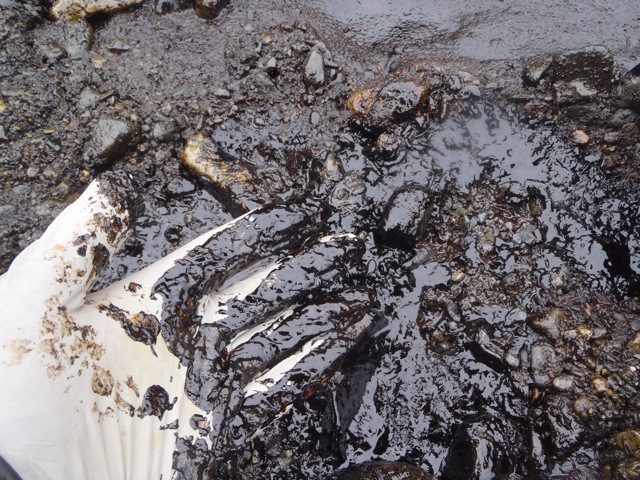
Exxon Valdez oil in 2012. Photo courtesy of David Janka, taken on May 24, 2012 on Eleanor Island, Prince William Sound, Alaska.
And today, 23 years later, most of the fish and wildlife
populations and habitats injured by the spill have yet to fully recover,
and there is still residual, toxic oil in beach sediments. It is
becoming evident that the injured Alaska coastal ecosystem may never
fully recover from the Exxon Valdez spill.”
What of the promised “state-of-the-art spill response”?
Despite a three-year, $2 billion effort by Exxon, the response was a
spectacular failure, recovering less than 7 percent of the spilled oil.
Oil that Exxon might have “encountered” decades ago, still remains
today, as do the impacts to the ecosystem and the wildlife and
communities that depend upon it.
A Republican proposal forcing quick approval of the Canada-to-U.S.
Keystone oil pipeline will not be part of a massive transportation
funding bill the U.S. Congress is trying to pass by week's end, a
senior Democratic aide said on Wednesday.
"Keystone
is out," said the aide, who asked not to be identified. The aide added
that while House-Senate negotiators are close to an overall deal on
the transportation bill, they have not yet wrapped it up.
The
House of Representatives and the Senate aim to pass the bill by Friday
to fund road, bridge and mass transit funding projects.
If a deal falls through, lawmakers were expected to pass a short-term extension for current transportation funding levels.
"A
lot of work that's gone into this, it's not finished yet. But it is
clear that there are significant reforms in this bill," House of
Representatives Speaker John Boehner told reporters earlier on
Wednesday.
The package is also expected to
include a one-year, $6 billion fix to prevent a doubling of interest
rates for about 7.4 million students with Stafford loans to help pay
their college costs.
"I'm cautiously optimistic
that we can end this week tomorrow even, with a little bit of luck -
but we may not be able to," said Harry Reid, the Senate Democratic
leader.
"We have to see what happens in the next 24 hours, which will be key," Reid said.
KEYSTONE WAS MAJOR HURDLE
The
subject of TransCanada's Keystone XL pipeline was one of the thorniest
issues before negotiators during weeks of talks - but was one of the
very last topics to be tackled.
President Barack
Obama ruled earlier this year that more environmental reviews were
needed for all but the southernmost tip of the 1,700-mile-long (2,736
km) pipeline, which would carry crude from Canada's oilsands to Texas.
The White House has said Obama would veto a bill that overrides his decision.
Republicans
have championed the pipeline's cause ahead of the November
presidential and congressional elections, arguing that it would create
much-needed construction jobs and panning Obama for stalling it.
The Keystone measure has passed in the House four times, but narrowly failed a Senate vote in March.
Republicans
pushed hard for other concessions in the transportation funding bill,
which is based on a two-year, $109 billion package passed by the
Senate.
Boehner told reporters the deal would
include "significant reforms" to streamline environmental reviews for
certain highway projects, and reduce the number of programs in the
highway bill, focusing spending on core transportation projects rather
than directing money toward roadside landscaping and other ancillary
programs.
The deal will include provisions to
ensure that 80 percent of fines imposed on BP after the Gulf of Mexico
oil spill will go to Gulf coast communities, Democratic Senator Bill
Nelson of Florida, who was on the negotiating panel, said in a tweet.
There
was also a last-minute push to include a compromise to ease proposed
Environmental Protection Agency regulations for coal ash, a byproduct
used in cement, an industry source said.
President Obama pledging to green-light a southern leg of the Keystone XL pipeline at a pipeyard near Cushing, Okla., in March
The Obama administration, moving swiftly on the president’s promise
to expedite the southernmost portion of the disputed Keystone XL
pipeline, has granted construction permits for part of the route passing
through Texas, officials said on Tuesday.
The Army Corps of Engineers on Monday told TransCanada, which wants
to build a 1,700-mile pipeline to carry heavy crude from Alberta to the
Gulf Coast, that it could begin construction on the portion of the
proposed pipeline that would end at the gulf port of Nederland, Tex. The
Corps of Engineers is still reviewing permits for a section of the
pipeline beginning at a major oil depot in Cushing, Okla., and linking
up with the final leg ending at the gulf.
In January, President Obama denied TransCanada permission to build
the northern part of the pipeline from Canada to Oklahoma, saying
Congress had not given him sufficient time to review the environmental
impact. But at a political appearance in March in Oklahoma, he announced
he was taking steps to speed approval of the portion of the project
running from Cushing to the gulf to relieve a bottleneck in oil supplies
at the Oklahoma oil terminal.
The president also invited the company to resubmit its application
for the rest of the pipeline. The company did so in early May.
2:14 p.m. | Updated TransCanada
said Tuesday that it welcomed the permits and was awaiting approvals
from the two other Corps of Engineers districts that must rule on the
remaining 400 miles of pipeline route beginning in Cushing.
“We continue to believe that we will be in a position to begin
construction later this summer and are working with the Corps and others
to secure the approvals and permits we require,” the company said in a
statement. “Once the gulf coast project is completed, it will help move
both Canadian and American oil to refineries on the gulf coast, where it
is critically needed.”
It will help push out oil from OPEC nations or conflict regions and
replace it with safe, secure and reliable access to Canadian and
American oil,” it added. “It will help remove the bottleneck that
currently exists in Cushing, which is impacting American producers.”
Environmental advocates and some local landowner groups strongly
opposed the pipeline, citing the dangers of possible spills and saying
that the oil it would carry, extracted from tar sands formations in
northern Canada, was a major contributor to greenhouse gas pollution.
More than 10,000 protesters surrounded the White House on Sunday calling
on President Obama to reject the proposed Keystone XL tar sands oil
pipeline from Canada to the Gulf Coast. The protest came exactly a year
before the 2012 election and the pipeline is shaping up to be a major
political issue. Last week, President Obama said for the first time he
will make the final decision on whether to approve the controversial
1,700-mile pipeline proposed by TransCanada, which would transport oil
from the Alberta tar sands fields to refineries in Texas. Up until now,
Obama said the final decision rested with the State Department. "[Sunday
protest] really underlines this has become not only the biggest
environmental flash point in many years, but maybe the issue in recent
times in the Obama administration when he has been most directly
confronted by people in the street," said leading environmentalist Bill
McKibben, a key organizer in the protest, to Democracy Now! Nov. 7.
For
the complete interview, read the transcript, download the podcast, and
for information on Democracy Now! and more reports on the Keystone XL
pipeline, visit http://www.democracynow.org/
Election year politics confusing a vital American decision. These are my sentiments:
How can world leaders at the Rio+20 Earth Summit
next week show that they are serious about sustainable development and
environmental protection? The answer is simple: end fossil fuel
subsidies.
Every year, governments around the world give nearly $1 trillion
dollars of public money to the fossil fuel industry. Three years ago,
the G20 committed to phase-out these handouts to coal, oil and gas
companies, but they haven't taken any action since.
Now is the perfect time. This June 18, finance ministers and heads of
state from G20 countries will come together in Los Cabos, Mexico. Three
days later, more than 100 presidents and prime ministers will join over
50,000 people at the Rio+20 Earth Summit, the largest environmental
conference in world history. Both meetings offer a clear opportunity for
world leaders to step up to the plate and stop these outrageous
handouts.
After all, how can you have a serious discussion about funding
sustainable development without taking on the hundreds of billions of
dollars handed over to the fossil fuel sector each year? A mere fraction
of these subsidies could jumpstart thousands of clean energy projects
around the world. Large scale transfers of money from dirty to clean
investments could catalyze the type of worldwide energy transformation
that is desperately needed.
It's still unclear if leaders will take the type of bold action
necessary, but the push to end fossil fuel subsidies is gaining momentum
around the world. On June 18, a dozen major groups -- from World
Wildlife Fund to Avaaz -- are taking part in a 24-hour "Twitter Storm"
to try and flood the online airwaves with the #endfossilfuelsubsidies
hashtag. The coalition may even be within striking distance of taking
down Justin Bieber's twitter world record for the most tweets on a
single hashtag.
The slogan for the Rio+20 meetings is, "The Future We Want." By next
week, we'll know if our politicians have lived up to that promise or
once again bought into "The Future Exxon Wants," a world where our tax
dollars continue to get sucked up by the world's richest corporations so
that they can continue to profit from destroying the planet.
What does environmental devastation actually look like? At
TEDxVictoria, photographer Garth Lenz shares shocking photos of the
Alberta Tar Sands mining project -- and the beautiful (and vital)
ecosystems under threat.