Showing posts with label Waste Water. Show all posts

Monday, September 24, 2012

Simple & Cheap Solution to India's Grave Water Crisis: Waste Water Recycling

India’s coming grave water crisis has a simple, cheap solution: wastewater recycling. But for private capital to get into this, public policy must challenge perception biases against recycled water.

Where will India get its water from in the coming years? The water challenge is already grave and could get graver. By 2050, for instance, it is estimated that demand would go up to 1,180 million cubic metres, 1.65 times the current levels, a situation that would be made worse by fast dwindling fresh water resources.

That's why desalination — removing salt from seawater to make fresh water — is increasingly catching the fancy of administrators. Two of India's most industrialised states, Tamil Nadu and Gujarat, are the keenest among the lot. A water-scarce Tamil Nadu, already running one desalination plant, is working to complete a second plant and planning for the third. Gujarat is also said to have desalination plans.

"The industrial sector's preference toward desalination is expected to increase with the growing demand for processed water. Many of the coastal municipalities are also keenly looking to invest in desalination," says consultancy Frost & Sullivan's environment technologies expert Sasidhar Chidanamarri. India, along with the US and China, is seen contributing quite a bit to a global doubling of desalination capacity between 2010 and 2025, says Frost & Sullivan. Of course, the biggest contributor would be West Asia, which would by then account for half the world capacity.

But the question that experts are increasingly asking, at a time when a draft water policy is being debated, is this: is desalination the best option?

Treating Waste Water

Countries the world over, while being bullish about desalination, are equally bullish about other means, notably waste water recycling. Not India. Only about 31% of municipal wastewater can be recycled. That would be more than 75% in China. In a recent working paper titled "Water Supply in Chennai: Desalination and Missed Opportunities", researcher Sridhar Vedachalam of the New York State Water Resources Institute at Cornell University wrote that "desalination may provide a reliable supply of water to a city with chronic water shortage, but it is hardly the best option for more than one reason".

"Desalination, while being a source of fresh water, does nothing to address the challenge of managing those extra million litres of wastewater," says Vedachalam. "Recycled water, on the other hand, solves the twin problems in a single shot."

When Tamil Nadu launched its first desalination plant in 2010, at Minjur, 27 km from north of Chennai, the benefits seemed apparent. Tamil Nadu's water challenge is historically well chronicled. Now, it houses 6% of the country's population but only has 3% of its water resources. Also, Tamil Nadu gets an annual rainfall of 792 million metres versus the national average of 1,250 million metres. The per capita availability at 800 cubic metres in the state is just a third of the national average.

"Why not go further and pick a more futuristic technology — one that addresses problems of water supply and wastewater management, is ecologically compatible — and lead the way for the rest of the country and even the world. Reuse can be implemented anywhere (not just in coastal areas) and, therefore, has a much bigger market allowing future improvements in technology and reduction in cost," says Vedachalam.

Rs 25/litre Difference

For Sam Yamdagni, managing director of the Indian arm of the $3.8-billion US-based water technology company Xylem, there is no way waste water treatment can be missed. "Even when you are creating water through desalination, you have to look at creating waste water treatment because again you are going to generate waste."

But ecological compatibility isn't the only reason. There's a compelling cost reason favouring waste water treatment.

R Raghuttama Rao, managing director of Icra Management Consulting Services, points out those cases. He says, "Desal is more expensive upwards of Rs 50 per kilo litre compared to Rs 25-35 per kilo litre for recycled sewage. Desal requires more power and is energy intensive."

Chidanamarri estimates the capex for desalination plants to be two-and-a-half times that of a conventional treatment technology. "Clearly, desalination is an expensive proposition. And the government is contemplating to offer tax incentives for industries which would help them in recovering the high costs." (He also points out, though, that improved technologies have over the years brought down the cost of water from desalination.)

Given this, Vedachalam had argued in his analysis, "Reliance on such expensive technology [desalination] does not augur well for a city [Chennai] that already does not collect revenues that match its expenses." A report in 2005 estimated that only a fifth of the water sold in Chennai was metered. The rest of the country may not be vastly different in this respect.

Data supports this view. According to a presentation available on the Ministry of Urban Development Website, the average cost of wastewater treatment is Rs 4.5-6 a kilo litre, and this can be used for agriculture or gardening purposes. If treated for drinking use, the cost does jump to Rs 12 but this is still far less than what metros in India spend to bring potable water to its residents. Here are the numbers: from Rs 20 per kilo litre in Delhi to Rs 40-60 in Chennai.

Perception Problems

The other significant side of the story is India's growing demand for water. Nowhere is this as evident as in the industrial sector, which now consumes about 50 billion cubic metres of water annually. That figure will jump to 120 billion cubic metres by 2025, says Frost's Chidanamarri.

Given this, going in for waste water recycling aggressively should be a no-brainer. But that's not been the case. There's a reason why the actual scope for use of recycled water is far less. "From a mindset perspective, people are more ready to drink desalination water relative to treated waste-water," says Icra's Rao.


Rajiv Mittal, managing director of water treatment company VA Tech Wabag, agrees about the mindset issue. "In Singapore, the prime minister of Singapore campaigned for safety of recycled water for drinking and he was the first one to use this." Mittal says in Singapore they call it reusable water, not waste water.

Icra's Rao says indirect potable use (where recycled treated sewage water is pumped into water bodies/river streams which is conventionally treated again) is becoming more popular. Singapore already does this. Bangalore was planning such a project but that has not happened so far, he says.

But the low-hanging fruit in waste water isn't in challenging strong perceptions of the people but actually is in the industrial sector. Already, there are examples of treated sewage being used by industries in India. In Chennai alone, wastewater is supplied to companies such as Madras Refineries, Madras Fertilisers and GMR Vasavi Power for reclamation and reuse.

Thirsty Industry

The industrial potential is already evident through desalination. VA Tech's Mittal knows that well. His company is the one building the second desalination plant in Chennai, some 45 km away at Nemelli. It is eyeing a big opportunity in the desalination space. Between 2005 and 2010, about 63% of the 5.3 lakh cubic metres per day of desalination capacity was accounted for by the industry. The municipal segment accounted for the rest.

He reckons the way to go about it is this: waste water treatment for industrial use and desalination for domestic use. Europe does it well. It recycles about 60% of the domestic sewage generated and it is consumed for non-potable applications such as boiler feed water, cooling tower, landscaping, gardening and flushing.

Anand Chiplunkar, a director of urban development at the Asian Development Bank, says, "Wastewater treatment can generate revenues and thereby not only reduce the operating and maintenance costs but also recover capital costs [when recycled to industries]." Therefore, he says, "it has the potential to attract private sector investments in properly structure projects".

Rao says, "Waste-water recycling would be particularly attractive to address requirements of industrial use, if the demand is concentrated [eg SEZs]." That's one way to meet India's growing water needs.


 By Sanjay Vijayakumar@economictimes.com


Sunday, August 26, 2012

The Urban Quest for ‘Zero’ Waste: Cities Lead the Way in Diverting Trash from Landfills


Across the US, a handful of municipalities are radically reducing the amount of refuse they send to landfills, with the eventual goal of reaching “zero waste.” Seattle recycles or composts more than half of what its residents toss out. San Francisco diverts 77% of its waste from landfills. Even sprawling Los Angeles recycles or composts about two-thirds of its garbage.


hose numbers stand in stark contrast to the rest of the U.S., where the Environmental Protection Agency (EPA) estimates only about a third of waste is recycled or composted. The cities are getting the job done largely by having citizens and businesses sort trash more carefully, to recycle as much as possible.
Officials in these cities think they can go further. “It’s good; doesn’t mean we stop there,” says Tim Croll, solid-waste director for Seattle Public Utilities. “We know the word ‘low-hanging fruit’ is overused, but there is still more stuff to be gotten out of that waste stream.”

Less Than Zero?

The prime benefits in adopting zero waste are environmental; many cities that have enacted zero-waste plans say they have taken up the task in the name of sustainability. According to the EPA, recycling and composting are effective ways for households, communities and businesses to save energy while reducing water and air quality impacts as well as landfill-generated methane, a potent climate destabilizing greenhouse gas.
Zero Waste maximizes recycling, minimizes waste, reduces consumption and ensures that products are made to be reused, repaired or recycled back into nature or the marketplace. The Zero Waste International Alliancedefines it as such:
“Zero Waste is an ethical, efficient, economical, and visionary goal guiding lifestyle changes and practices emulating sustainable natural cycles, where all discarded materials are designed to become resources for others to use.
Zero Waste means designing and managing products and processes to systematically avoid and eliminate the volume and toxicity of waste and materials, conserve and recover all resources, and not burn or bury them.
Implementing Zero Waste will eliminate all discharges (90% reuse-recycle-diversion without incineration) to land, water or air that are a threat to planetary, human, animal or plant health.”
As well, supporters argue that reducing waste doesn’t necessarily mean increasing costs. For cities with limited landfill space—and the higher fees that come with it—most zero-waste activities cost less than normal garbage disposal, says Gary Liss, a zero-waste consultant who has helped about 20 cities form plans to reduce waste.
Why don’t cities shoot for 100% diversion? “We’re not crazy,” says Neil Seldman, president of the Institute for Local Self-Reliance, a nonprofit based in Washington, D.C., that promotes sustainable communities. The closer cities get to that goal, the harder it is to go further, largely because there are so many products out there that just can’t be recycled—and people continue to buy them.

According to Paul Connett, “Waste is the evidence that we are doing something wrong. Our task is to fight over-consumption and its most visible manifestation: the throwaway ethic. Instead of trying to become more sophisticated about getting rid of waste, we have to stop buying things we do not need, and industries have to stop making things, which cannot be reused in some way.”

Extended Producers Responsibility (EPR) could make a difference on the production end, placing the legal, financial, and environmental responsibility for materials entering the waste stream with the manufacturer, not on the consumer or the local government at the end of the product’s or packaging’s life cycle. The end result is a fundamental shift in responsibility and financing so that manufacturers redesign products to reduce material consumption and facilitate reuse, recycling and recovery.
Cities can pass ordinances and require households and businesses to recycle and compost, but “they can’t control the behavior of residents,” says Chaz Miller, the state programs director for the National Solid Wastes Management Association, a Washington, D.C., trade group for the waste and recycling industry. “There is still a lot of material to dispose of in this country, and it’s going to remain that way for a long time,” he adds.
Indeed, despite increased recycling in recent years, Americans are still prodigious wasters. In 2009, the most recent year for which figures are available, Americans threw out roughly 243 million tons of trash—or about 4.34 pounds of garbage per person, per day, according to data from the EPA. After recycling, composting and incineration, about 132 million tons ended up in landfills that year.

Recycling by the Bay

One of the most comprehensive zero-waste strategies is San Francisco’s. The city has relied on ordinances and regulations to prod citizens and businesses into wasting less. In 2009, it became the first city in the U.S. to require food composting for residents and businesses, Rather than throw food scraps and dirty napkins into the trash, individuals and businesses must chuck their organic material into city-provided green bins.
Jepson Prairie Organics
Jepson Prairie Organics is one of two Recology-owned compost facilities that together process 600 tons of organics collected daily from the City of San Francisco - from BioCycle
The mandate led to a large boost in compost collection, says San Francisco Department of the Environment director Melanie Nutter. Recology, the city’s collection agency, now hauls more than 600 tons of organic waste to a composting facility each day. In an effort to “close the loop,” Recology sells the certified organic compost materials.
Along with putting compost in green bins, individuals and companies are expected to sort plastics, aluminum and papers into blue bins and garbage in black “landfill” bins. The less waste residents put in the landfill bin, the less they pay for curbside collection; recycling and compost collection are free. (The system, known as “pay as you throw,” is used in hundreds of other cities as well.)
San Francisco’s rules don’t end there. There’s also a mandate for waste at building sites. Construction and demolition crews must recycle or reuse at least 65% of the material from a site, which involves sorting all debris or ensuring it is hauled to a collection facility.
The result of all these efforts is a waste-diversion rate of 77%—the nation’s highest—and the city is aiming for 100% by 2020. Ms. Nutter says the city can reach 90% if it prods its citizens to be even more waste-conscious; about a third of the waste that San Francisco sends to the landfill is recyclable, and another third is compostable.
Officials in San Francisco say sustainability is the driving factor behind its push for zero waste. The city pays for garbage collection only from city buildings and property; residents and businesses pay for their service through fees. The city says residents pay about the same for curbside trash service as in nearby cities.

Shades of Green

Another zero-waste leader is Seattle, which diverts about 54% of its waste from the dump and hopes to reach 70% by 2022. The city mandates recycling for businesses and residents, and requires food composting for single-family residences.
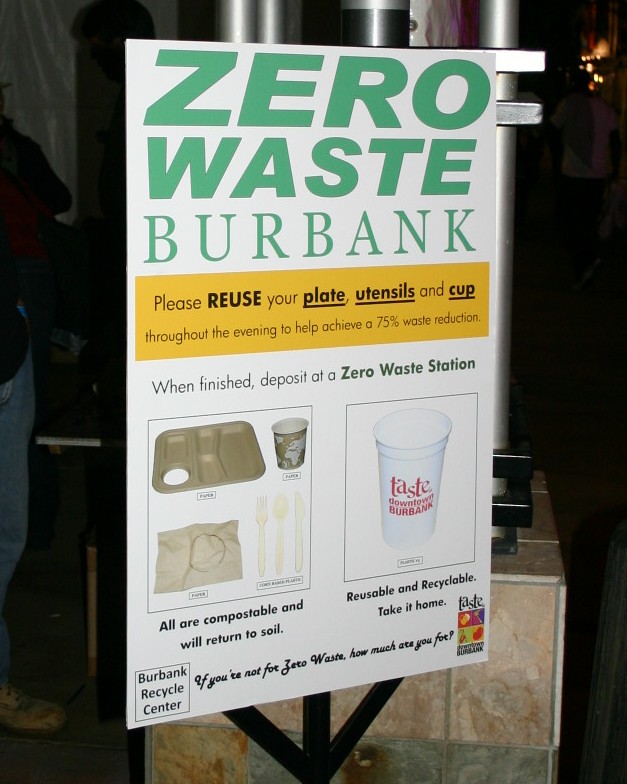
zero waste event
Zero Waste Event in Burbank - "If you're not for zero waste, how much are you for?"
It has also banned the food-service industry from providing goods in plastic-foam containers, and requires single-use packaging—including plates, coffee cups and utensils—to be recyclable or compostable. Among the approved alternatives on the city’s website: drink cups made from corn, bowls made from tapioca starch and wooden utensils.
Still, not all high-achieving cities get there with mandates and bans. Los Angeles diverts over 65% of its waste from landfills and is shooting for 70% by 2013. But it doesn’t mandate recycling. “We don’t believe in banning, as a city,” says Alex Helou, assistant director of the city’s Bureau of Sanitation.  However, the State of California, per AB341, will mandate for them and all municipalities. After July 1, 2012, a business that generates more than four cubic yards of commercial solid waste per week, or a multifamily residential dwelling of five units or more, shall arrange for recycling services consistent with state or local laws or requirements.
LA’s Mr. Helou says the bureau encourages residents by giving prizes like Starbucks gift cards to neighborhoods that increase their recycling the most. He says the city has also sought to make recycling as convenient as possible and has expanded the type of waste that consumers can throw into recycling bins to include items like plastic foam and milk cartons. Active movements in the city, however, are advocating for a stronger stance on recycling mandates.
Austin, Texas, currently recycles or composts about 38% of its waste and is in the process of finalizing its zero-waste plan. In addition to considering a recycling mandate, the city has pursued an original outreach campaign. Earlier this year, “Dare To Go Zero” premiered on the city’s public-access channel. The “Biggest Loser”-style reality show challenged four families to reduce their waste by 90% over the course of five weeks.
The city’s director of solid-waste services, Bob Gedert, says Austin hopes to ratchet up its diversion rate to 75% by 2020 through a mix of regulation and outreach, but says the city does not expect to reach zero waste until 2040.

Innovate Instead of Incinerate

Officials in San Francisco, like many other zero-waste supporters, maintain that incinerating waste increases greenhouse-gas emissions, and note that incineration destroys, rather than conserves, resources.
Still, many city officials agree that some sort of technological help will be needed as they get closer to zero waste. Seattle’s Mr. Croll says he is interested in anaerobic digestion, a process where micro-organisms break down organic waste and produce methane, which can later be used for energy. San Francisco is hoping to rely on advanced mechanized sorting systems that pick more recyclables from the garbage flow, Ms. Nutter says.
After that, she says, it may be out of the city’s hands. “There are some items in the waste stream that can’t be recycled or reused or repurposed,” she says. “So, in that case, we think the last 10% will really come down to working with manufacturers” to reduce and rework materials packaging.
Mr. Liss, the zero-waste consultant, says that at some point cities have to say, “We’ve done a lot with recycling, but we need to do a lot more with reducing and reusing.”

Tuesday, June 26, 2012

UN cites Israeli Wastewater Treatment Plant as Global Model

                                                                                               A worker at Israel's Shafdan


The Dan Region Wastewater Treatment Plant is among 30 projects from around the world chosen by the United Nations, to demonstrate the ability of local authorities to deal with environmental problems.

The plant, known to Israelis as Shafdan, was included on the list thanks to its unique method of using the natural filtration qualities of sand in order to improve the quality of sewage. After wastewater is purified in an ordinary facility, it is recharged into the ground, where it undergoes an additional, natural filtration in the sands of Rishon Letzion and Yavne. 

This improves the quality of the water such that it can ultimately be used safely for all forms of irrigation.

The list of projects was published in a special report of the UN Environment Programme and ICLEI, an international association of local governments that have made a commitment to sustainable development.

The report, which deals with the environmental challenges facing cities, was published last week, ahead of the UN Conference on Sustainable Development that was held in Rio de Janeiro.

Urban areas comprise only 1-2 percent of the area of the earth's surface, but they cause the emission of almost 80 percent of greenhouse gases. Today about half of the world's population lives in urban areas, and the forecast is that this figure will increase to over 60 percent within a decade.

According to the authors of the UN report, local authorities have the ability to get organized and to deal with a variety of environmental problems without being dependent on federal assistance. The 30 examples they provide are from from all over the world, including developing and poor countries.

The Shafdan plant that was named on the list belongs to the local authorities in the Dan region, but Mekorot, the national water company, is responsible for administering and carrying out the purification process.

Recently the company began to develop even more advanced methods of purifying the sewage before recharging it into the sand. This is necessary because despite the benefits of the current purification process, it was discovered that when the wastewater is recharged into the ground after undergoing only primary purification, it damages the soil that it reaches before it hits the sand.

As a result of that damage, experts have been forced to seek new areas where they can purify the wastewater, which are not easy to find in such a densely populated area.

The new method is designed to enable more efficient use of areas where the purified sewage is already being recharged into the soil. Today Mekorot pumps 130 million cubic meters of purified sewage water into the area of the sands. The water is almost equal in quality to drinking water, and is used for irrigation in the Negev.

The company points out that the new method of purification and filtration will also make it possible to remove polluters such as remnants of medicines, that until now were not removed in the purification process.

Among other notable projects in the report were: Water Smart Parks in the city of Stirling, Australia, where park planners used advanced irrigation methods to reduce water consumption by more 80 percent.

In Pangkal Pinang, Indonesia, the municipality and a private firm created a cooperative venture that turned an area that had been used as a zinc mine into a botanical garden.

An interesting innovation in the city of Portland, Oregon set an "urban growth boundary" beyond which building is forbidden. In order to meet this restriction the municipality developed more efficient methods for utilizing existing construction areas. 


Israel company EMEFCY has developed a revolutionary, innovative and environmentally sound process to convert waste water into electricy, while purifying the water. This process convert waste water treatment plants from energy consumers into energy producers.


Saturday, June 2, 2012

Turning Wastewater Into Fertilizer Pellets


Phosphorus and other nutrients found in wastewater can present a host of problems for treatment plant operators. They can clog internal piping and pumps, which raises maintenance costs. And treatment plants are typically restricted by how much phosphorus can end up back in rivers and other water ways.

Ostara Nutrient Recovery Technologies, which announced today it raised $14.5 million in venture capital, has developed a way to remove up to 90 percent of phosphorus and 40 percent of the ammonia load from sewage sludge and turn it into commercial-grade slow release fertilizer pellets that can be sold to nurseries, turf farms, and specialty agriculture businesses. Ostara plans to use the venture funding, which was raised in a round led by  
VantagePoint Capital Partners, to expand its operations.

Farms have reused waste as fertilizer for centuries. Ostara’s tech puts a new spin on the concept by turning wastewater into a marketable product on an industrial scale and without using harmful chemicals.

Ostara has four commercial nutrient recovery facilities in operation in the United States, including a system at Clean Water Services, a water utility west of Portland that serves more than 500,000 customers. The $4.5 facility will be paid for in six years through reduced maintenance costs, savings from chemical and electrical use and revenue from the sale of the fertilizer.

Three other facilities are under construction, including one in Canada and its first European operation for Thames Water in London.


Sunday, April 8, 2012

The Optimistic Futurist: Benefits Flow From Reuse of Waste Water

A surprising amount of the drinking water in the United States has already been used by toilets and passed through an old sewage treatment plant upstream and back into a river. The river also gets runoff from farms and feedlots, and storm water from parking lots. To this, add new-generation bad stuff, including industrial, home cleaning and agriculture chemicals and drugs, all mixed into the human waste, making a whole new brew unknown 50 years ago.

This is the raw material that our drinking water is made from.
Many of these drinking water preparation plants are also old and do not remove all the latest generation bad stuff. Across the United States, more than 260 contaminants have been found in public tap water, and more than 140 of them have no enforceable safety limits. 

These include pharmaceuticals and industrial chemicals. A 2008 study by the Associated Press discovered that these unregulated pharmaceuticals were found in the drinking water systems of 41 million Americans. This does not count those who get their drinking water from untested private wells, as 40 percent of North Carolinians do.

Before the mid-1800s, city people all over America had toilet buckets in their apartments, which they emptied into the streets in the morning. Cholera outbreaks created support for public waste removal systems. The first solutions were horse-drawn carts that made neighborhood rounds and collected the contents of the buckets.

When municipal water supplies began delivering fresh drinking water to apartments and homes in the late 1800s, the flush toilet became possible. Using the running water now in the homes, human waste was carried through sewer pipes to a central place by the flowing flushed water. At the central place, it was put in ponds, where living critters already in us ate the bad stuff. Over time, the goop settled into liquids and solids. The solids were used to fertilize farmers’ fields. The leftover liquids were put in a nearby river. The civil engineers of the day were taught a slogan: “The solution to pollution is dilution” — and as long as the sewage was only human waste, this was largely true. It no longer is.

We have gone from a nation whose sewage was from humans to one where we annually add millions of tons of drugs and chemicals to human sewage, which mix together and make new dangers.

One solution is to take wastewater and treat a portion of it for reuse for purposes other than drinking water. You take the waste water, clean it and use it for landscape irrigation, flushing toilets or building cooling, while lowering the need for new under-the-street plumbing or expensive large drinking water preparation plants.

One example of a success story is the headquarters building of the Port of Portland in Oregon. By including an “on-site reuse wastewater treatment plant” that put two sets of waste-water plumbing into the design of the new 200,000-square-foot building, water use was reduced by 75 percent Instead of sending all the waste to the sewage plant, the cleaner water is kept on site, where it is treated for reuse for irrigation, flushing toilets and cooling buildings.

Because of the success of this concept, the city of San Francisco has adopted it for use in their new Public Utilities Commission building, where it will save water, energy and money, and serve as a role model.

A third example is an installation at Furman University in South Carolina, where this model was selected over the “business as usual” systems based on low life-cycle costs for both energy and water.

On a personal level, one thing you can do is install a charcoal filter on your faucet, which significantly reduces the amounts of many pollutants. You can buy a charcoal filter at the hardware store.

Societies require safe air, water and food in order to survive. We need to keep the issue of safe and secure water supplies on our radar — for our sake and the sake of our children.


By Francis Koster@The Salisbury Post 

Mr. Koster can also be read@The Optimistic Futurist.org

Sunday, February 26, 2012

Recycling Waste Water by Khalilur Rahman

In the wake of steady decline in groundwater reserve for overuse leading to its short supply, particularly in dry season across the country, experts suggest measures to face the crisis. They say that 80 per cent of waste water from households can be effectively recycled for reuse to meet its increasing demand in cities and towns. While speaking at a seminar on "Complete use of water: Expectations and Duties" held in the city on January 30 last, experts said only 20 per cent of the water supplied to consumers by the Dhaka Water Supply and Sewerage Authority (WASA) in Dhaka city is used for cooking and drinking and the rest for other household purposes. There are scientific ways to recycle waste water from households which can be reused, especially in toilets and for washing linens and many other purposes.

WASA estimates that the groundwater level is falling at a rate of two to three metres in the metropolis each year due to its overuse. The WASA authority says that its daily production of water stands at 2100 million litres of which 88 per cent is groundwater and the rest comes from surface sources. It is also distressing to learn that 80 per cent water for irrigation in rural areas and 98 per cent water for household use are received from underground sources. This massive extraction of groundwater has caused an adverse effect on environment and posed a serious threat to life of millions of people in the country. Moreover the fast depletion of groundwater has rendered thousands of shallow tubewells out of operation, threatening farm output.

A report by Bangladesh Sangbad Songstha (BSS) last month quoted experts as saying that groundwater for irrigation is extracted without proper planning resulting in its colossal wastage as well as adverse impact on ecology and agriculture. They estimate that 0.8 million tubewells are enough to maintain irrigation countrywide. Whereas about 1.3 million shallow tubewells are now in operation causing huge wastage of groundwater. Australia and many other countries across the global don't use groundwater for irrigation in order to protect ecological balance. Therefore, experts suggest, dependency on groundwater for irrigation and other purposes must be reduced to avoid environmental hazards.

In another development, Dhaka WASA had earlier taken a plan to harvest rain water. The project remained stalled for bureaucratic bottleneck. WASA has, of late, started the project on a trial basis. The government has also decided to amend the Building Construction Rules 2008 with a provision to make harvesting of rain water mandatory for all new houses in Dhaka city. Under the proposed rule, the new buildings must have facility to retain rain water. The Rajdhani Unnyan Kartipakkha (RAJUK), the lone city development authority, says that the amendment to the existing construction rules will facilitate harvesting of rain water as well as groundwater recharge.

We know that harvesting of rain water has been proved effective in various countries of the world. During monsoon Dhaka city experiences rainfall of about 2000 mm. The rain water may be stored on rooftops during this period.

Saturday, February 18, 2012

Global Boom for Upgrading Wastewaster Treatment by Jenny Marusiak

Research on a “green” solution for wastewater treatment is underway at Siemens’ global R&D center in Singapore. Image: Siemens.com

 
Governments and water utilities across the world will be investing some $28 billion this year to improve their existing wastewater treatment infrastructure, a new report by Lux Research has found.

The report published last week by the Boston-based independent research house estimated that water managers globally will spend aboout USD$27.8 billion for advanced wastewater treatment technologies in 2012.

That spend will provide an additional global wastewater treatment capacity of 16.3 million cubic metres (m3) per day.

The report noted that wastewater technologies most commonly used by cities today “gobble enormous amounts of energy, send megatons of toxic sludge to landfills and incinerators, and throw away valuable water that many communities could reuse”.

Using specialised filters and other techniques, advanced wastewater treatments can clean wastewater such that the water and other byproducts can by recycled, and in some cases used for energy production.

The investments into new technologies are aimed at taking advantage of these opportunities. More than half of the money – 55 per cent – will be spent on upgrading or replacing old treatment plants in urban areas, many of which are in developing countries.

Of the potential advanced wastewater projects identified across the globe by Lux Research, 15 per cent were new facilities, while the rest of the projects involved upgrading or expanding existing plants.

China and the United States are the largest markets for advanced wastewater treatment technology, with Japan, Brazil, Germany and India completing the list of top investment opportunities.

While the wastewater treatment projects identifed were distributed evenly between developing and developed countries, the bulk of the investment – $22.3 billion – will be in developed countries. The costs for such projects are four times higher in developed countries, according to the report.

But even though the costs in building and upgrading plants are significantly smaller in developing countries, they are still a barrier, noted report author and senior analyst Brent Giles in a statement.

“Solving the most pressing problems in wastewater treatment will require technologies that are not just effective, but also affordable to the rapidly growing market in the developing world,” he said.

Research manager Melvin Leong of advisory firm Frost & Sullivan’s Asia Pacific environment and building technologies division told Eco-Business that governments in Asia’s developing countries usually cite ‘lack of financial means’ as the reason for delaying the use of advanced water treatment technologies.

The use of such technologies may become more viable in this region if the technology companies are able to offer business models that defray the up-front costs, he said.

Wednesday, January 25, 2012

Reuse of Municipal Waste Water Has Increased Substantially Over The Past 30 years

Decades ago, your correspondent visited one of the larger sewage works in the Thames Valley to learn how the new biodegradable detergents, with their long hydrocarbon chains, were affecting the plant’s filtration processes. The plant was coping just fine, he was informed. And the output was so good, it was piped straight back to local reservoirs for redistribution.Each drop of water used by Londoners subsequently passed through the plant for reprocessing at least six times before eventually escaping to the sea. The engineer in charge was convinced that, with further refinement, the sewage works would be capable of recycling the same water indefinitely—with the quality improving with each treatment cycle. Offered a glass of the finished product, your correspondent thought it tasted a good deal better than the chalky liquid that spluttered from London taps (see “From toilet to tap”, September 26th 2008).

In America, the assumption is that, if recycled at all, reprocessed effluent is used strictly for irrigating golf courses, parks and highway embankments, or for providing feedwater for industrial boilers and cooling at power stations. The one thing water authorities are loathe to discuss is how much treated sewage (politely known as “reclaimed water”) is actually incorporated in the drinking supply.

The very idea of consuming reprocessed human, animal and industrial waste can turn people’s stomachs. But it happens more than most realise. Even municipalities that do not pump waste-water back into aquifers or reservoirs, often draw their drinking supply from rivers that contain the treated effluent from communities upstream.

A survey done in 1980 for the Environment Protection Agency (EPA), which looked at two dozen water authorities that took their drinking water from big rivers, found this unplanned use of waste-water (known as “de facto reuse”) accounted for 10% or more of the flow when the rivers were low. Given the increase in population, de facto reuse has increased substantially over the past 30 years, says a recent report on the reuse of municipal waste-water by the National Research Council (NRC) in Washington, DC.

Along the Trinity River in Texas, for instance, water now being drawn off by places downstream of Dallas and Fort Worth consists of roughly 50% effluent. In summer months, when the natural flow of the river dwindles to a trickle, drinking water piped to Houston consists almost entirely of processed effluent.
continue>>>> 

Tuesday, January 24, 2012

Wasting the Wastewater by Dylan Walsh

Wastewater being treated at a plant in Fort Worth. While its reuse in industry and on golf courses is common, scientists say that recycling will also be crucial to the drinking supply someday.

Each day, American municipalities discharge enough treated wastewater into natural sources to fill Lake Champlain within six months. Growing pressure on water supplies and calls for updating the ancient subterranean piping infrastructure have brought new scrutiny to this step in the treatment process, which is labeled wasteful and unnecessary by a spectrum of voices.

“As the world enters the 21st century, the human community finds itself searching for new paradigms for water supply and management,” says a report released this month by the Water Science and Technology Board of the National Research Council, a division of the National Academy of Sciences. The report investigates the potential for establishing a more resilient national water supply through the direct recycling of municipal wastewater.

“Law and practice have always been that water goes back into a river or into groundwater or the ocean before it returns for further treatment,” said Brent Haddad, founder and director of the Center for Integrated Water Research at the University of California, Santa Cruz, and a member of the committee that wrote the report. The critical question, he said, is “whether that natural stage of treatment is actually an efficient stage of treatment.”

Sixteen experts representing industry, government, and research fields in the social sciences and hard sciences collaborated over three years to produce the study, examining everything from pathogenic risks to public attitudes about reuse. 

Friday, January 20, 2012

Wastewater-treatment System to Produce Electricity

Scientists will bio-engineer bacteria to break down large amounts of solid waste using anaerobic digestion (without oxygen) in a reactor based on existing technology used by distilleries and pharmaceutical companies; they hope to be able to capture the gas from the process to generate electricity. Because the system would not produce other waste products, they also hope it could improve wastewater treatment in the developed world

Researchers in Scotland are hoping a new low-cost wastewater-treatment system for the developing world could also produce electricity.

A multi-disciplinary team led by Glasgow University has received £1 million from the EPSRC to create a bacteria-based system for treating waste in areas on the outskirts of cities that have poor or no sewage facilities.

Scientists will bio-engineer bacteria to break down large amounts of solid waste using anaerobic digestion (without oxygen) in a reactor based on existing technology used by distilleries and pharmaceutical companies.

They hope to be able to capture the gas from the process to generate electricity. Because the system would not produce other waste products, they also hope it could improve wastewater treatment in the developed world.