Showing posts with label The Ocean. Show all posts

Tuesday, April 17, 2012

Collapsing Seas – An Infographic

The oceans make up about 70% of the Earth and support all life on the planet.  There are so many issues of concern with the oceans today – overfishing, pollution, sea level rise – it’s hard to keep it all straight.  This infographic packages all that into bite-size pieces.  Click to view it in a larger format.


Thursday, January 26, 2012

Greening the Economy is Good for Business: Agence France Presse

The worldwide fishing industry could benefit from a $50 billion boost annually if stocks were allowed time to recover, the UN said Wednesday.
 
Already 32 percent of the world's fish stocks have been depleted by years of overfishing and poor coastal management, according to a UN Environment Programme report released in Pasig City.
 
"The potential economic gain from reducing fishing capacity to an optimal and restoring fish stocks is in the order of $50 billion per annum," a summary of the UN report said.
 
The report said overfishing, pollution from land-based farming and industry, and the destruction of habitat, including coral reefs and mangroves, were all having an effect on fish stocks.
 
This was directly affecting the 540 million people around the world who are dependent on the fishing industry, experts at the launch of the "Green Economy in a Blue World" report said.
 
Cutting pollution would help fish stocks and fishermen's catches to rebound, Amina Mohammed, deputy executive director of the UNEP, said.
 
"Many ocean industries and businesses stand to benefit directly from cleaner, more ecologically robust marine ecosystems," she said.
 
While overfishing reduces fish stocks, pollution from the overuse of fertilizer in farming is also a major problem, she said.
 
The fertilizer washes into the sea, resulting in runaway growth of algae which sucks up all the oxygen in the waters and causes fish to "drown".
 
Experts have said there are over 500 oxygen-deprived "dead zones" in waters around the world created in such a way.
 
Europe could save at least $100 million annually just through improvements in fertilizer use to stop it affecting the oceans, said Linwood Pendleton, an oceans and coast expert from the United States' Duke University.
 
Marine specialist Raphael Lotilla said that as much as 49 percent of all fertilizer used in Philippine farms ended up being washed into the sea.
 
"Let's work with farmers to figure out what is the right amount of fertilizer so everyone wins," Mohammed said.
 
The UN report also said marine-based renewable energy sources like wind, wave and tidal power, have huge potential but are not yet cost competitive.
 
It called for "long-term policies and targeted financial support from governments" such as grants, subsidies and tax credits, to improve the technology and bring costs down.
 
It also called for more measures to curb destruction of coral reefs, mangroves, seagrass beds and other marine habitats, as well as measures to prevent the spread of "invasive species" carried by ships' hulls.
 
Such species cause an estimated $100 billion in losses each year, the report said.
United Nations Report: Green Economy in a Blue World 

Monday, January 23, 2012

Carbon dioxide is "Driving Fish Crazy" by Prof. Munday


Rising human carbon dioxide emissions may be affecting the brains and central nervous system of sea fishes with serious consequences for their survival, an international scientific team has found.

Carbon dioxide concentrations predicted to occur in the ocean by the end of this century will interfere with fishes’ ability to hear, smell, turn and evade predators, says Professor Philip Munday of the ARC Centre of Excellence for Coral Reef Studies and James Cook University.

“For several years our team have been testing the performance of baby coral fishes in sea water containing higher levels of dissolved CO2 – and it is now pretty clear that they sustain significant disruption to their central nervous system, which is likely to impair their chances of survival,” Prof. Munday says.

In their latest paper, published in the journal Nature Climate Change, Prof. Munday and colleagues report world-first evidence that high CO2 levels in sea water disrupts a key brain receptor in fish, causing marked changes in their behaviour and sensory ability.

“We’ve found that elevated CO2 in the oceans can directly interfere with fish neurotransmitter functions, which poses a direct and previously unknown threat to sea life,” Prof. Munday says.

Prof. Munday and his colleagues began by studying how baby clown and damsel fishes performed alongside their predators in CO2-enriched water. They found that, while the predators were somewhat affected, the baby fish suffered much higher rates of attrition.

“Our early work showed that the sense of smell of baby fish was harmed by higher CO2 in the water – meaning they found it harder to locate a reef to settle on or detect the warning smell of a predator fish. But we suspected there was much more to it than the loss of ability to smell.”

The team then examined whether fishes’ sense of hearing – used to locate and home in on reefs at night, and avoid them during the day – was affected. “The answer is, yes it was. They were confused and no longer avoided reef sounds during the day. Being attracted to reefs during daylight would make them easy meat for predators.”

Other work showed the fish also tended to lose their natural instinct to turn left or right – an important factor in schooling behaviour which also makes them more vulnerable, as lone fish are easily eaten by predators.

Sunday, January 15, 2012

Our Ocean Backyard: Fertility Food Chains and Fish by Gary Griggs


The waters off the coast of California are some of the most biologically productive on the planet because of the process of upwelling, which is most pronounced in the spring and early summer. During these months, winds from the northwest dominate along the California coast, and help drive the offshore California Current southward.

The surface waters of the ocean, however, are also influenced by the Earth's rotation. This process, known as the Coriolis effect, causes surface currents in the northern hemisphere to be deflected ninety degrees to the right of their direction of movement. As a result, the surface waters off California tend to move offshore in the spring and early summer, and are replaced by bottom waters through upwelling.

This deeper water is typically rich in nutrients, such as nitrates and phosphates, from the decomposing organic matter that is constantly sinking to the sea floor.

The combination of the nutrients, which serve as fertilizer, and the exposure to the longer days and sunlight of spring and summer, lead to enhanced photosynthesis or blooms of the phytoplankton, which are the small floating algae. These microscopic plants, such as diatoms, are in turn fed on by the zooplankton, or the small floating animals such as krill.

The growth of the small plants and animals serve as the base of the food chain that provides for all of those marine animals higher up the food chain, the fish, sea birds, and marine mammals.

Coastal upwelling also influences weather patterns. Along the northern and central California coast, upwelling lowers sea surface temperatures and increases the frequency of summer fog. The cold surface waters chill the overlying humid air so that saturation occurs and fog forms, just like the condensation of moisture that occurs on a glass when you bring an ice cold drink outside on a warm day.

Globally, upwelling regions only constitute about 0.1 percent of the total surface area of the oceans, but these regions account for an astonishing 95 percent of the global production of marine biomass, and about 21 percent of the world's fishery landings. The major upwelling areas occur off the west coast of continents. In addition to California, these include the rich fishing grounds off Ecuador, Peru and Chile, and off northwest Africa.

The fertile waters offshore California have been fished for as long as there have been humans occupying the coast. Native Americans stayed close to shore, fishing in the bays, estuaries and tide pools.

The Chinese, Japanese, Italians, Azoreans, Portuguese, and others who came later, all discovered different resources they could harvest from the near shore waters. At different times over the past 150 years these included abalone, albacore, anchovies, crabs, salmon, sardines, sea otters and sea urchins, shrimp, squid, rockfish, whales and just about everything else that had any value to humans.

Thursday, January 12, 2012

Action Plan for Nation's First-Ever Ocean Policy Imminent by Sarah Chasis Director NRDC's Ocean Initiative

The year 2012 promises hope for the future of America’s oceans. Changes are expected that will help the creatures that live below the surface, the people who live and vacation along our coasts, and the clean energy developers who want to tap into the vast wind potential that lies off our shores.
Any day now, the National Ocean Council -- a forum for federal agencies -- will release a draft blueprint of how we should best tackle the major threats facing ocean life, such as ocean acidification, habitat protection, water quality and pollution. We are looking forward to a robust public discussion of how we can help.

Putting a strong ocean action plan in place is one of the key deliverables of the national ocean policy set into motion by President Obama in 2010. The national ocean policy -- for the first time ever-- calls on agencies to coordinate their offshore work and ensure that our oceans will be healthy for this and future generations’ use.

The executive order that established this policy also called for comprehensive, regional ocean planning to evaluate the uses of our oceans -- recreation, fishing, tourism, industry, energy and conservation -- and identify ways to manage these uses sustainably so that future generations, as well as our own, can continue to enjoy the ocean’s vast resources. NRDC just developed a basic fact sheet on the value of this kind of smart ocean planning -- it’s exactly the sort of common sense process we need to get our watery home in order. And this short film narrated by Philippe Cousteau -- a tireless ocean advocate and grandson of the famed underwater explorer, Jacques Cousteau -- also helps explain how this kind of sensible ocean planning can improve the health of our seas.

Thursday, December 22, 2011

Team Gallagher Rowing to Build World's Biggest Coral Reef by Rob Hamill

Bad weather has blown Team Gallagher back over the exact same spot this morning for the third time. Clearly they aren't just rowing across the Tasman for fun, they're also raising money to help build the world's biggest man made coral reef in Borneo.

Coral Reefs cover 1% of the ocean yet provide a home for 25% of all marine species. Unfortunately, half of the coral reefs globally have vanished or are in a state of serious decline.

Team Gallagher are generating funds to build an artificial reef off the northern coast of Borneo, just east of Semporna. The reef, while providing a home and hunting ground for a vast diversity of marine species, will also function as an educational tool, one enabled by art and the community.

The reef will be shaped into an ever growing nautilus and will be built out of eco-friendly ceramic modules that provide a perfect substrate for the coral to grow. To start, clippings of sustainably grown coral will be planted onto the modules by local coral gardeners, with the help of the surrounding community and visiting divers.

"The Tasman row reaffirms the our commitment to raise awareness of our oceans plight," says Team Gallagher rower James Blake. "The enormity of the row and the vastness of this stretch of water reminds me how significant our oceans are to our very existence."

Team Gallagher Director and trans Atlantic rower Rob Hamill believes the Coral Garden Project has the potential to become a global movement, "This will raise awareness of the issue of dynamite fishing and the related destruction of coral reefs in developing countries and in the long term will make a difference to the global fishery."

The quartet made up of Nigel Cherrie (35), James Blake (24), Andrew McCowan (28) and Berka have been battling brutal weather in the Tasman since leaving Sydney on November 27. They have spent approximately ten of the 26 days at sea so far under sea anchor, causing them to drift much further north than planned.

Team Gallagher aim to be the first Kiwi team to row from Sydney to Auckland using the iconic harbour bridges as their start and finish lines. The challenge will require them to complete some half a million strokes over 1,400 nautical miles (2500km). Currently they are approximately 1000km West of Cape Reinga. Arrival into Auckland is now expected in the next 20 to 30 days.

Want to support this great cause? Visit our donations page here and donate to the Coral Garden Project to help save this unique marine environment.

The team's progress is mapped using satellite positioning systems on www.teamgallagher.co.nz And don't you wish you could join them. I do!

Wednesday, December 21, 2011

Mining the Deep Sea: What’s it Worth? by Southern Fried Scientist

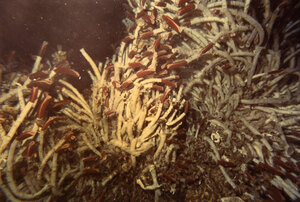
                                                The shimmering insides of a vent chimney

In Jules Verne’s 20,000 Leagues Under the Sea*, the iconic Captain Nemo announced that “in the depths of the ocean, there are mines of zinc, iron, silver and gold that would be quite easy to exploit” while predicting that the abundance of marine resources could satisfy human need. If the pace of development for deep-sea mining projects and the estimated value of deep-sea ores is any indicator, it seems as though our misanthropic mariner was wrong on both counts.

In The abundance of seafloor massive sulfide deposits, an international team of geologists attempts to quantify the total available copper and zinc contained in deep-sea massive sulfide mounds. Seafloor massive sulfide mounds are a byproduct of the processes that create deep-sea hydrothermal vents. As super-heated sea water emerges from the vent, it deposits heavy metals and other elements and minerals along the walls of the vent. Over thousands of years, an active vent field can build up a huge mound of metal and mineral rich ore – a massive sulfide mound. In addition to copper and zinc, these mounds can contain gold and silver. Generally, the ore is of much higher quality than its terrestrial counterpart. Over the last few decades, many exploration companies were eyeing these deposits, but it’s only recently that technological developments and economic incentives have aligned to permit potentially profitable deep-sea mining.

Not all hydrothermal vent systems produce massive sulfide mounds, and not all massive sulfide mounds are rich in heavy metals and valuable ore. To determine how much ore really is available in the deep sea, Hannington and his team examined 32 control sites of approximately equal size that broadly represent the geologic conditions of the global seafloor. They discovered 106 ore deposits great than 100 square meters, with many concentrated around neo-volcanic regions (areas of volcanic activity where most hydrothermal vents are found). Based on these samples, they estimated that there are approximately 900 neo-volcanic massive sulfide deposits, but that number could be as low as 500 or as high as 5000.

Saturday, December 17, 2011

   Black tiger shrimp may pose a huge problem for the Gulf Coast shrimp and oyster industry, an expert says.


Just when you thought it was safe to go back in the Gulf of Mexico, a new menace, this one striped like a big cat, is preying on aquatic life: The black tiger shrimp.


The biggest saltwater shrimp in the world, black tigers “are cannibalistic as are other shrimp but it’s larger so it can consume the others,” Tony Reisinger, country extension agent for the Texas Sea Grant Extension Service, told CNN on Friday.


Because of the threat of disease, the predatory intruder poses a problem for the native shrimp and oyster population of the Gulf, Reisinger said.


"Our oystermen right now are hurting because the oyster season is shut down due to a red tide. But this (black tiger) shrimp poses other concerns,” he said.


Appearing more than 25 years ago, the black tiger’s sudden reappearance is a mystery.


“The first time they started appearing was in the late 1980s on the East Coast,” he said. “Then they disappeared in 1991.”


But following the record-breaking hurricane season of 2005, which brought successive monster storms 
Katrina, Rita and Wilma, they started showing up again, he said.


“They’re well over 1,000 of them in the Gulf of Mexico now,” he said. “We’ve had five of them caught off Texas.”


Reisinger said he spoke to the Brownsville-Port Isabel Shrimp Producers Association recently to warn them about the shrimp but he was too late.


“It turns our fishermen have been catching them for a while, but they didn’t think they were marketable so they were throwing them back,” he said.
Is there a harvestable population already established in the Gulf? What does that mean for the Louisiana and South Texas shrimp and oyster industry? Many questions remain, Reisinger said. 

Wednesday, December 14, 2011

The Oceans are Getting Warmer by Jennifer Donelson

The average temperature of the oceans has already increased significantly due to global warming and will continue to warm rapidly in coming decades. If we are going to effectively manage and conserve fish populations, we need to understand if (and how) these species will adjust to higher temperatures.
Unfortunately, our current understanding of how species might acclimate and adjust to rising temperatures is incomplete. A recent study completed by my colleagues and I will hopefully develop our understanding in this area.

Tropical species are expected to be among the groups most sensitive to environmental warming because they have evolved in a relatively stable thermal environment. In addition, “ectothermic” (cold-blooded) organisms – such as fish and lizards – are likely to be strongly impacted by rises in temperature since their body temperature varies directly with the environmental temperature.
Generally, we expect some capacity for acclimation and adaptation since we already know this occurs between populations. Differences in performance (the ability to function within the environment) can be observed between the same species living at different latitudes and therefore different temperature regimes.

But there is limited knowledge of whether species' evolutionary response to climate change will occur quickly enough to keep up with climate change. One way to approach this question is by running long-term experiments that simulate future conditions (as we did).

Tuesday, December 13, 2011

Acidic Oceans Threaten Fish by Hannah Hoag

                                 Fish could be most susceptible to carbon dioxide when in the egg, or just hatched.

Stocks could suffer as seas soak up more carbon dioxide.

Ocean acidification — caused by climate change — looks likely to damage crucial fish stocks. Two studies published today in Nature Climate Change reveal that high carbon dioxide concentrations can cause death and organ damage in very young fish.

The work challenges the belief that fish, unlike organisms with shells or exoskeletons made of calcium carbonate, will be safe as marine CO2 levels rise.

Oceans act like carbon sponges, drawing CO2 from the atmosphere into the water. As the CO2 mixes with the water, it forms carbonic acid, making the water more acidic. The drop in pH removes calcite and aragonite — carbonate minerals essential for skeleton and shell formation — from the marine environment.

This can mean that corals, algae, shellfish and molluscs have difficulty forming skeletons and shells or that their shells become pitted and dissolve.

Flawed belief?

At present, atmospheric CO2 levels exceed 380 parts per million and are expected to climb throughout the century to approximately 800 p.p.m. if emissions are not kept in check. And the oceans are expected to continue to sop up the gas, dropping ocean pH by 0.4 units to about 7.7 by 2100

However, many scientists have suggested that acidification wouldn't be problematic for marine fish because they don’t have exoskeletons and because as adults they possess mechanisms that allow them to tolerate high concentrations of CO2.

But a handful of studies have shown that increased CO2 levels can wreck the sense of smell of orange clown fish larvae and increase the size of the otolith — a bony organ akin to the human inner ear — in white sea bass larvae.

Monday, December 12, 2011

Elephant Seal Travels 18,000 Miles

The Wildlife Conservation Society tracked a southern elephant seal for an astonishing 18,000 miles – the equivalent of New York to Sydney and back again.

WCS tracked the male seal from December, 2010, to November, 2011. The animal – nicknamed Jackson – was tagged on the beach in Admiralty Sound in Tierra del Fuego in southern Chile. WCS conservationists fitted Jackson with a small satellite transmitter that recorded his exact location when he surfaced to breathe.

Jackson swam 1,000 miles north, 400 miles west, and 100 miles south from the original tagging location, meandering through fjords and venturing past the continental shelf as he foraged for fish and squid.

During this tracking, the WCS team analyzed the data to better understand elephant seal migratory routes.

Elephant seals are potential indicators of the health of marine ecosystems and may show how climate change influences the distribution of prey species that serve as the basis of Patagonia's rich marine ecosystem. To protect this vast region, conservationists need to know how wildlife uses it throughout the year.

"Jackson's travels provide a roadmap of how elephant seals use the Patagonian Coast and its associated seas," said Caleb McClennen, WCS Director for Global Marine Programs. "This information is vital to improving ocean management in the region, helping establish protected areas in the right places, and ensuring fisheries are managed sustainably without harming vulnerable marine species like the southern elephant seal."

The information WCS gathers will serve as a foundation for a new model of private-public, terrestrial-marine conservation of the Admiralty Sound, Karukinka Natural Park (a WCS private protected area), and Alberto de Agostini National Park. It will help build a broader vision for bolstering conservation efforts across the Patagonian Sea and coast.

"The Wildlife Conservation Society has a long history of working in the spectacular Patagonia region to establish protected areas and advance conservation of its rich wildlife," said Julie Kunen, WCS Director of Latin America and Caribbean. "Individual stories like Jackson's are awe-inspiring, and also inform the science that will ultimately help protect this region."

WCS reports that Jackson has returned to Admiralty Sound, the site of the original tagging. Each year, elephant seals haul ashore in colonies to molt and find mates. The satellite transmitter is expected to work until early next year, when it will eventually fall off.

WCS has tracked more than 60 southern elephant seals via satellite on the Atlantic side of the Southern Cone since the early 1990s. Jackson represented the first southern elephant seal tagged from the Pacific side of the Southern Cone.

Elephant seals are among the largest pinnipeds in the world, reaching weights of up to 7,500 pounds and lengths of 20 feet.


Since 2004, WCS has owned and managed Karukinka Natural Park, the largest protected area on the main island of Tierra del Fuego. The 728,960-acre park protects the world's southernmost stands of old growth forests as well as grasslands, rivers, and wetlands. WCS, in partnership with the global investment bank Goldman, Sachs & Co., which donated the lands, has transformed Karukinka into a flagship for wildlife conservation in Patagonia. It is now supported by an advisory council made up of local scientific and business sector representatives who provide recommendations on the park's development and serves as a model demonstrating how the private sector help advance conservation activities worldwide.
From The World Conservation Society 

Tuesday, December 6, 2011

The Deep-Sea Find That Changed Biology by Rebecca Davis and Christopher Joyce

Saturday, December 3, 2011

Alabama Pilot's Nightmare in Shark-infested Waters May Help Save Coral Reefs

Twenty five years ago, on December 4, 1986, Walter Wyatt's plane crashed in the waters of Cay Sal Bank, a remote area between Cuba and The Bahamas. It sank almost immediately.

Walter, who now lives in Enterprise, Alabama, spent a night in the ocean fending off sharks, plugging holes in his leaking life vest, and hoping for a merciful end. The Coast Guard located and saved him the next morning and his harrowing experience made many headlines.

Now, a quarter-century later, his sunken plane has played an important part in a discovery that may help scientists better understand coral reef ecosystems.

In April, 2011, researchers from the Global Reef Expedition, a project of the Khaled bin Sultan Living Oceans Foundation, stumbled upon Walter's submerged twin-engine plane. That discovery shed light on the mysterious formation of perfectly circular "meadows" of seagrass.

The Seagrass circles range in diameter from a few dozen meters to hundreds of meters. Some are solid circles and others have a 'doughnut hole' in the middle. They are important to the health of coral reefs, because they provide vital nursery habitat and feeding areas to many animal species that live in and around reefs. But their round shape has been baffling.

Scientists from the Global Reef Expedition, a multi year research program to study and preserve coral reefs around the world, discovered filled in sink holes under the solid seagrass circles. And, in every doughnut shaped seagrass circle they found a synthetic object, including Walter Wyatt's plane.
Research suggests that phosphorous leaching from the sinkholes acts like a fertilizer for the solid circular seagrass beds above. And, for the doughnut shaped seagrass beds another kind of fertilizer is at work.

Underwater observations made during reef surveys revealed that Walter Wyatt's plane is acting as an artificial reef, providing safe harbor for many fishes and marine invertebrates. This "fertilizer," the researchers believe, is the waste excreted by the animals that make the reefs home.  To avoid predators, these creatures typically venture just a short distance from the safety of the reefs.  As a result, they fertilize a relatively narrow ring around the 'reef' or object.  It's in this circular ring where seagrass thrives.

The findings of the Global Reef Expedition will help the Bahamian government better manage Cay Sal Bank.  That should lead to improved protection of the coral reefs that are such a vital part of ocean environment.  That's good news for coral reefs in the western Atlantic Ocean, and for people everywhere.

Walter now feels that he benefited from his terrible misfortune. "It was a life-changing experience for me, and not entirely to the negative," he said.  "For one thing, I found out I wasn't the only being in the world.  I found out I was fragile."

As are coral reefs everywhere.

Friday, December 2, 2011

Trouble - Ocean Acidification, Warming and Deoxygenation

As huge amounts of financial investments are put into mitigating the effects of climate change on forests and renewable energy projects, marine scientists feel the oceans are being neglected by governments and policymakers.

As much as the land is affected by the climate change conditions, oceans are affected by acidification, warming and deoygenation which are all detrimental to the marine ecosystem. Climate change influences oxygen levels in the oceans with a particularly harsh effect on the warmer waters as higher temperatures reduce oxygen solubility. Ocean acidification and nutrient run-off from streams and rivers can contribute to deoxygenation. These effects combine resulting in interconnected triple trouble for the oceans.

Dr Anthony Ribbink, CEO of Sustainable Ocean Trust in South Africa, and programme manager for the South African Institute for Aquatic Biodiversity, provides a human analogy where the world has two lungs - forests and oceans.

Ribbink says at the UNFCCC COP 16 in Cancun, billions of dollars were pledged to restore, develop and maintain forests. "This is welcomed as forests play such a critical role in maintaining the atmosphere and accommodating a stunning diversity of species. The focus of COP 16, therefore, was on one lung of the globe (the forests)."

Recent Ocean Acidification

The diagram depicts the ocean’s carbonate buffer, which converts atmospheric CO2 into nongaseous forms such as bicarbonate (HCO3-) and carbonate ions (CO32-). Marine calcifiers create the calcium carbonate (CaCO3) and organic carbon(C) shown in the middle of the diagram, a process that will become more difficult with decreasing carbonate ion concentrations resulting from ocean acidification. The descending wiggly arrows represent the ocean’s ‘biological pump,’ which transfers carbon into the deep ocean and sediments over long time scales.


The oceans are more acidic as a result of carbon dioxide (CO2) emissions associated with human activity.

Surface ocean pH has become more acidic by approximately 0.1 units since pre-industrial times.

Ocean acidification affects calcium carbonate saturation in ocean waters, thereby making this building block of shells and skeletons less available which affects the health of corals and other marine organisms (e.g., crabs and clams).

The atmosphere and the oceans play key roles in regulating climate by continually exchanging carbon. As a result of anthropogenic CO2 emissions, the atmospheric concentration of CO2 has increased about 38 percent from pre-industrial times to 2009.  The amount of carbon contained in the ocean has increased in tandem with increasing atmospheric concentrations (IPCC, 2007b), due to the increasing atmospheric pressure of CO2. Over the past 200 years, oceans have absorbed approximately one-half of the CO2 produced by the burning of fossil fuels and other industrial processes (Raven et al, 2005).  This absorptive capacity of the oceans has resulted in atmospheric CO2 concentrations that are much lower than they otherwise would be (IPCC, 2007a).

The increase in the amount of CO2 dissolved in the oceans has increased the concentration of hydrogen ions (see Figure 1) in the oceans (IPCC, 2007b). As a result, the pH (a measure of acidity) of the oceans has decreased, making the oceans more acidic. It is estimated that the mean surface pH of the oceans has decreased by 0.1 units since pre-industrial times due to increased uptake of anthropogenic CO2 emissions (IPCC, 2007b). Since pH is measured on a logarithmic scale, a decrease of 0.1 in ocean pH equates to a 30 percent increase in the hydrogen ion concentration of the ocean (Raven et al, 2005).

The ocean’s natural carbonate buffer system (see Figure 1) allows seawater to accommodate the addition of an acid or base without appreciable pH change.  Therefore, this system buffers the increased concentration of hydrogen ions that results from elevated levels of dissolved CO2 in surface waters.  This keeps the oceans much less acidic than they otherwise would be, but it also reduces the carbonate ion concentration of the seawater, making calcification harder for corals and other marine calcifiers.

While the full impact of existing acidification on marine organisms is not well understood, experiments show that the calcification rates of marine organisms are strongly dependent on the saturation state of carbonate ions in seawater, which is affected by acidification (IPCC, 2007a). Future acidification could significantly affect many kinds of marine organisms and is very likely to interfere with the formation of shells and skeletons by corals and other marine calcifiers, such as crabs, marine snails, and clams.
                   

Monday, November 28, 2011


The Arctic Ocean and its adjacent seas are undergoing rapid environmental changes, most notably in the extent and duration of sea ice cover. However, the biological consequences of these changes and their impacts on humans remain poorly understood. For example, larger areas of open water and a longer production season are likely to increase primary production, but nutrient availability and increased storm events may limit any such increases. Changes in the abundance and spatial distribution of fish and mammals have been documented, but the ability of subarctic species to colonize new habitat in the Arctic, and the response of arctic species to an extended ice-free season, are highly uncertain. This symposium seeks to advance our understanding of present and future responses of arctic marine ecosystems to climate change at all trophic levels, from plankton to marine mammals. In addition to documenting and forecasting likely changes, we encourage contributions that focus on strategies for a proactive approach to managing living marine resources of the Arctic and for the successful adaptation of arctic people and their communities to these changing conditions.

Saturday, November 26, 2011

Australia to create world’s largest marine reserve in Coral Sea


CANBERRA, Australia — Australia says it will create the world’s largest marine reserve in the Coral Sea.

The Environment Ministry says the area has shallow reefs that support tropical ecosystems with sharks, coral, sponges and many fish species. The proposal includes seas beyond the already protected Great Barrier Reef Marine Park off northeast Australia.


The reserve would cover almost 400,000 square miles (nearly 1 million square kilometers).
Fishing would be allowed in parts of the reserve. Some conservationists raised concern such exceptions would make management of the reserve more difficult.

The proposal announced in a ministry statement Friday is now open for a 90-day comment period.
Copyright 2011 The Associated Press. All rights reserved. This material may not be published, broadcast, rewritten or redistributed.

Monday, November 14, 2011

Oceans from Disney Nature


After wowing us in the skies with “Winged Migration,” the two Jacques (Perrin and Cluzaud) are back to entice us to gaze in the opposite direction. In “Oceans,” Disneynature’s reconstitution of the 2009 French release “Océans,” the filmmakers venture in, on and around our seas to discover photogenic oddities and endangered wonders.

All the crystalline imagery and poetic immediacy that we have come to expect from this new generation of up-close-and-personal nature documentaries is here. Horseshoe crabs scuttle like possessed Nazi helmets and a school of fish morphs from dreidel to disco ball, as if choreographed by Busby Berkeley.

Moving from the infinitesimal to the gargantuan — from sea urchin larvae to 120-ton blue whales — the filmmakers work tirelessly to parallel their undersea world with the larger universe, offering genteel reminders of our mutual dependence.


Playing down the cruel (baby turtles running the gantlet of dive-bombing frigate birds) without overdoing the cute (a mommy-and-me walrus cuddle-fest), “Oceans” is almost too soothing.

“Human indifference is surely the oceans’ greatest threat,” murmurs Pierce Brosnan’s excruciatingly bland narration while images of the garbage patch in the North Pacific Gyre float on screen.

Reviews of the original film suggest a somewhat harsher environmental message (for example, a sequence showing several extinct species has, um, disappeared), but the poor bluefin tuna have survived the Disneynature editors if not the nets of bottom-trawling fishing boats. In any case, that lone supermarket cart sitting forlornly on the ocean floor says it all. 


Saturday, November 12, 2011

The Oceans.


Over 40% of the world’s oceans are heavily impacted by human activities with few areas—if any—left unaffected by anthropogenic factors. This means we humans (and what we deem civilization) have played a major role in the despoiling of the waters of the earth.

It’s not some unstoppable force of nature or preordained theology that 90% of the large fish are already gone. Human decisions have led us to where we are now and new human decisions are needed to forge a more logical and compassionate path. After all, 80% of all life on earth is found in the oceans and its where over half our oxygen is created.

The relentless quest for corporate profit has blinded us to the plight of the deep blue sea and how it impacts all forms of life. To follow is but a small sampling of what human culture has done and is doing to our beautiful—and essential—oceans:

We can begin this discussion with the ever-increasing ocean acidification. The carbon dioxide (CO2) that results from the burning of fossil fuels dissolves in the ocean and decreases the pH. Consider this:
  • Roughly 25% of all CO2 emissions are absorbed by oceans
  • Before humans began burning coal and oil, ocean pH had been relatively stable for 20 million years
  • Over the last 250 years, oceans have absorbed 530 billion tons of CO2, which has resulted in a 30% in ocean acidity

    The myriad deleterious impacts of acidification include the reduction of a mineral called carbonate, which forms the shells and skeletons of many shellfish and corals. As pH levels drop, shells literally dissolve. This effect also slows the building of coral reefs and some believe the tipping point for such reefs could be less then 40 years away. Often called “rainforests of the sea,” coral reefs are home to a quarter of all marine fish species and their presence buttresses coastal regions from strong waves and storms.

    Those forms of ocean life still somehow able to manage the increasing acidity are not exactly in the clear—thanks to bottom trawling. This is the highly non-selective fishing method of dragging immense nets along the ocean floor. Think of it as the sea-based version of forest clear cutting. Called “arguably the single most destructive human action for the world’s oceans,” trawling often leaves a trail that can be seen from space.


    Trawling is a major component in overfishing (or what I call “fishing”). Since large-scale industrial fishing methods was introduced in the 1950s, 90% of the large fish—e.g. tuna, swordfish, marlin, cod, halibut, skate, and flounder—are gone.

    In addition, estimates range as high as 50 to 100 million sharks killed each year—sometimes as unintended ‘bycatch’, other times more specifically when untold millions of sharks are targeted each year for their fins.

    This practice involves catching sharks, cutting off their fins while they are alive, and tossing the maimed fish back into the ocean (often still alive). The fins are dried and used in shark fin soup. To make this even more despicable, the shark fins don’t add flavor to the soup. They are added solely for texture.


    More than 200 million years before the dinosaurs, there were sharks. Do we really want to be part of the species that wiped them out?

    Thursday, November 10, 2011

    The Making of the Ocean Health Index

    If all goes well, when a scientific paper is published and the media pick up on the story, a lot of effort gets boiled down into a soundbite. New cure for cancer discovered. Water found on Mars. Fish stocks disappearing from the world’s oceans.

    This focus can be a good thing for communicating science to the public, but it masks a lot of what was necessary to produce that result. Often, the story of how, and why, science gets done is as interesting and important as the actual result. Indeed, the decisions about what does not belong in the soundbite are as critical as the decisions about what does. We’ve all heard about aha! moments or the apple falling on Newton’s head. Most of the time, the story is much messier than that, but also often more compelling.

    This is the first in a series of stories in which we will explain, explore and expose the process of science — as it is happening — for a large, collaborative, international project to develop a single composite measure for the health of the world’s oceans. The Ocean Health Index is trying to capture and synthesize how people benefit from marine systems and the ways that we interact with and affect ocean health — all in a single number.