Showing posts with label Water Industrial Use. Show all posts

Thursday, October 18, 2012

Emerging Asia Hits a Wall of Water

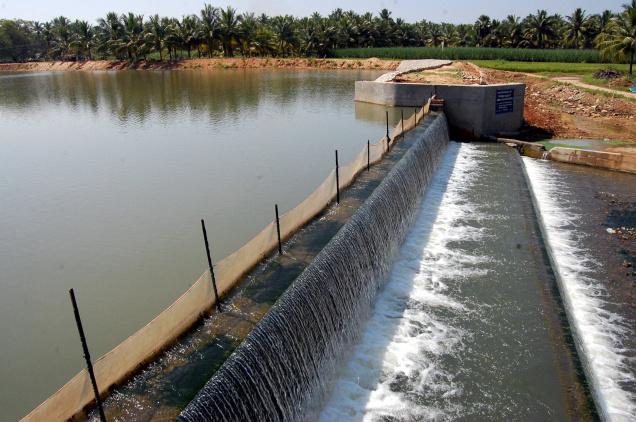
                                                                                                   India's Sardar Sarovar Narmada Dam 

It’s often said that people are a nation’s greatest resource. That can be true, especially with their knowledge and creativity, which can supplement physical resources. But one basic must is hard to think your way around: water.


So it is that the great emerging nations of Asia–China, India, Indonesia–face a wall in their development. All are confronted with either a scarcity of moisture in key regions, or an inability to contain the water that sometimes pours and deliver it in potable form to millions for daily life. The results can be barren fields, destructive floods or sickened populations from exposure to contamination.

Usually the water problem is a natural one of scant rainfall or the absence of topographical means of collection and retention, such as mountains for snowpack or lakes and flowing rivers. Thus you can have monsoons and still be dried out. (Some challenge the notion that this is any longer “natural” by contending that man-made climate change is involved.)

However, even tropical states can be water-constrained when the public infrastructure is so poor that inundation causes bacteria to run off from sewage and other sources and spoil the vital supply. This is the case in booming Indonesia, according to a currently featured article in the country’s fine Strategic Review quarterly.

India has both natural and man-made problems. A recent feature in the licensed edition Forbes India said the country has only 4% of the “total world resource” of water but 18% of the population. It noted: “Deficient monsoons often lead to shortage of drinking and irrigation water. Groundwater is polluted due to poor land practices, atmospheric deposition of pollutants and direct discharge of sewage into water bodies.” Quite a bill of particulars. And then there is controversy when dams have ultimately been attempted.

Forbes India cited a similar predicament in China, with 7% of “resource share” and 19% of global population. The Chinese government, of course, is more proactive on this front, at least in terms of damming and other diversions intended to route precious fluid from the mountainous south to the populous north. What this is doing or will do to areas like the Tibetan Plateau is debated, and it is now difficult for many foreigners to enter that sensitive zone to investigate. China has stumbled on an attempt to dam northern Burma.

(Dams are also a growing issue in the strategic battleground of Central Asia, where the major powers are plying for mineral wealth, whose extraction also takes water.)

So, mere expenditure for mass public works–even if done honestly and efficiently, and not riddled by graft–is not necessarily an easy response to water scarcity. (Few would object to basic water containmentl and purification projects.) There is also, for most nations, the option of the vast sea, if desalination can be afforded. Countries in North Africa and the Middle East have chosen this course as a palliative. It takes a well-stocked Treasury.

A supremely logical approach is to curb waste and misallocation by pricing water. Yet, failure to do so is common, nowhere more egregiously than in India. But this is understandable: where democracy is most rampant, the interests favored by currently free or cheap common water, if numerous, will be most able to keep their booty. Moreover, some who grasp the environmental aspects of water misuse nonetheless have a mental block on invoking the market as a remedy.

So we have a fundamental problem amid rising affluence, one that software code largely cannot solve, especially if politics blocks better allocation. Indonesia should be able to marshal its abundance, given honest government. But unless science somehow can muster rain clouds, much of Asia cannot affordably get “more” of something it needs to grow–and live. At some point, if the policy riddle of unpopular allocation is not solved, this becomes a Malthusian knot. That could trump the wisdom of the “people resource” and sidetrack a very promising growth story.


Saturday, October 6, 2012

Does China Have Enough Water to Keep Building Three Power Stations a Week?

                                                                        A farmer in drought-stricken Yunnan province, south-west China, March 2012. 

China builds an average of three new power stations a week; by 2030 it plans to add more power capacity than exists in the US, the UK and Australia today. This will require huge amounts of water for cooling and driving steam turbine generators. The country’s water resources are already stretched and climate change is making conditions even tougher.

So what does this mean for investors and companies?

We believe that water and power risks must be a top priority when planning capital expenditure. It is vital that the availability of water and the potential effect on supply chains is taken into account for the life of the investment.

Forty percent of China’s total agricultural output is produced in water-scarce regions. We believe five provinces – Hebei, Shanxi, Shandong, Henan and Jiangsu – and three municipalities, Beijing, Shanghai and Tianjin, are most at risk of water shortages. The industrial sector is doubly exposed because it consumes well over 80% of all electricity.

Given the investment implications, it’s important to look at how China is attempting to deal with the twin challenges of generating sufficient power to drive its giant economy and protecting its precious water supplies.

In 2010, thermal power represented 74% of China’s total installed capacity and hydropower 22%. This means that almost all power generation relies on water. The nation’s industrialisation, urbanisation and rising affluence will increase demand for electric power and with that comes the further depletion of limited water resources.

China’s annual renewable-water resource per capita averaged slightly over 2,000 cubic metres in 2003-2010, just above the water stress level of 1,700 cubic metres. On closer examination, this water is not evenly distributed throughout the country’s 31 provinces and municipalities. Eleven provinces are already water scarce (meaning they have less than 1,000 cubic metres per capita per year) and climate change, caused mostly by carbon-dioxide emissions from burning fossil fuels, exacerbates existing water stresses. The Chinese government recognises this and has responded by setting tough new water quotas as well as pollution reduction targets.

Coal and hydro expansion
We estimate China’s power sector uses approximately 10% of the nation’s water, relatively low compared to the UK’s 34% and 49% in the US. However, China plans to add 1,212 gigawatts of water-reliant power capacity by 2030, equivalent to almost six times India’s current installed generation capacity. Coal-fired power will continue to dominate: in the decade to 2020, China plans to add 453 gigawatts of coal-fired power capacity, equivalent to double Russia’s entire 2009 power generation capacity.

China’s coal-fired power capacity expansion will also involve an increase in coal mining, which consumes an abundance of water for extraction and processing. We estimate that 47% of coal reserves are located in water-scarce regions. Water scarcity could also lead to a greater reliance on coal imports; for example, 30% of China’s ensured coal reserves are in Shanxi, a province suffering from extreme water scarcity.

Changes in water availability also threaten hydropower. Although hydro-capacity is usually built in water-rich areas, the effects of shortages can be felt more quickly in the event of drought. Some hydropower stations have operated at below capacity in recent summers due to droughts in southern China.

The government plans to expand hydropower from 216 gigawatts in 2010 to 568 gigawatts by 2030. Unfortunately, the damming of rivers upstream has the potential to generate tensions with countries further downstream, so hydropower in China comes with geopolitical risk.

We believe the expansion of China’s installed thermal and hydro capacity will further stress water resources. Even with a change in fuel mix, we expect that 87% of power capacity will still require water. That means efficiency needs to be greatly improved.

Capping water use

Energy efficiency is as important as water efficiency. Using less energy would reduce demand for power, alleviating some of the water stress. China has improved both water and energy efficiency in recent years, although much more must be done to achieve national targets.

Stricter energy-efficiency targets have already been imposed on the industrial sector after they missed 2011 targets. We think industrial water targets could follow suit, though more efficient expansion may also require more upfront capital expenditure.

Water scarcity puts the metals and mining, utilities production and supply, and manufacturing segments at risk. No water means no electricity, and no raw materials such as iron and steel. As mentioned earlier, some 40% of agricultural output is produced in water-scarce regions, mainly in the country’s north. Climate change will also affect agricultural productivity through increased temperatures and altered water availability. Moreover, since agriculture is of prime importance to China in terms of food security, competition for water could become fiercer.

The central government set national water quotas in 2011. In response, provincial administrations have set and released 2015 water caps. Since the total of the 31 provincial caps actually exceeds the national total for 2015, some inter-provincial planning or collaboration will have to take place. We believe this further highlights the problem of enforcement in China. Moreover, some of the most water-scarce provinces have been given the toughest water pollution-reduction targets, making it extra hard to balance growth with water quantity and quality.

Since 45% of China’s GDP originates in water-scarce provinces, we think provincial water caps could force a change in the economic mix. Facilities may have to relocate, and water quotas and pollution-reduction targets could be enforced more strictly than in the past. In addition to the five provinces and three municipalities that are most at risk of water shortages, three borderline stressed provinces – Guangdong, Zhejiang and Inner Mongolia – are also vulnerable as they fluctuate in and out of water stress.

China’s planned economy is taking water and other resource stresses into account, however, the growth profiles of power and water in certain provinces seem to reveal a planning mismatch. Although water tariff hikes are also a concern, we believe the greater risk lies with water shortages. Improving both the water and energy efficiency of operations is crucial.

Water and power risks need to be considered as a core feature of capital expenditure plans. Project financiers should consider these resource shortages before funding assets, ensuring that water availability has been taken into account, and somewhat assured, for the life of the asset. Investors should examine the effects of potential water shortages on facilities located in water-scarce provinces and whether direct operations or supply chains could be affected. Companies should be more conscious of water quotas and pollution targets as they strive to make operations more efficient, as water targets may be more strictly enforced than in the past.

Finally, we believe that water constraints will provide an additional driver for industrial energy efficiency, already a priority of the 12th Five-Year Plan. Without upfront action now, we believe the risk remains and future assets could be left stranded high and dry.


By Wai-Shin Chan@chinadialogue.net

Wednesday, September 26, 2012

Wrong Climate for Damming Rivers


Hundreds of large dams are proposed in areas where climate change could bring great hydrological uncertainty, including the Amazon, the Mekong, Africa, China, and the Himalayas. While there is uncertainty in hydrological forecasts, one thing is clear: it's the wrong climate for damming rivers. First, big dams are at huge risk from climate change's impacts on river flows. Equally important, healthy rivers are also key to successful climate adaptation, especially for the world's poorest, who are also at greatest risk of climate change. Finally, large reservoirs can be significant sources of greenhouse gases. International Rivers is working to raise capacity on this critical issue globally and in dam-building regions, and promoting an energy revolution that allows us to dramatically cut our use of fossil fuels, while also preserving life-giving water resources.
Explore the following resources to learn more:

Raising Awareness with a global information campaign

International Rivers is working to create awareness about these issues, through a Google Earth 3D tour and video that  narrated by Nigerian activist Nnimmo Bassey, winner of the prestigious Right Livelihood Award and chair of Friends of the Earth International. The production was launched at the COP 17 climate meeting in Durban, South Africa in November 2011. The video and tour allow viewers to explore why dams are the wrong answer to climate change, by learning about topics such as reservoir emissions, dam safety, and adaptation while visiting real case studies in Africa, the Himalayas and the Amazon.

Friday, September 21, 2012

Energy Policies Have Water and Other Hidden Costs


Huge demands on increasingly scarce water are a major hidden cost of a "business as usual" approach to American electricity generation that needs to be more fully understood by policymakers and the public, according to a new Synapse Energy Economics Inc. report prepared for the nonprofit and nonpartisan Civil Society Institute (CSI) and the Environmental Working Group (EWG).

The new analysis, "The Hidden Costs of Electricity: Comparing the Hidden Costs of Power Generation Fuels," is available online. Six fuels used to generate electricity --- biomass, coal, nuclear, natural gas, solar (photovoltaic and concentrating solar power), and wind (both onshore and offshore) – are analyzed in the following categories: water impacts, climate change impacts, air pollution impacts, planning and cost risk, subsidies and tax incentives, land impacts, and other impacts.

Examples of the water-related findings in the report include the following:
  • Nuclear power has critical cooling requirements that require huge amounts of water. Roughly 62 percent of U.S. nuclear plants have closed-loop cooling systems. Reactors with closed-loop systems withdraw between 700-1,100 gallons of water per megawatt hour (MWh) and lose most of that water to evaporation. Water withdrawals are even higher at open-loop cooled nuclear plants, which need between 25,000-60,000 gallons per MWh. Most of the water is returned, but at a higher temperature and lower quality.
  • In addition to fouling streams and drinking water through mining and coal-ash dump sites, coal-fired power relies heavily on closed-loop cooling systems which withdraw between 500 and 600 gallons of water per MWh and lose most of this via evaporation. Withdrawals for open-looped cooled coal-fired power plants are between 20,000-50,000 gallons per MWh. Most of the water is returned, but at a higher temperature and lower quality.
  • Under a so-called "Clean Energy Standard," biomass would become a much larger source of U.S. electricity generation; however, biomass also requires vast amounts of water. The report notes that a typical 50 megawatt (MW) biomass plant could withdraw roughly 242 million gallons of water per year and lose most of this. Adding 10 of these plants in a region would use 2.42 billion gallons of water per year. For dedicated energy crops, water use for irrigation can be considerable. One study estimates water use for most crops between 40,000 and 100,000 gallons per MWh, with some crops exceeding this range.
  • In 2010, EPA estimated that fracking shale wells can use anywhere from two to 10 million gallons of water per well. The water is often extracted from on-site surface or groundwater supplies. Such huge water withdrawals raise serious concerns about the impacts on ecosystems and drinking water supplies, especially in areas under drought conditions, areas with low seasonal flow, locations with already stressed water supplies, or locations with waters that have sensitive aquatic communities.
  • By contrast, wind and solar photovoltaic power requires little water in the electricity generation process. Concentrating solar power requires water for cooling purposes, but new technologies are placing greater emphasis on dry cooling. Solar power plants with dry cooling use only around 80 gallons per MWh – about a tenth of the low-end estimate for nuclear power and one-sixth of the low end estimate for coal-fired power generation.
Click here to read the full article.

Monday, September 17, 2012

India: Making Better Use of Water Resources


Farmers in many parts of the country utilised groundwater to save their crops when monsoon played truant this year.
Groundwater’s use for agriculture assumes significance since only 44 per cent of the net sown area of 140 million hectares is irrigated.

OVER USE

Due to unplanned development, overexploitation of ground water resources has resulted in considerable decline in ground water.
About 15 per cent of the blocks, talukas and mandals in the country are currently in the over-exploited zones.
Also, the over-use of surface water has resulted in drainage problem in irrigation, causing water logging in some areas.

POLLUTION

Pollution of river and deterioration in the quality of ground water are other added problems.
Pollution has mainly been caused by untreated sewage from the urban areas and effluent from the industry.
Excessive use of chemicals and fertilisers and pesticides is another reason for pollution.
These issues call for further development of water resources to meet the growing demand, particularly for irrigation, industrial use and drinking.
According to the Ministry of Water Resources, there is a need to bring more cropped area under assured irrigation to increase productivity and production.
A policy paper of the Ministry has estimated the irrigation potential of the country at 140 million hectares. Surface water is seen meeting the requirements of 76 million hectares and ground water the rest.

WATER MANAGEMENT PRACTICES

The Ministry is in constant dialogue with various arms of the Government to harness the available irrigation potential.
In fact, the Centre prefers to see irrigation potential beyond the identified 140 million hectares through better water management practices. Given the hydrological features and topographical constraints in the country, this is a challenging task. But surplus flood water is one source that can be utilised to tap the irrigation potential.

POSSIBILITIES

One way for this could be interlinking of rivers and this is seen as helping to provide irrigational facilities for 35 million hectares.
Artificial recharge of ground water could also help in additional water availability of about 36 billion cubic metres that can be utilised for various purposes included irrigation.
Water is seen as the solution to challenges of food security and climate change impact in developing countries.
Though the impact of climate change on water resources is yet to be made, various studies say that this could lead to intensification of the variation in the availability of water. In particular, there could extreme events of flood and drought.

SAVING METHODS

The emerging situation calls for various methods to save water. One of the ways could be to harvest rain water.
Very few States in the country have taken the initiative. The other way could be to construct check dams so that water can not only be preserved but the groundwater can also be recharged.
Recycling water for irrigation and industrial use can be another way. Also, water for irrigation is free in the country and power to draw water is also free in most States.
A review of these is another way to preserve water besides ensuring its proper usage.


Tuesday, August 28, 2012

Four Ways Water is Connected to India's Blackouts

Early last week, the strained electrical power infrastructure in northern and eastern India was pushed to its breaking point. Two days of power failures impacted a staggering 670 million people(or, put another way, more than the combined populations of the U.S., Canada, Mexico, Central America, and Brazil!) , leaving them in the dark and without air conditioning during a period of sweltering heat. India is now putting increased scrutiny on its power grid, with an independent audit already in the works. However, last week’s blackouts were created as much by pipes and pumps as they were by power plants and transmission lines. In many ways, the country’s power problems are symptoms of agrowing water crisis.

How Water Impacted India’s Power System

So what does a series of blackouts have to do with a water crisis? More than you might think. Here are just a few examples that illustrate how water is at the root of India’s power challenge:
  1. An abnormally weak monsoon in India’s agricultural states, with rainfall down 18 percent from normal, hit farmers first . Without enough rain to adequately water their crops, Indian farmers turned to pumping groundwater for irrigation, using electric pumps. This added draw on the electricity supply increased pressure on the already strained power grid.
  2. Low rainfall has also impacted the hydroelectric power plants India relies on for 19 percent of its electricity. Less water behind dams means less power. This year’s hydroelectric power production is down 19 percent from last year..
  3. Conventional power plants are just as dependent on water as hydroelectric plants. Thermal power plants (such as fossil fuel and nuclear plants) need water to keep their equipment cool and functioning. A lack of water for cooling has threatened to force some of India’s nuclear power facilities to shut down.
  4. Even as much of India struggles with lack of rain, in some places, too much water is driving power problems. Two hydropower plants in Himachal Pradesh—including the country’s largest at 1,500 megawatts—were forced to shut down last week due to high silt levels in the Sutlej river. Silt, washed into the river by heavy rains, can seriously damage hydroelectric facilities and must be cleared before power production can resume.

What Does the Future Hold?

The future of India’s water and power management are inextricably linked. With the direct financial impacts of those two days of blackouts estimated to be in the hundreds of millions of dollars, the risks water can pose to power must be better understood and managed in the coming years.
However, there is some concern that the path India is taking towards improving its power grid may be a dangerous one. A 2010 report by WRI found that 79 percent of new thermal and hydroelectric power plants planned for construction by the three largest power companies in the country were to be built in water scarce regions. WRI’s Aqueduct project created the map below, which shows that the trend of building power plants in places facing worsening water stress is prevalent throughout Southeast Asia. The blue spots show the locations of hydroelectric, nuclear, and thermal power plants, while the redder regions of the map are places projected to experience severe increases in water stress driven by climate change, increased water use, and economic development.
Location of Power Plants in Southeast Asia, and Projected Water Stress in 2025 - Aqueduct

Understanding and Managing Water Risks

While it is undeniably important for governments and other decision makers to increase electric power generation capacity to meet growing demands, these projects need to be planned in ways that consider a country’s resources. Decision makers will need to further their knowledge of current and projected water risks before adding to their grid capacity.
The complex relationship between water and power is just one of the ways water scarcity is shaping the 21st century. Water has similar relationships with food production, industry, security, and other facets of human civilization. As the ability of water to impact these other parts of our lives becomes more prominent, improving our understanding of water and water management has never been more urgent.

Wednesday, July 11, 2012

My Water’s On Fire Tonight (The Fracking Song)


“My Water’s On Fire Tonight” is a product of Studio 20 NYU (http://bit.ly/hzGRYP) in collaboration with ProPublica.org (http://bit.ly/5tJN). The song is based on ProPublica’s investigation on hydraulic fractured gas drilling (read the full investigation here: http://bit.ly/15sib6).

Music by David Holmes and Andrew Bean
Vocals and Lyrics by David Holmes and Niel Bekker
Animation by Adam Sakellarides and Lisa Rucker

Saturday, July 7, 2012

How Much Water Did It Take to Make Your Jeans


When we talk about water consumption, we immediately think about drinking, bathing, watering plants, cooking and washing.

Those of us with the privilege of having our names on monthly water bills are told clearly how much water has been consumed by the household and how that figure stacks against an average household of similar size.

However, this is not our total water consumption. In fact, globally the water consumption due to household water use accounts for only 8 per cent of total water demand. The rest is used in industries and agriculture. Given that the purpose of industry and agriculture is to produce goods and services that are eventually consumed by us, placing a water tag on them might provide a true measure of the water consumption by an individual or a nation.

The table shows the amount of water consumed to produce a list of products.


The value of imposing a water tag on goods consumed could help create awareness of the amount of water that is being used in the production of various goods and the amount of water that an individual, region or nation is consuming. This could potentially lead to optimisation of water use in the production of these goods and also help countries/regions with water scarcity to decide effectively what goods should be produced and what should be imported.

For example, a water scarce country might find it more favourable to import jeans to meet the local demand as opposed to producing the jeans itself. This way it can save tonnes of water. For the consideration to work however, the scarcity of water has to be priced into the value of water, when compared against land, labour, energy and other economic considerations.

With a water tag on goods and services, it is then possible to calculate the total water footprint of an individual or country. This measure is being championed by the Water Footprint Network (WFN) to become a global standard for the measurement of water consumption. According to data collected by WFN, although the total water footprint for China, India and the United States together accounts for 39 per cent of the global water footprint, the water footprint per capita in China and India is less than half that of the US and other affluent countries due to higher consumption.

The percentage of a country's water footprint that falls outside it is another useful parameter. In the case of India it is less than 3 per cent, but Singapore, without any natural resources, is estimated at 90 per cent. Therefore countries with sufficient water resources to meet their water footprints should manage them efficiently. And countries with insufficient water resources should strive to increase these resources by adopting technology for recycling/desalination or importing water intensive products.

All should strive to reduce consumption of goods.

Therefore the next time you decide what to consume or discard, do consider its water tag and how every decision you make helps to lessen the dependency on water in your country and globally.

Dr Gurdev Singh@ASIAONE Science & Tech

Saturday, June 23, 2012

Double the Benefits: Clean Energy also Saves Water

                                                     Production of electricity results in one of the largest uses of water in the nation. 

In his first State of the Union, President Barack Obama set a goal for 80 percent of America's electricity to come from clean energy. Last week, the release of the Renewable Electricity Future study by the U.S. National Renewable Energy Laboratory (NREL) confirms that reaching this goal by 2050 is very possible. But what impact would clean energy have on another key ingredient to daily life: clean water? Researchers at MIT helped answer that question in NREL's report.

The MIT research — The Impact of Renewable Electricity Futures on Water Demand — is a compilation of the water segment of the Renewable Electricity Future study. In it, the researchers find that as solar panels, wind turbines and other sources of non-thermal renewable energy replace coal, gas and similar thermal powerplants, the use of water to cool those powerplants will decrease by about half.

"The most important use of water for electricity production is for cooling," says Adam Schlosser, an author of the study and the assistant director for science research at MIT's Joint Program on the Science and Policy of Global Change. "The benefit of renewables like wind or solar is that you don't need to boil water for steam to spin the turbines, and then you don't need water to cool the steam. That cooling process is removed, saving a lot of water."

This is good news for water-stressed regions, including much of the western United States, as production of electrical power results in one of the largest uses of water in the nation. A 2005 report by the U.S. Geological Service found that about 201,000 million gallons of water each day were used to produce electricity, with much of this water going toward keeping powerplants cool.

While most Americans will use less water when powering their homes with renewable energy, the MIT researchers did find that areas that switch to thermal renewable technologies might end up using more water. Biomass energy, being produced mostly in the northwestern United States, is one strong example, the study finds.

"Biomass is obviously contributing to the carbon aspect of the overall problem," Schlosser says, "But it's actually exacerbating an already water-stressed situation because you not only need water to grow it, you also need water to cool the thermal electricity generation process."

Schlosser compares this to concentrated solar technology being used in the southwest, which typically relies on a dry cooling system where fans are used instead of water.

"Solar technology really benefits the southwest because it uses a resource that's so plentiful in that region — the sun — and doesn't use a resource that there is very little of — water," Schlosser says.

But Schlosser explains that the dry cooling technology — while an obvious choice for the drought-stricken southwestern United States because it uses 90 percent less water — is less efficient and more expensive because the electric plant would need to use electricity to run large fans that force air through the heat-exchange process. This explains why areas where water scarcity is more subtle would choose to stick to water cooling technologies in thermal electricity generation.

Along with using less water, the Renewable Electricity Future study finds that greenhouse gas emissions would be reduced by about 80 percent, potentially offering significant public health benefits. The National Research Council estimated that in 2005, air pollution emissions from coal powerplants cost $32 per megawatt of energy in public health damages, the report notes, suggesting that the health cost benefits could counterbalance the costs to build clean energy infrastructure. 


Tuesday, June 5, 2012

Conflict Over Water in 2020: Mining or Agriculture?


Water will be a source of conflict and could possibly be a reason for war in 2020 if  the river basins of Mindanao are not managed properly and the crucial resource is not allocated well, Secretary Lucille Sering, vice chair of the Climate Change Commission, warned in her keynote address at the Mindanao Economy and Environment Summit Monday.

But Sering added that water can also be a “catalyst for unity”  depending on how we act now.

Given a reduced rainfall by 2020, potential conflicts over water use have to be defined and studied, she told some 200 participants at the Grand Regal Hotel.

“Mining has been mentioned. Water is crucial… If you see reduction of water in 2020,  mining needs water, agriculture needs water and even hydropower needs water. Ano po ba ang uunahin natin sa paggamit sa ating tubig?” (What will be our first priority in using water?), Sering asked.

But she quickly answered her own question. “Hindi lang po natin pag-aaralan kung paano i-manage ang ating river basins kundi paano natin i-allocate itong resources na ito para hindi tayo mag-away-away at maging panibagong rason para magkagyera,” (Let us not just study about how to manage the river basins but also how to allocate water resources so that we will not fight and make this a new reason for war), the Secretary said.

She said Mindanawons need to protect their right to live peacefully and to live with sufficient water.

Talking about water is not that simple, said Sering. “When we talk about water, it means a lot of things. What we do now will really somehow define what will happen to us  in the future. What we will do now and how we will take care of it will also really define what will happen in the future. It could either be a source of conflict or a catalyst for unity,”  Sering explained.

Citing the climate change scenario of the Philippine Atmospheric Geophysical and Astronomical Services Administration (PAG-ASA),  Sering said Mindanao and the entire country will experience reduction of rainfall around 2020.

Mindanao will experience a decrease in rainfall for at least six months from April to September “and when it rains, it will really, really pour so this is where we have to understand and determine how do we manage our waters.”

Sering also pointed to the need to have an economic model that is “unique to Mindanao.”

She took note of what Davao City Planning Officer Roberto Alabadao, representative of Davao City Mayor Sara Duterte, said on the challenge of balance, “that if you do environment — somehow that was the impression that I got — it’s like anti-development. 

And maybe we should look at this economic model because we have to have an economic model that’s unique to Mindanao. We now need to review this brown economy. We now need to look at this green economy because we now need to understand if the current economic model is still fit.”

The United Nations Environment Programme (UNEP) defines green economy as “a system of economic activities related to the production, distribution and consumption of goods and services that result in improved human wellbeing over the long term, while not exposing future generations to significant environmental risks and ecological scarcities.”
 
Jose Ma. Lorenzo Tan, executive director of the World Wildlife Fund, also mentioned mining and agriculture in his presentation. He stressed the need to think about Mindanao’s priorities, given that government and the business sector have zeroed in on mining as an opportunity.

“To a great extent, the key environmental decision that Mindanao has to make today, revolves around the perceived potential of this non-renewable resource and the impacts of mining on the island’s dependence on natural resource, and its core business, i.e, agriculture.”

“Think about this carefully,” he said.

He ticked off statistics on Mindanao’s mineral wealth: an estimated 43% of the country’s chromite reserves, 56% of copper, 63% of nickel, 67% of bauxite and 75% of the country’s gold reserves.

Gold mining, Tan said, stands out as an activity of special concern as this mineral has “almost singlehandedly fueled the proliferation of less stringently regulated small scale and artisanal mining activity.”

But given that agriculture has its own set of requirements that remain unrealized, Tan said Mindanao has to decide “how best to sustain its core business and avoid a case of double jeopardy.”

“Unless it is the collective intention of Mindanao’s leaders to scale down agriculture as its primary economic driver, the difficult decisions on mining have to be made soon and cast in stone,” Tan said, adding that if the non-renewable wealth is withdrawn, “there must be some prior definition of how much of those earnings will constitute a net benefit to the people of Mindanao.”

In her opening remarks, Secretary Luwalhati Antonino, Mindanao Development Authority (MinDA) chair,  narrated how Mindanao, the country’s food basket, “produces 40% of the total food requirements of the country”  but with the pace of forest degradation, is at risk of not being able to feed its population of 22 million.

Tan noted Mindanao is consistently a net exporting economy with export earnings, mostly from agri-based products at USD2.19 billion in 2009, that it has improved its product mix over the years and from 1995 to 2007, 71% of its total agricultural exports have been enhanced by added value.

This underscores that Mindanao’s competitiveness is “firmly anchored on the sustained viability of ecosystem services,” he said.

But Tan asked, “how much of this has returned to accelerate the internal velocity of money within Mindanao?”

Tan also aired a concern that needs to be addressed: that while wealth is being created in Mindanao and Mindanao has been a net contributor of savings to the rest of the Philippine economy, Mindanao’s deposits to the banking system “far exceed loans granted for Mindanao projects.”

“This indicates that the banking system effectively withdraws wealth out of the island’s economy. Rather than serving to boost its own ‘natural balance sheet,’ the ‘net income’ of Mindanao is being utilized elsewhere,” he said.

Sering said Mindanao continues to lag behind despite that fact it has the biggest contribution to the national economy.

The two-day Summit, whose theme is “Building Constituency, Managing River Basins, 

Achieving Green Economy,” is part of  the Mindanao Nurturing Our Waters (MindaNOW) program of  MinDA that is aimed at “creating champions, building constituency and adapting change in responding to the challenge of ensuring food on the table without compromising the carrying capacity of the environment by caring for our waters.”
 
The Summit is also timed for the June 5 celebration of World Environment Day. This year’s theme is “Green Economy: Does it include you?”  

Sunday, June 3, 2012

Removal of Billions of Gallons of Water from the Earth’s Surface Arouses New Opposition to Fracking

Tom Bragg (left) of Sunpro Inc. works on filling his truck as Gary Wortman (right) takes off the filler hose from his truck after filling up with water at a Chesapeake Energy Corporation fresh water collection station in Carroll County, Ohio. (Mike CardewAkron Beacon Journal) 


Lea Harper of Senecaville is on the warpath.

The southeast Ohio resident is upset that the Muskingum Watershed Conservancy District, which collects surface water from Akron’s south side all the way to Marietta on the Ohio River, is selling water from one of its reservoirs to Gulfport Energy Corp. for natural gas drilling.

That water from Clendening Reservoir in Harrison County could be just the beginning of a huge drain on Ohio’s water resources, she said. Hundreds of billions of gallons are at stake, not only because of its immediate effect on lakes and rivers, but also perhaps a permanent effect on water supplies.

Chesapeake Energy Corp., for example, the most active driller in the state, is interested in the watershed’s Leesville Reservoir about 20 miles south of Canton.

Paul Feezel of Carroll Concerned Citizens, a grass-roots group in Carroll County where drilling is heaviest, estimates that the water needed to supply Ohio’s annual drilling needs could drain two thirds of Leesville Reservoir annually.

In all, the conservancy district has requests for water from a dozen drilling companies that are eager to tap six reservoirs in eastern Ohio: Clendening, Leesville and Tappan Lake in Harrison County; Atwood Lake in Carroll and Tuscarawas counties; Piedmont Lake in Belmont and Harrison counties and Seneca Lake in Noble and Guernsey counties.

But the conservancy is not the only source: Drillers are buying water from communities, private pond owners, water districts and private water companies, as well as pulling free water from Ohio streams.

“I’m just flabbergasted and appalled that Ohioans are willing to see their water future disappear,” said Harper, who heads the Southeast Ohio Alliance to Save Our Water, a grass-roots group.

Billions of gallons needed

Ohio has plenty of water and can furnish the water needed for drilling to help boost Ohio’s economy, state officials say. The water needed by drillers is just a drop in the bucket.

Ohio typically uses 8.7 billion gallons per day from surface and underground supplies, according to state data. Electric power plants are the biggest users alone using 6.5 billion gallons daily, according to 2010 data.

In comparison, it will take an entire year for natural gas drilling to consume about 5.2 billion gallons in Ohio.

Water, sand and chemicals are mixed and forced into wells under high pressure to fracture the earth, releasing natural gas. Water also is used to prepare cement that lines the wells, mix chemicals and control dust on roads.

Each natural gas well in Ohio needs 2 million to 6 million gallons of fresh water, the state says. The initial Ohio wells generally took 5 million to 6 million gallons.

That’s about as much as 50 four-person households would consume over the course of a year. On the other hand, in one day the city of Akron typically uses 34.66 million gallons from its reservoirs — enough to frack six wells.

If Ohio’s quest for natural gas plays out over the next 20 to 40 years, it is estimated that 120 billion to 200 billion gallons of water could be needed — more than Akron is likely to deliver to its customers in 95 years.

In water-poor western states like Texas, Oklahoma, Colorado, New Mexico and Wyoming, that has become a problem. Even in central Pennsylvania, which typically is not considered a dry area, drilling has been curtailed because drought has reduced water levels in the Susquehanna River and its tributaries.

Multiple concerns

Harper said she is troubled by the heavy use of a limited fresh-water resource, the threat of contamination, the threat to recreation on the lakes and whether it is right that a public agency be making a profit off water sales.

The district, she says, was created to prevent flooding and to conserve water, not to profit from water sales to drillers.

“It’s one of our greatest resources and we’re giving it away,” she said. “We’re supporting a risky and exploitative industry. We need to fight this. It’s not sustainable. This is a big issue that’s getting bigger. … It’s a problem that not enough people are paying attention to. We have to take a stand.”

No one is monitoring such withdrawals or tracking the cumulative impacts of providing billions of gallons of water to drillers, she said.

Her group and other grass-root groups across eastern Ohio joined Saturday as a show of force when they rallied before a meeting of the conservancy district’s court in New Philadelphia.

Early stages of demand

The 18-county conservancy district — it covers 20 percent of Ohio stretching from the Ohio River to parts of Summit, Medina and Wayne counties — has defended its actions and says it is doing nothing wrong in selling water to drillers and boosting economic development, said spokesman Darrin Lautenschleger.

Ohio has plenty of water to handle drillers’ requests now and in the future, said Ted Lozier of the Ohio Department of Natural Resources’ Division of Soil and Water Resources.

The amount being requested by drillers may sound like a large volume of water, he said.
“But, relatively speaking, it’s not much at all,” he said.

He added: “Ohio has definitely been blessed with rich water resources … and we don’t see this being a problem. We have more than enough supply to handle drilling.”

He acknowledged that if there were a sustained drought, there could be a need for alternate sources. Drillers cannot take water from Lake Erie or streams that feed into Lake Erie under Great Lakes rules.

Like Ohio officials, Chesapeake considers water availability in Ohio to be a non-issue, but the company works with federal, state and local agencies to assure there are no negative impacts from its water withdrawals, said company spokesman Pete Kenworthy.

Water is lost

Environmentalists are not convinced there is no problem, especially in light of the fact that Ohio could be looking at tens of thousands of wells in the coming years. And those wells will be fracked multiple times over the years.

When the fresh water goes down into the well, it comes out polluted with dissolved solids, toxic chemicals used in the fracking process, heavy metals and even low levels of radiation from the rock.

A few companies like Chesapeake Energy are starting to recycle that wastewater and reuse it in future drilling. A Canadian company wants to frack with propane, not water. Both ideas would require less fresh water.

But at the moment, most of the wastewater is injected below ground in Ohio’s 176 injection wells for permanent disposal.

That means that the water is lost from the fresh water cycle, said critic Sara Rollet Gosman, a water resources attorney with the National Wildlife Federation’s Great Lakes office in Ann Arbor, Mich.

Unlike water used by agriculture and industry, water used in fracking disappears from the hydrological cycle and cannot be used again, she said.

That’s where the numbers take on new meaning.

If the U.S. Environmental Protection Agency is correct — that somewhere between 70 billion and 140 billion gallons of water were used in 2011 alone in fracking an estimated 35,000 wells across the country — much of that water may be forever removed from life cycle of the earth’s surface.

“It’s different than other traditional water withdrawals,” she said. “It is a 100 percent consumptive use. The water is basically pretty much lost and gone forever.”

One environmental group, Food & Water Watch, has called for a ban on fracking because of the growing threat to drinking-water supplies.

Fracking poses “serious, long-term risks to vital water resources,” said Wenonah Hauter, executive director of Food & Water Watch, a group based in Washington, D.C., in a statement in March.

Another group, American Rivers, has expressed major concerns on fracking and its impact on streams.

Finding sources

At present, drillers are finding multiple sources, from free water in Ohio streams to buying from community water systems.

Chesapeake Energy tries to get its water as close as possible to the well to minimize transport costs.

“We look to all potential water sources whether it be from landowners, businesses or municipalities,” said Chesapeake’s Kenworthy.

Companies are contracting with a number of Ohio municipalities, among them Louisville, Steubenville, Cambridge, Cadiz, Salem, Jefferson County and the Buckeye Water District in Columbiana County.

In February, Chesapeake signed a five-year contract with Steubenville to buy as much as 700,000 gallons a day from the University Boulevard reservoir that is filled with water pumped from the Ohio River.

The Oklahoma-based firm and the No. 1 player in Ohio’s Utica shale pays $5 per 1,000 gallons of raw river, treated wastewater or treated drinking water. That means that Steubenville earns up to $120,000 a month in Chesapeake water sales.

Such sales now make it impossible to track how much water drillers are using in Ohio because the water shows up in state data as municipal water usage, not for drilling, said eco-advocate Teresa Mills of Center for Health, Environment and Justice in Columbus.

“I don’t see how we will ever get the true picture of how much water is being destroyed by this industry,” she said.

Under Senate Bill 315, Ohio’s newly passed law on drilling, drillers will have to disclose their water source and how much water they use for the first time, the state says.

The Ohio Department of Natural Resources now typically meets with drillers before drilling begins and discusses planned water usage, said spokeswoman Heidi Hetzel-Evans.

But plans are often sketchy and under current rules, drillers do not have to tell the state what the water source or volume is, she said.

Drillers also are getting well water from landowners with whom they have leases, although the 12 counties in eastern Ohio where the drilling into the Utica shale is under way are poor for ground water yields. Five gallons a minute, enough for a household, is the typical yield, according to state reports.

Lakes are more dependable

The drillers now want to tap into larger, dependable lakes and reservoirs in eastern Ohio.

Clendening Reservoir holds an estimated 8.6 billion gallons. The watershed district agreed to sell up to 11 million gallons or 0.12 percent of the reservoir’s capacity to Gulfport Energy. Gulfport agreed to pay $9 per 1,000 gallons.

The village of Cadiz gets its drinking water from the district via Tappan Lake in Harrison County. It pays 10 cents per 1,000 gallons. It has then been selling its water at a much higher price to Chesapeake Energy. The village wants to buy more water from Tappan to sell to drillers.

The watershed district has asked the U.S. Geological Survey to determine how much “excess” water it might have available to sell to drillers from three of its reservoirs: Clendening, Leesville and Atwood.

A preliminary federal study indicated that the district has available water in April but that level declines through the summer as recreational needs must be met in the reservoirs.
Harper, meanwhile, has no intention of giving up.

“Water is a valuable resource that we cannot afford to lose,” she said. “What’s happening just isn’t right. It may be legal but we don’t think it’s moral to exploit our natural resources. And I’m not going away.”

Written by Bob Downing@Ohio.com