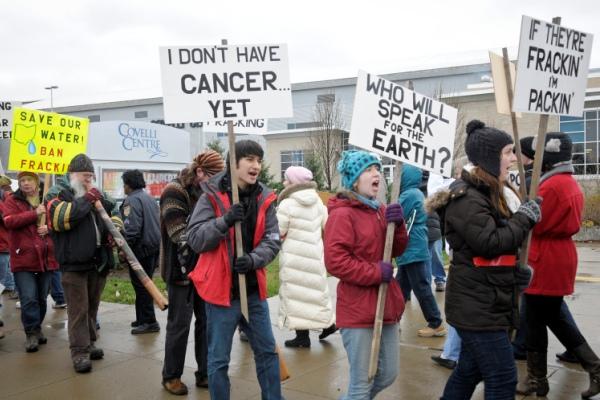
Showing posts with label Fracking. Show all posts

Tuesday, October 9, 2012

First Assessment of Shale Gas Resources in the Utica Shale: 38 Trillion Cubic Feet


The Utica Shale contains about 38 trillion cubic feet of undiscovered, technically recoverable natural gas (at the mean estimate) according to the first assessment of this continuous (unconventional) natural gas accumulation by the U. S. Geological Survey.  The Utica Shale has a mean of 940 million barrels of unconventional oil resources and a mean of 208 million barrels of unconventional natural gas liquids.

The Utica Shale lies beneath the Marcellus Shale, and both are part of the Appalachian Basin, which is the longest-producing petroleum province in the United States. The Marcellus Shale, at 84 TCF of natural gas, is the largest unconventional gas basin USGS has assessed.  This is followed closely by the Greater Green River Basin in southwestern Wyoming, which has 84 TCF of undiscovered natural gas, of which 82 TCF is continuous (tight gas). 

"Understanding our domestic oil and gas resource potential is important, which is why we assess emerging plays like the Utica, as well as areas that have been in production for some time" said Brenda Pierce, USGS Energy Resources Program Coordinator.  "Publicly available information about undiscovered oil and gas resources can aid policy makers and resource managers, and inform the debate about resource development."

The Utica Shale assessment covered areas in Maryland, New York, Ohio, Pennsylvania, Virginia, and West Virginia. 

Some shale rock formations, like the Utica and Marcellus, can be source rocks – those formations from which hydrocarbons, such as oil and gas, originate. Conventional oil and gas resources gradually migrate away from the source rock into other formations and traps, whereas continuous resources, such as shale oil and shale gas, remain trapped within the original source rock.

These new estimates are for technically recoverable oil and gas resources, which are those quantities of oil and gas producible using currently available technology and industry practices, regardless of economic or accessibility considerations.

This USGS assessment is an estimate of continuous oil, gas, and natural gas liquid accumulations in the Upper Ordovician Utica Shale of the Appalachian Basin. The estimate of undiscovered oil ranges from 590 million barrels to 1.39 billion barrels (95 percent to 5 percent probability, respectively), natural gas ranges from 21 to 61 TCF (95 percent to 5 percent probability, respectively), and the estimate of natural gas liquids ranges from 4 to 16 million barrels (95 percent to 5 percent probability, respectively).

USGS is the only provider of publicly available estimates of undiscovered technically recoverable oil and gas resources of onshore lands and offshore state waters. The USGS Utica Shale assessment was undertaken as part of a nationwide project assessing domestic petroleum basins using standardized methodology and protocol.

The new assessment of the Utica Shale may be found online. To find out more about USGS energy assessments and other energy research, please visit the USGS Energy Resources Program website, sign up for ourNewsletter, and follow us on Twitter.


Monday, October 8, 2012

Is Fracking Behind Contamination in Wyoming Groundwater?


The US Environmental Protection Agency (EPA) sparked a firestorm in December last year when it released a draft report1 suggesting that the use of hydraulic fracturing — or 'fracking' — to extract natural gas had contaminated groundwater near Pavillion, Wyoming. Industry officials have long denied that fracking affects groundwater, and Pavillion has become the first high-profile test of this claim. On 26 September, the US Geological Survey (USGS) released data showing the presence of groundwater contamination in the region2. Although the data would seem to support the EPA’s assessment — as does an independent analysis released by environmental groups this week3 — the survey did not seek to determine the source of the contamination. Natureexamines the on-going debate and how it relates to broader questions about groundwater contamination from fracking across the United States.

How did this investigation begin?

After local landowners complained about the smell and taste of their water, the EPA began in 2009 to analyse the groundwater outside Pavillion. The agency tested the water in the shallow wells that tap the groundwater above the 169 gas-producing wells in the field; in two municipal wells in the town; and in several surface and deep wells that it drilled for monitoring purposes. It found evidence of contamination in both the shallow and deep wells, and attributed the shallow contamination to the 33 or so nearby surface pits used to store drilling wastes1. The pits could not, however, explain the contamination in the deeper groundwater.

What is the evidence that fracking contaminated the deep groundwater?

A range of hydrocarbons showed up in the deep wells, as did some synthetic organic chemicals associated with fracking fluids and drilling activities. The EPA also found high pH levels that could be explained by potassium hydroxide, which was used in a solvent at the site. The agency also analyzed the evolution of the pollution plume to determine that groundwater seems to be migrating upward, suggesting that the source of contamination came from the gas production zone rather than the surface pits.
Officials with both industry and the state of Wyoming questioned the EPA’s data as well as its interpretation, arguing that some hydrocarbons are to be expected through natural migration from the gas field. The state then asked the USGS to conduct a new analysis and provide the data to the state. The USGS provided those data last week2; it also sent samples to the EPA, which is conducting its own analysis.

What do the latest results suggest?

The USGS provided only the raw data and no interpretation. A spokeswoman for the EPA has said that the results are consistent with the agency's findings, and an analysis by environmental groups released this week confirmed that. A scientist who has investigated possible contamination at other sites, Rob Jackson of Duke University in Durham, North Carolina, says that multiple lines of evidence are certainly “suggestive” of fracking as a source of contamination.

Does this settle the debate?

No. Encana Corporation, an energy producer based in Calgary, Canada, that has wells in the field near Pavillion, maintains that neither the EPA draft report nor the USGS results provide any proof that drilling operations are to blame.

Is this case unique?

There have been allegations of groundwater contamination at other locations where fracking has taken place, but it is not yet clear how common the problem might be. It is less likely, for instance, in regions where the gas is very deep in the ground, such as in Pennsylvania, where production takes place at depths of 1,500 meters or more. In Pavillion, the gas wells are as shallow as 372 metres, while wells tapping groundwater are up to 244 metres deep; this makes communication between the two zones much easier.
A report in February by the University of Texas at Austin's Energy Institute found no evidence of contamination from fracking near wells in Texas, Pennsylvania or New York, but the university is currently reviewing that report after the lead scientist, Charles Groat, was accused of having a conflict of interest (see 'Unfortunate oversight').
A 2011 study in the Proceedings of the National Academy of Sciences by Jackson and his colleagues4 documented high concentrations of methane and other hydrocarbons in groundwater close to fracking operations in Pennsylvania and New York. But Jackson says that the contamination may have come not from the fracking but from the wells themselves, which can serve as a conduit between geological formations if not properly sealed. 

What comes next?

The EPA plans to complete its analysis of the water samples and then turn over all of the data for an independent peer review later this year. In a press conference on Tuesday, Wyoming Governor Matt Mead said that the state would analyse the USGS data and then determine whether it needs to change its rules on fracking operations.
In parallel, the EPA is conducting a national assessment of environmental and public-health issues associated with fracking and expects to produce an initial report later this year. 

Hydraulic fracking (full Wyoming PBS studio interview) is a hot issue nationwide with Pavillion, Wyoming, as the poster child. Join Wyoming Chronicle for a look at life in the shadow of fracking, followed by a panel discussion on its history, perceptions and issues of responsible development as Wyoming reaffirms its commitment to this natural resource development

Saturday, October 6, 2012

How Fracking Is a Danger to Your Health


Amid controversy, New York will embark on a health impacts study, but residents living in the gaslands are already speaking out about their experiences.
The ethics of medicine are guided by the Hippocratic Oath which commits medical professionals to the principle of health care based on,Primum non nocere - -First do no harm . Health professionals are speaking out on behalf of the public health of their patients as hydraulic fracturing, otherwise known as fracking is introduced into their communities.
Fifty years ago this month Rachel Carson wrote Silent Spring a book that warned of the devastating impacts of pesticides and pollutants on human health. That seminal book led to the formation of the EPA and catalyzed a ban on DDT. Decades after the publication of Carson’s book the alarm has escalated with fracking, a technology that is forging a global gas initiative of extreme extraction. Many of the potential human rights injustices are being ignored by governing agencies, as extreme fossil fuel is being fast tracked locally and internationally.
Environmental scientist and biologist Sandra Steingraber (and founder of New Yorkers Against Fracking) referred to as a contemporary Carson asks this,“Is fracking going to kill more New Yorkers than it employs?” She continues to be outspoken about the human rights issue of the “crime of contamination” as she shares her own story of being a cancer survivor struck with bladder cancer at the age of 20 in her environmentally-polluted town in Illinois where she grew up.
Her story is resonating across New York where it was recently announced that Governor Cuomo will not be making an imminent decision about whether to begin high-volume horizontal fracking in the Southern Tier of New York State, but instead has ordered a health study to be completed. As Mary Esch reported for the AP:
New York's health commissioner and ‘qualified outside experts’ will review the health impacts of shale gas drilling before a moratorium on the ‘fracking’ extraction process is lifted, Department of Environmental Conservation Commissioner Joe Martens said Thursday.
Martens said he has rejected calls from health and environmental groups for a health impact analysis by a university school of public health or other independent group, saying such a review is the job of government. Martens said he's asked Health Commissioner Nirav Shah to assess DEC's own health impact analysis.
Although community groups worry that the study won’t be conducted by an outside, independent body, many are relieved that the multitude of health risks associated with the process of fracking has now become central in the NY debate of how to proceed.
Pressure groups are concerned though about connections between the government and industry. The Environmental Working Group (EWG) sued the Cuomo administration for documents that would show “how the state has drafted its plan to permit high volume hydraulic fracturing and horizontal drilling for shale gas.” In the EWG press release they state, “…the Cuomo administration failed to honor EWG’s request under the state’s Freedom of Information Law for full disclosure of public records showing communications between the governor and six other senior officials and about two-dozen representatives of the oil and natural gas industry.”
While New Yorkers wait for the study, the process of shale gas development is already impacting people, whether by exploration, production, distribution and storage to name only a few of the aspects of this full-scale industrial activity. When one reads the reports, the testimonials, meets people suffering and sees the statistics on the chemicals it becomes clear that the only ethical choice and one that supports social justice is to begin an independent Health Impact Assessment, an HIA that addresses the cumulative health impacts.
Jill Wiener representing the 10,000 member volunteer citizens group, Catskill Citizens for Safe Energy  said, “New Yorkers are rightly concerned about the serious health impacts that would accompany the fracking industry's march through the Marcellus shale.  It's hard to have confidence in a health study that will be overseen by the Cuomo Administration and the DEC considering the DEC has produced an environmental impact statement that ignores peer reviewed science in favor of mis-information obtained from industry websites. Is the Administration really concerned with the health impacts of fracking NY or with covering their 'legal obligations' so fracking can commence?”
And the health impacts could be severe. Dr. Sheila Bushkin has been an active member of the Medical Society of the State of New York (MSSNY) for 14 years, in addition to being the of Director of the CME Program Committee of Physicians, Scientists and Engineers for Healthy Energy (PSE) and she shared a Table of 12 known chemicals associated with fracking that have dangerous impacts on health. These chemicals include, arsenic, benzene, lead and phenol with symptoms including Leukemia and lymphoma, renal failure, pulmonary damage and the list goes on illuminating the seriousness of the threats to public health.
Nadia Steinzor, the Marcellus regional organizer for Earthworks Oil & Gas Accountability Project, an organization that is working on a health survey study now in Pennsylvania addressed the risks of the entire process of gas development. Steinzor says, “Most people are getting sick from facilities which include wells but is not exclusive to wells. There are compressor stations and compoundment pits and some of the earliest cases we’ve seen of health impacts out west were from very shallow vertical drilling. So health threats are not exclusive to horizontal drilling. It is a question of scale and deep shale drilling is an extremely large industrial process increasing the health risks. It’s what drilling used to be on steroids. The oil and gas industry has reigned supreme in our politics for a really long time and 90% of oil and gas wells are fracked today.”
The Pennsylvania Alliance for Clean Water and Air has a growing “ List of the Harmed ” as case studies are being compiled about the illnesses people are suffering that they feel are connected to shale gas development.
The list of people who’ve been affected by fracking is long and growing – here are some of them who’ve been brave enough to speak out:
On May 1, 2011 Charles Edward Bevins III, 23 was killed on a drilling site in Smyrna, New York. I spoke with his mother, Nancy Bevins and his sister Charlotte Bevins who shared the story of his death. When we met they were holding signs that said, “A life lost in the rush to drill” and there was a photograph of him holding his infant son and his daughter.
Nancy Bevins: We want to show that this is more than the water and the air; this is affecting people’s lives.
Charlotte Bevins: We’re from West Virginia and he was working for a small drilling company contracted by Norse Energy and they were working up in New York. The freeze months had just been lifted by the company, even though the ground was still in very bad condition. But they were pushed to move forward and even asked for safety equipment, which was denied because they were told it wasn’t in the budget. As a result my brother’s life…
Nancy Bevins: He was pinned between a forklift and a building because the forklift fell off the mat and into the soft ruts of deep mud. The man driving the forklift didn’t even have an operator’s license or training. Read More @alternet.org/fracking

Pages


    Tuesday, October 2, 2012

    Cabot’s Methodology Links Tainted Water Wells to Gas Fracking

    Methane gas is vented from a water well outside the home in Dimock, Pennsylvania, in 2010. Industry groups say there hasn't been proof of fracking contaminating water anywhere.


    The data, collected by the U.S. Environmental Protection Agency, are significant because the composition of the gas --its isotopic signature -- falls into a range Cabot Oil & Gas Corp. (COG) had identified as that of the Marcellus Shale, which it tapped through hydraulic fracturing, or fracking.
    “The EPA data falls squarely in the Marcellus space” established by Cabot’s scientists, said Rob Jackson, anenvironmental scientist at Duke University. That evidence backs up his findings linking gas drilling and water problems in the town of Dimock, applying the very methodology that Cabot established to try to debunk it, he said.
    Cabot maintains that its operations haven’t contaminated homeowners’ wells, and its scientists say further analysis shows this gas isn’t from the Marcellus, a mile-deep formation running from New York to the southwestern tip of Virginia. Industry groups say there hasn’t been proof of fracking contaminating water anywhere, and dispute research that suggests pumping millions of gallons of water, sand and chemicals underground to break apart rock and free trapped gas endangers the environment.
    The question of the provenance of the gas in the northeastern Pennsylvania town has taken on national importance after tainted wells there were featured in the film “Gasland.” Last year, the EPA stepped in to test the water, one of only a few cases nationwide where the federal agency intervened in a dispute over fracking and water woes.

    High Profile

    “Dimock is so important because it’s so high profile,” Kate Sinding, a senior attorney at theNatural Resources Defense Council in New York, said in an interview. “It’s been a poster child for what can happen with fracking.”
    In a 2010 consent order, the Pennsylvania Department of Environmental Protection found that 18 drinking-water wells in the area were “affected” by Cabot’s drilling. The company disagreed, and applauded when the EPA cleared the water in Dimock as safe this July. State regulators ruled last month that Cabot could begin fracking seven wells in the affected area of Dimock, ending a moratorium imposed in 2010.
    The latest data, which the EPA began to collect early this year, were posted on the agency’s website in response to Freedom of Information Act requests from Jackson, Cabot and others. The EPA submitted the results to its researchers conducting a broader nationwide study about the effects of fracking on drinking water, agency spokesman David Bloomgren said.

    Gas Production

    Gas production in Pennsylvania shot up over the past few years as companies expanded their use of fracking. The Marcellus Shale is about 5,000 feet underground in Pennsylvania, separated by thick rock layers from water aquifers, which are at most a few hundred feet down.
    Still, the surge in fracking has been accompanied by a spurt in complaints from homeowners who say their water has been contaminated, resulting in sick children, dead livestock andflammable tap water.
    In Dimock, the EPA found that some residents had methane in their water at or more than 14 milligrams per liter -- double the Pennsylvania state safety level -- even as it issued a statement that the water was safe to drink. The U.S. doesn’t set a limit on the gas’s level, as the agency says methane doesn’t impair the smell or taste of water. It can be explosive.

    Methane Amounts

    Jackson was part of a four-person team from Durham, North Carolina-based Duke that first published research in the Proceedings of the National Academy of Sciences last year that said water wells found closer to gas drilling had greater amounts of methane. The isotopic characteristics of some of the gas in those wells were consistent with that of the Marcellus, they concluded.
    Jackson’s lab received $50,000 from the Park Foundation, which has funded groups critical of oil and gas drilling, to conduct baseline testing of water in New York, which is considering lifting a de facto ban on fracking. That funding came after the initial Dimock research was completed, he said.
    Cabot took issue with the Duke findings.
    In a paper its scientists co-published with Lisa Molofsky, an environmental geologist at GSI Environmental Inc., an environmental-engineering consulting firm in Houston, they concluded that pre-drilling data from more than 1,700 water wells in Pennsylvania showed methane was naturally “ubiquitous in shallow groundwater.”

    Isotopic Characteristics

    They identified the isotopic characteristics that would differentiate Marcellus Shale gas from other so-called thermogenic gases, which are fossil fuels formed by pressure and heat underground, and concluded that the water wells in Dimock didn’t have gas from the Marcellus, but from a shallower layer, the Middle and Upper Devonian.
    “The assertion by the Duke study that hydraulic fracturing of the Marcellus Shale is contributing thermogenic methane to local water wells and shallow regional groundwater is unsubstantiated given the lines of evidence,” Molofsky and her co-authors concluded in the December paper published in Oil & Gas Journal.
    To reach that finding, Molofsky established a range of isotopic values, or the ratio of heavier to lighter carbon, and heavier to lighter hydrogen molecules in the gas, which the researchers wrote provide “valuable geochemical fingerprinting tools.”
    In the recently published EPA samples from Dimock, two households had methane that fell within that range. Three others had values nearby.

    Results Disputed

    Neither Cabot nor Molofsky is convinced.
    Molofsky said that the structure of the molecules shows evidence of oxidation, which could allow a shallower-origin gas to appear to be from the Marcellus. She has now moved to analyze the isotopic signatures of the methane along with that of ethane, another component of natural gas. That evidence, which hasn’t been published yet, shows the gas in homeowner wells is not from the Marcellus formation, she said in an interview.
    “The vast array of data that we have analyzed does not show a match for Marcellus Shale gas” in Dimock, Cabot spokesman George Stark said in an interview.

    Seeping Gas

    If it is Marcellus gas, how did it get in the water wells? Jackson hypothesizes that the steel casings used to keep wells from leaking failed, allowing Marcellus gas to seep out. In the other wells that show evidence of shallower gas, cement lining the wells may not have been installed correctly, providing a pathway for gas to migrate, he said. The results could be an indication of more contamination to follow.
    “If it’s Marcellus, and a problem with casing or even hydraulic fracturing, is it only a matter of time before other things show up?” Jackson said in an e-mail, referring to the chemicals used in fracking. “That’s what I would worry about if I lived there.”
    Industry geologists counter that even if it’s Marcellus gas, it could have arrived in the aquifer via natural channels and not because of drilling.
    “This doesn’t tell us anything about the travel time,” John Conrad, a hydrogeologist at Conrad Geoscience Corp. in Poughkeepsie, New York, said in an interview. “More likely than not” the gas migrated “over millions of years.”

    Pennsylvania Scientist

    Fred Baldassare was a hydro-geologist at the Pennsylvania Department of Environmental Protection who analyzed the isotopes of methane in Dimock when the state began investigating homeowners’ complaints in 2009.
    He is neither convinced by the new EPA data, which he said is too limited to make a conclusion, nor the denials by Cabot. The methane the EPA sampled could have changed over time, and without earlier results from those same wells, they aren’t conclusive, he said.
    Still, he said, earlier evidence that he analyzed was conclusive.
    “The molecular and isotopic evidence I saw was that the gas in the water supply looked like the gas in the Cabot gas wells,” Baldassare, who now runs his own water testing firm called Echelon Applied Geoscience Consulting in Murrysville, Pennsylvania, said in an interview.
    “It’s doing more damage than good to keep denying” that connection, he said: “Let’s get past that.”

    By Mark Drajem and Jim Efstathiou Jr.@bloomberg.com

    Friday, September 28, 2012

    Support Slips for More Rules as Gas-Frackers Campaign


    A worker cleans and lubricates the head of the machine, after the stimulation hydraulic fracturing of one segment of the well is finished, at Southwestern Energy Co.'s natural gas production site at the Marcellus Shale formation in Camptown, Pennsylvania. 
    Public support has cooled for stricter environmental regulation of hydraulic fracturing for natural gas, a drilling method that has lowered U.S. energy prices while raising concerns over its impact on drinking water.
    Fifty-six percent of Americans said there needs to be more regulation of the technique, also called fracking, according to a Bloomberg National Poll conducted Sept. 21-24, down from 65 percent in March. The share of respondents calling for less regulation of fracking rose to 29 percent, from 18 percent in March.
    Gas prices have dropped 76 percent since July 2008 as producers use fracking, in which chemically treated water and sand are forced underground to break up rock and free gas trapped in tight layers of shale. In his Jan. 24 State of the Union address, President Barack Obama said fracking could support more than 600,000 jobs by the end of the decade.
    As more people realize the benefits of gas production “the more public support we’ll continue to see for this truly historic opportunity,” Kathryn Klaber, president of the Marcellus Shale Coalition, a Pittsburgh-based industry group, said in an e-mail.
    Companies and industry groups, such as America’s Natural Gas Alliance in Washington, have sponsored advertisements that stress measures to protect the environment during drilling.

    ‘Tobacco Style’

    “The oil and gas industry have been blanketing the airwaves with ads that tout gas as our savior,” Kate Sinding, a senior attorney with the Natural Resources Defense Council in New York, said in an e-mail. “They’re using Big-Tobacco style smoke and mirrors messaging to deflect genuine concerns about the health threats.”
    Supporters of Republican presidential candidate Mitt Romney reported having greater faith in existing drilling rules, with only 32 percent calling for more regulation compared with 76 percent of Obama supporters. Among those who make less than $50,000 a year, 62 percent favor greater regulation compared to 53 percent of those earning $100,000 or more.
    Because of fracking, the U.S. is producing a glut of gas after warning four years ago of a need to boost imports. Owners of liquefied natural gas import terminals have proposed exports, and in April, Cheniere Energy Inc. (LNG) won federal approval to build the largest U.S. natural-gas export terminal.
    Gas from shale, fine-grained sedimentary rocks that trap the fuel, made up 23 percent of U.S. production in 2010, and is forecast to rise to 49 percent by 2035, according to the Energy Department.

    Regional Views

    Fracking has been used in places such as Texas and Oklahoma since 1949 and is largely regulated by the states. In Pennsylvania, Ohio and West Virginia, drillers are tapping the Marcellus Shale formation, which may be the largest U.S. gas field.
    In the northeast, where drilling has boomed in Pennsylvania’s portion of the Marcellus, 69 percent favor more regulation compared with 55 percent in the west.
    “Those numbers still show there’s a majority of people who want action, and in fact, I’d argue there seems to be growing concern in the specific communities that are currently being threatened by fracking,” Sinding said.
    The boom has also produced failures that have prompted states to review standards. In Pennsylvania, rules were beefed up after regulators found that gas from wells operated byChesapeake Energy Corp. (CHK) had seeped into drinking water supplies in 2010. In his State of the Union address, Obama said his administration would “take every possible action” to see that fracking is done without putting the public’s health or safety at risk.

    Federal Rules

    The U.S. Environmental Protection Agency is studying the potential impacts of fracking on ground water. In April, the agency issued rules that will require gas drillers to capture smog-forming compounds and other substances that are now often released into the air or flared off when a well is first tapped. Weeks later, the Interior Department said drillers won’t be forced to disclose chemicals used in hydraulic fracturing until work is completed.
    The Bloomberg poll of 1,007 adults was conducted by Selzer & Co., a Des Moines, Iowa-based firm. It has a margin of error of plus or minus 3.1 percentage points.

    By Jim Efstathiou Jr.@bloomberg.com/

    Sunday, September 23, 2012

    Global Frackdown on Five Continents!


    Fracking for oil and gas poses a direct and immediate threat to our drinking water, our health and our communities. But the oil and gas industry is ramping up its PR machine to try and convince the public and decision makers that fracking is safe. It’s time to fight back in our communities with a Global Frackdown!
    There is a tremendous amount of organizing going on across the world to protect our water and our communities from fracking.
    Together as a movement, in the past year we have:
    • Passed over 200 local measures across the United States to ban fracking (including state-level legislation in Vermont);
    • Stopped fracking in Bulgaria and France;
    • Pushed for moratoriums in multiple regions in Europe;
    • Obtained a moratorium on fracking in South Africa;
    • Defeated state legislation that would have expanded fracking;
    • Prevented plans to open the Delaware River Basin to fracking;
    • Worked to stop pipelines and facilities to export fracked gas from coast to coast.
    The Global Frackdown will unite concerned citizens everywhere for a day of action on September 22, 2012 to send a message to elected officials in our communities and across the globe that we want a future fueled by clean, renewable energy, not dirty, polluting fossil fuels.
    This Fall as the United States debates its energy future and the oil and gas industry escalates its public relations offensive, it’s critical that our elected officials – some of whom are running scared – hear the truth in a powerful way from their constituents. It’s time to expose the oil and gas industry’s propaganda for what it is. It’s time to hold our elected officials accountable. It’s time for a Global Frackdown!
    Participants in the Global Frackdown will be organizing events in their communities to challenge decision makers to oppose fracking, united around a common mission statement calling for a ban on fracking and investment in a clean energy future.
    Are you ready for the Frackdown? Sign up to endorse the day of action or join or host and event in your area.
    About Fracking
    Fracking, technically known as hydraulic fracturing, is a highly water-intensive and relatively new process that injects millions of gallons of water mixed with sand and chemicals thousands of feet beneath the ground to obtain previously hard-to-reach oil and gas deposits. This polluting process is:
    • Endangering our drinking water supplies
    • Polluting our air
    • Releasing dangerous levels of methane, a potent greenhouse gas that can migrate into nearby wells, causing home explosions
    • Negatively impacting agricultural communities
    • Perpetuating our addiction to fossil fuels
    Learn more about the risks fracking imposes on our water, air and communities.


    Saturday, September 22, 2012

    Quebec: Shale Gas Chop


    Environmental activists were celebrating Thursday as Quebec’s new government gave an unambiguous thumbs-down to the shale gas industry in the morning and confirmed its intention to quickly shut down the Gentilly-2 nuclear plant in the afternoon.

    Add to this recent assurances by the new government that asbestos mining will soon be prohibited in the province, and that three former environmental activists have been named to the cabinet, and it’s no surprise that some ecologically minded Quebecers are figuratively, if not literally, popping corks.

    “It’s a beautiful day,” said André Bélisle, president of the Association québécoise de lutte contre la pollution atmosphérique (AQLPA), which has been fighting the shale gas, nuclear and asbestos industries for years.

    “A lot of people say they are disillusioned with politicians because they don’t do what they say they will do, but here we are seeing the PQ doing exactly that; following through on all of these commitments they made during the campaign,” said Steven Guilbeault of Équiterre.

    On her way into her first cabinet meeting Thursday morning, Natural Resources Minister Martine Ouellet told reporters she does not believe natural gas can ever be safely extracted from shale rock. She vowed to impose a complete moratorium on the industry until a new and more complete environmental assessment by the Bureau d’audiences publiques sur l’environnement (BAPE) is completed.

    The Liberal government already imposed a de facto moratorium on shale gas exploration and exploitation last March for the two and a half years it would take to do a Strategic Environmental Assessment on the issue.

    That assessment was to be completed by November 2013. Now it looks like a full BAPE review will be ordered, one that will include a look at alternatives to shale gas exploitation.
    The new minister’s position is “frustrating” to Michael Binnion, president of Questerre, a company that has invested about $200 million with its partner Talisman in shale gas exploration projects in Quebec with “no return to date.”

    “We’ve already had a BAPE review, not a full one, but we worked and cooperated with that process. The BAPE recommended a Strategic Environmental Assessment and we are co-operating with that, and now this would be our third environmental review of natural gas development in Quebec so it seems likely the decision would be kicked down the road even further.”

    He said slowing down development of shale gas in Quebec is only benefiting producers in Western Canada and the U.S., from which Quebec is purchasing natural gas.

    But Ouellet seems to be listening to the hundreds of mostly rural Quebecers who showed up at a series of information sessions last December and said they are concerned about the threat shale gas drilling poses to their drinking water, air quality and quality of life.

    Ouellet, as the PQ’s spokesperson on shale gas before the election, has visited communities in Pennsylvania where shale gas drilling has caused well-publicized problems.
    As a former president of the water protection group Eau Secours!, Ouellet is considered a very green choice for Natural Resources Minister, although she is also an engineer who worked for Hydro-Québec before entering politics.

    But the biggest coup for the environmental movement is Quebec’s new environment minister, Daniel Breton, founder and until recently president of Groupe Maître chez nous 21e siècle, a group that specializes in energy and transportation issues.

    Breton is also a former director of the AQLPA, and a co-founder of Quebec’s Green Party.
    And Breton’s deputy in the environment department will be Scott McKay, a former Montreal city councillor who lead Quebec’s Green Party from 2006 to 2008 and has also been active with the AQLPA.

    Premier Pauline Marois announced Thursday afternoon her government will be closing the Gentilly-2 nuclear plant in Bécancour, as soon as Hydro-Québec and the Natural Resources Department can agree on a process to decommission the plant “in an orderly fashion.” The Liberals had planned to spend about $2 billion to refurbish the plant.

    Équiterre’s Guilbeault praised these moves, and noted that Marois visited his organization’s Montreal headquarters during the campaign and promised to reduce Quebec’s oil dependence by 30 per cent between now and 2020. She said they would reduce funding to new highway projects and invest the money saved in electrifying public transit systems and promoting use of electric vehicles, he said.

    He only hopes the PQ will be able to achieve some of its key environmental commitments, despite its minority status. “Minority governments tend to be short-lived so we are hoping they can achieve as much as possible,” he said.


    BY MICHELLE LALONDE@montrealgazette.com


    This video explains the geological and technical aspects of the proposed exploitation of the Utica shale gas in the densely populated area between Montreal and Quebec. The technical documents discusses the very serious technical limitations and flaws of the fracking method. It shows why only a mere 20% of the gas can be extracted by this technique, and the serious consequences that this will imply, with the remaining 80% of methane that will slowly but continuously for years and centuries, flow from the fractured shale.

    Wednesday, September 19, 2012

    Global Frackdown Calls for a Worldwide Ban on Hydraulic Fracturing


    The global grassroots movement to protect public health and the environment from the risks associated with hydraulic fracturing intensified today as concerned citizens in Brussels came together for an action as part of the Global Frackdown. As the European Parliament votes on two reports on the environmental and energy impacts of shale, Food & Water Europe, together with Friends of the Earth and The Greens—European Free Alliance, called on the oil and gas industry to “Stop the Propaganda” and on the European Parliament to recognize that the potential of shale gas has been hyped, while the risks and impacts of shale gas have been downplayed.
    “The dubious benefits and poor environmental record of shale gas development in the U.S. serve as a cautionary tale for Europe,” said Food and Water Watch’s executive director Wenonah Hauter. “It is worrying that European policymakers have bought into the myth, propagated by the gas industry, that shale gas can serve as a viable bridge to a low carbon future.”
    The first coordinated international day of action against fracking on Sept. 22—Global Frackdown—will unite activists on five continents through more than 100 events to call for a ban on fracking in their communities, and to advocate for the development of clean, sustainable energy solutions. Initiated by Food & Water Watch, more than 150 consumer, environmental and public health organizations worldwide including No Fracking Ireland, Friends of the Earth UK, STOPHF of the Czech Republic, Ecologistas en Accion from Spain, numerous anti-fracking associations across France, 350.org and many more are expected to participate in the Global Frackdown.
    Worldwide, opposition to drilling and fracking has escalated dramatically over the last year, and the oil and gas industry has intensified its public relations campaign to obscure the dangers of fracking from the public. Earlier this year, the American Petroleum Institute launched its Vote 4 Energy campaign, an astroturf effort to promote drilling and fracking during the 2012 election. A similar campaign is underway in the European Union (EU), where the fossil fuel lobby has been presenting natural gas, including unconventional gas extraction, as a cheap “no regrets option” and painting renewable energy sources as unaffordable. Seeking support from the EU for shale gas is an integral part of oil and has companies to turn natural gas into a destination fuel in Europe.
    To date, more than 270 municipalities in the U.S. have taken action against fracking, and Vermont State, France and Bulgaria have banned the use of hydraulic fracturing. There is a moratorium on fracking in the Czech Republic, Romania, the German state of North Rhine Westphalia, New Jersey and New York. This week, it was also announced that the oil and gas company OMV would also halt drilling in Austria, due to the protests of local communities.
    More than 140 events are planned for the Global Frackdown, and each will challenge local decision makers to oppose fracking. Major actions include a rally on the steps of the European Parliament, demonstrations in front of Parliament buildings in South Africa, Bulgaria and the Czech republic, several marches in cities in Argentina, grassroots activities in Paris and the south of France, screenings of Gasland in Spain, a ‘Dash for gas’ day of action at the Lib Dem party conference, flyering at the airport of Knock in Ireland, a street theater action in Chicago promoting a statewide fracking ban … the list goes on.
     
    An increasingly controversial form of energy extraction, fracking involves blasting millions of gallons of water mixed with carcinogenic chemicals underground to release natural gas and oil from tight rock formations. Drilling and fracking have been linked to water contamination and climate change, and the process has been responsible for industrializing rural areas, destroying property values and undermining local economies.

    Monday, September 17, 2012

    Why We Should Worry About Fracking


    Yesterday I returned from several days in western Pennsylvania seeing and hearing about the impacts of fracking firsthand from local activists, homeowners and scientists. People in the region fear their water is contaminated with toxic substances from fracking operations. They worry the air pollution coming from compressor stations or well pads is harming their families. And they believe their property values are forever compromised.
    Their fears were heightened by reports — featured on NPR last month—that the  Pennsylvania Department of Environmental Protection has confirmed methane from improperly constructed gas wells has contaminated people’s drinking water in Northern Pennsylvania — and created a risk of fire or explosion in people’s homes and water wells.
    We experienced two instances of flammable water, one in a field, another in a jug of drinking water. We don’t know what caused them, and sadly the state doesn’t seem to have investigated to determine the causes, but we could see how disturbing it was for homeowners to have flaming water. Every single person we spoke with had stories of contaminated water and air.
    There were many aspects to the trip that were very troubling. First, was the high potential for exposure to contaminants with little to no information on what compounds people may be exposed to. Second was the consistent story of how little response and assistance people were getting from state or local governments.
    The health and environmental threats posed by fracking are simply too high to let the oil and gas industry run amok in our towns and cities.
    In the past five years alone, ExxonMobil, Shell, and other energy companies have drilled more than 200,000 new wells across the United States — many in the backyards of people’s homes, schools and parks.
    These operations can turn rural towns and peaceful suburbs into industrial zones. Gas production and diesel engines emit hazardous levels of air pollution. Millions of gallons of wastewater laced with carcinogens are dumped in open-air reservoirs that can leak and contaminate drinking water. Some people living nearby say they suffer from migraines, dizziness, nausea, asthma, burning eyes and fainting.
    When something goes wrong at one of these well pads, nearby residents have very little recourse. Thanks to the so-called Halliburton Loophole, fracking operations are exempt from the Safe Drinking Water Act and other bedrock environmental measures.
    State governments, meanwhile, have a patchwork of often ineffective rules. Only half the states where fracking occurs have even taken the simple step of requiring companies to disclose the chemicals they use in fracking fluid. And in eight of those states, companies can withhold any information they decide is confidential. And state enforcement of existing rules is woefully inadequate.
    NRDC is committed to changing this. We are pushing for strong national safeguards for fracking, and helping empower local communities to restrict or ban dangerous fracking as they so choose. We want to ensure that reckless fracking operations no longer endanger people’s health and well being.
    Take Action! Call on President Obama to protect us from dangerous fracking by imposing tough federal safeguards on oil and gas drilling.


    By Frances Beinecke, President, NRDC@care2.com